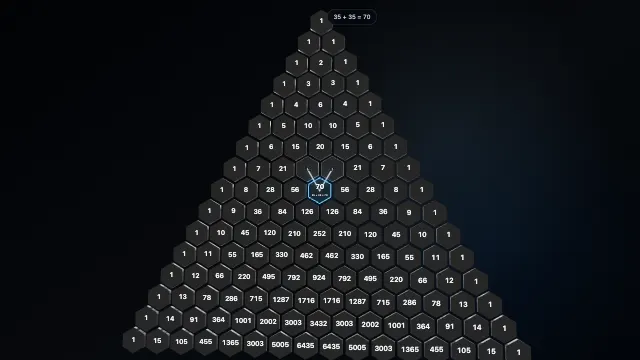
Mathematical reference
- Indexing
- The apex is row 0; positions within each row also begin at 0
- Two parents
- Row 6, position 2: 5+10 = 15
- Boundary versus interior
- The edge entries stay 1; interior entries add their two parents
Lesson transcript
This is the text of the narrated lesson. References to turning, highlighting or changing an object describe the linked interactive lesson; its demonstrations are not embedded in this reading page.
Find a cell and its two parents
This is Pascal’s Triangle. The entries are arranged in rows, beginning with a single one at the top. The next row has two ones, and each later row extends one place farther. We will learn one rule that builds the interior. You do not need a formula to begin: look for the two entries immediately above a cell.
Move toward the two near the top. Its two parents are the ones just above it, one on each side. The highlighted connections lead from those parents into the two. Adding one and one gives two. The value belongs to this cell; the connecting lines show where its two contributions come from.
Now follow the triangle down to this three. Its parents are one and two. Add those values and the result is three. The same operation works even though the parents are different. We call them parents because they are the two cells that supply the value immediately below their shared gap.
Move one position to the right, to the other three. Its parents are two and one. Reversing their order does not change the total. We have used the same two-parent rule at three different cells. Keep looking at the local triangle formed by a result and the two entries above it, rather than trying to read every entry at once.
Grow the triangle one row at a time
Pull back to the first three rows. The top is row zero, so the row containing one, two, one is row two. This indexing counts how many downward steps separate a row from the apex. Within a row, positions also begin at zero on the left. The middle two is therefore at row two, position one.
Reveal the next row. Its interior entries are both three. This selected three receives one and two from the row above. Notice that a new row uses values that are already available. Nothing in this construction asks us to guess a later row, or to fill an entire list from memory.
Add another row and approach its middle six. The two parents are three and three. Together they give six. The highlighted result is at row four, position two. The rows are getting wider, but the calculation still involves just one neighboring pair from the preceding row.
Reveal row five and visit this ten. Its parents are four and six, giving ten. A larger value has appeared through the same small addition. You could keep building in this way: preserve the outside ones, then add each adjacent pair to supply the interior of the next row.
The same rule gives different totals
Let the larger triangle return, then come toward fifteen in row six, position two. Its parents are five and ten. Their sum is fifteen, as the small equation inside the selected cell records. That equation describes the highlighted relationship you can already see; it is not a separate instruction for a different calculation.
Slide to the next cell in that row. Its value is twenty, and its parents are ten and ten. One of those tens was also a parent of the previous fifteen. Adjacent results share a parent, but each result has its own pair. Follow both connecting lines before deciding which two values to add.
Continue to the next fifteen. The parents are now ten and five. This mirrors the first fifteen we visited. The triangle has equal entries at equal distances from its two outside edges. Here you can see matching parent values in reversed order producing matching results.
Move down to thirty-five in row seven, position three. Its parents are fifteen and twenty. The values from the preceding row have become inputs to the next addition. A cell can be a result in one local triangle and a parent in the next. That repeated role is what allows the construction to continue.
Keep the outside ones distinct
Travel to the left edge of row six. This entry is one. There are not two parent cells directly above it inside the triangle, so the ordinary interior picture does not apply here. The outside ones provide the boundary of the construction. We keep them, then use adjacent pairs to fill the interior.
Cross to the right edge of the same row. This entry is also one, and it has the same boundary role. The two edges are symmetric. No missing visible cell needs to be imagined as another one: adding two ones would give two and would change the boundary we are describing.
Come one place inward from the left edge, to six. Now there really are two parents: one and five. Adding them gives six. The difference between a boundary cell and a nearby interior cell is visible in their connections. The local rule applies as soon as both parent positions are inside the triangle.
Return to the complete triangle. The apex and outside ones establish a starting framework. Every interior value follows from the neighboring pair above it. Those two instructions have different jobs. Together they determine each new row, without a separate rule for small entries, central entries, or the larger values farther down.
Two incoming families make a sum
There is another way to read the two near the top. Switch to Paths and follow one highlighted route from the apex to that cell. At each step, the route goes down-left or down-right. This first route goes left and then right. It reaches the same selected two whose parents were one and one.
Follow the other route: right and then left. It reaches the same destination, but enters from the other parent. These are the two possible routes to this cell. They are distinct because their steps differ. One arrives through each parent, so the two parent counts add to the destination’s count.
Move to the three at row three, position one, and watch its three routes in turn. Each has exactly one right step, occurring at a different stage of the journey. Two routes enter through the parent two, and one enters through the parent one. Every route has one final edge, so it belongs to exactly one of those two families.
Return to Parents at that same three. The values one and two now have a counting meaning: they tell us how many routes reach each parent. Extending those routes by the final edge supplies every route to the child. The two families do not overlap, because their final incoming edges differ. That is why adding the parent counts gives the child count.
Follow a result into the next addition
Move to row nine, position three. The selected entry is eighty-four. Its parents are twenty-eight and fifty-six. Fifty-six is twice twenty-eight, so the total is three groups of twenty-eight. This is a useful arithmetic check, but the triangle still uses addition of the two displayed parents. Their unequal values do not change the construction rule.
Slide one position to the right in that same row. The selected value becomes one hundred twenty-six. Its parents are fifty-six and seventy. Compare this with the previous eighty-four: the shared parent is fifty-six, while twenty-eight has been replaced by seventy. The destination therefore increases by forty-two, exactly the difference between those two changed parents.
Move down to row ten, position four. The two results we just visited, eighty-four and one hundred twenty-six, are now the parents of one cell. Their sum is two hundred ten. Follow the two incoming connections. This is how a local addition becomes part of a larger network: each result remains available as an input for the next row.
Cross to the matching position on the other side, row ten, position six. The value is again two hundred ten, but its parent values appear in the reversed order: one hundred twenty-six and eighty-four. The matching total is explained by the matching parent pair. Symmetry is visible in the positions and supported by the addition, rather than inferred only from the triangle’s outline.
Return to one hundred twenty-six and read the relationship backward. Suppose you knew the child and its parent fifty-six. Subtracting fifty-six from one hundred twenty-six recovers the other parent, seventy. The displayed entries let you check that subtraction. This does not change how the triangle is built; it uses the same local equation to recover a missing quantity when two of its three values are known.
Read a new neighborhood yourself
Visit twenty-one at row seven, position two. Its parents are six and fifteen. Before following the written calculation, use those two values yourself. Six plus fifteen gives twenty-one. The triangle lets you check both the arithmetic and the positions supplying it, so the result is tied to a visible relationship.
Move to fifty-six at row eight, position three. The parents are twenty-one and thirty-five. Add them to get fifty-six. This is the same operation we began with near the top. Larger entries may take a little more arithmetic, but they do not introduce a different construction rule.
Approach the neighboring seventy. Its parents are thirty-five and thirty-five. Their equal values give seventy. Notice again that the thirty-five shared with the preceding calculation has not changed. We have shifted the destination and therefore changed the other parent in the pair.
Pull back and trace the construction with your eyes. Outside ones remain at the edges; adjacent pairs supply the interior below. A selected cell can lead you upward to its sources or downward to the results it helps create. You can pause here and select another cell to read its local relationship. In the next lesson, we will connect these route counts to choosing groups of objects.