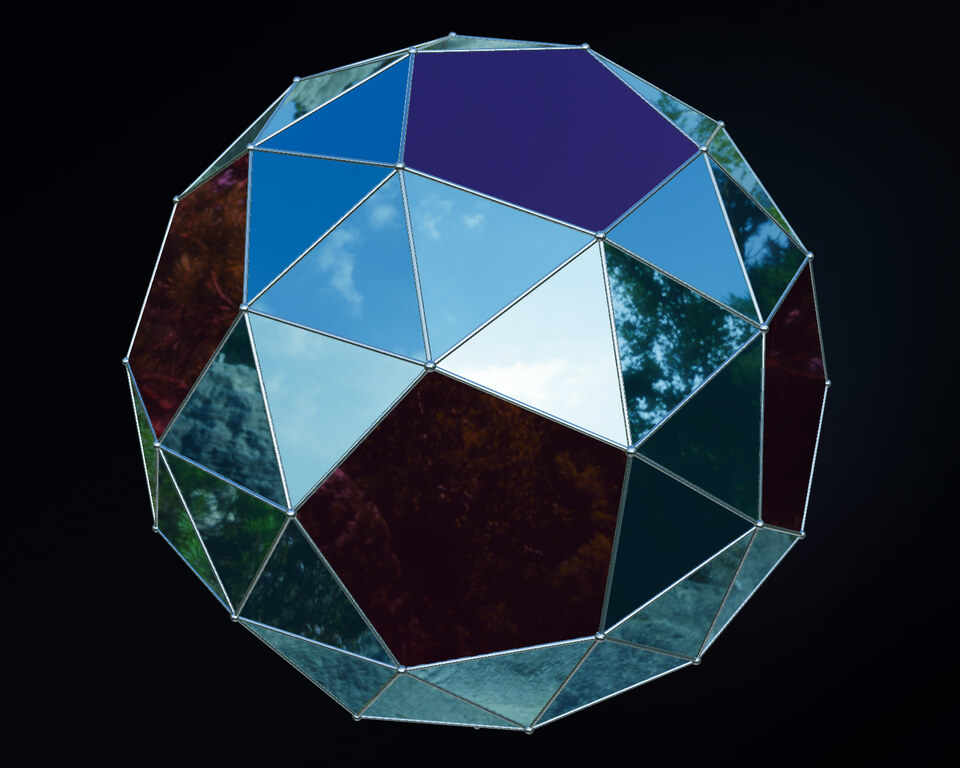
The Five Platonic Solids
Compare the tetrahedron, cube, octahedron, dodecahedron and icosahedron through their regular faces, vertices and convex corners.
Read the lesson →Lesson transcripts and mathematical references, connected to the interactive Worlds of Mathematics.
Read 69 lessons across 23 Worlds: geometry, algebra, number patterns, probability, fractals and more.
Compare the tetrahedron, cube, octahedron, dodecahedron and icosahedron through their regular faces, vertices and convex corners.
Read the lesson →
Build a segment, square, cube and tesseract by taking two copies of the preceding object and connecting corresponding vertices in a new coordinate direction.
Read the lesson →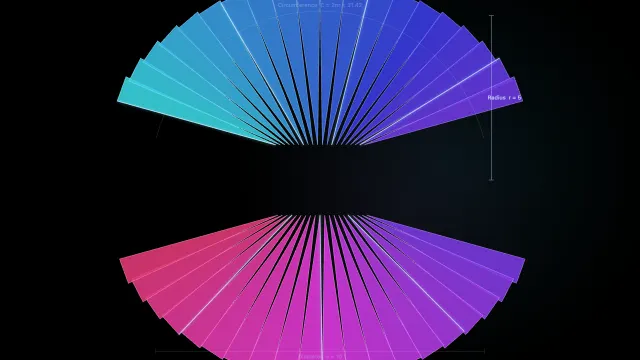
Compare circumference with diameter and radius, see why scaling a circle preserves π, and distinguish exact lengths from decimal approximations.
Read the lesson →Read the ordered cycle of faces around a vertex and distinguish local incidences from the total faces, edges and vertices of a solid.
Read the lesson →Compare the regular polygons meeting at the vertices of Archimedean solids, using cyclic face descriptions to connect local corners with complete solids.
Read the lesson →Count hypercube vertices, edges and square faces by following how each new dimension makes two copies and connects matching parts.
Read the lesson →Separate a hypercube from its lower-dimensional projection, and distinguish changing views, overlaps and apparent lengths from the object’s original geometry.
Read the lesson →Measure angles by comparing arc length with radius, and connect one complete turn with 2π radians and the arc-length formula s = rθ.
Read the lesson →Rearrange inscribed triangles, track their preserved area, and connect their limiting base and height with the circle-area formula A = πr².
Read the lesson →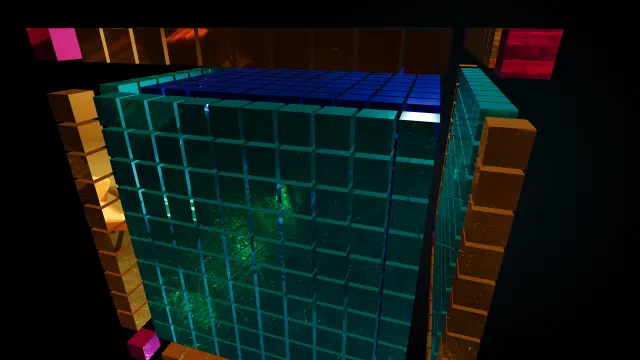
Read 11³ and 12³ through their face slabs, edge bars and corners, comparing one-sided and centered partitions of the same twelve-cube.
Read the lesson →Grow a nine-cube into a ten-cube and account for its 271 new units in two ways: face-edge-corner pieces and successive directional slabs.
Read the lesson →Connect the four terms of a binomial cube to its pieces, then compare one-sided and centered constructions with equal exterior dimensions.
Read the lesson →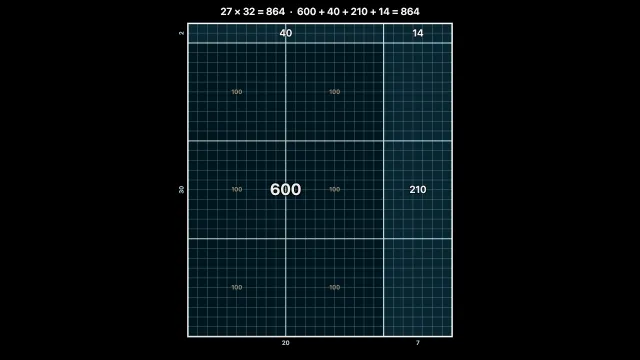
Read side lengths and area separately, use rows to count products, and compare differently shaped rectangles containing the same number of unit squares.
Read the lesson →Split both sides of a rectangle, pair every width part with every height part, and use the four areas to calculate products such as 23×27.
Read the lesson →Calculate products from a nearby square, tracking added strips, removed strips and the overlap correction that makes 9² equal 81 rather than 80.
Read the lesson →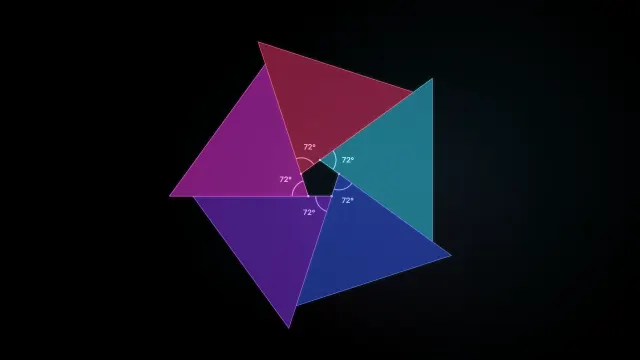
Gather exterior turns into one full rotation, then use the exterior angle to predict and recover the number of sides of a regular polygon.
Read the lesson →Pair interior and exterior angles at each vertex, subtract one full outside turn, and recover a regular polygon from its interior angle or total.
Read the lesson →Relabel unchanged polygon angles in radians, calculate their interior sums, and identify regular polygons from exact fractions of π.
Read the lesson →
Read each fractional digit as a count of a particular place-value unit, including zero positions and the unequal contributions of repeated digits.
Read the lesson →Hold a fraction fixed while changing its base, comparing short and repeating expansions without mistaking a different digit pattern for a different quantity.
Read the lesson →Predict whether a reduced fraction terminates in a chosen base, then use powers of that base to determine how many places are needed.
Read the lesson →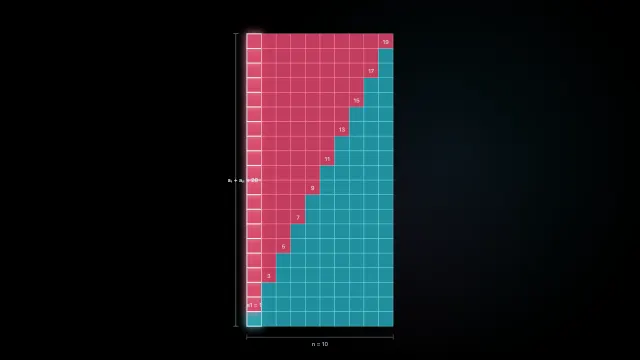
Join a reversed copy of an arithmetic staircase to make equal-height pairs, including odd term counts and zero-height terms.
Read the lesson →Separate the effects of shifting every term, changing the common difference and adding a new term, using the endpoint average to track the total.
Read the lesson →Use reversed arithmetic staircases to derive the sum of the first n odd numbers, and distinguish that square rule from a later block of odd terms.
Read the lesson →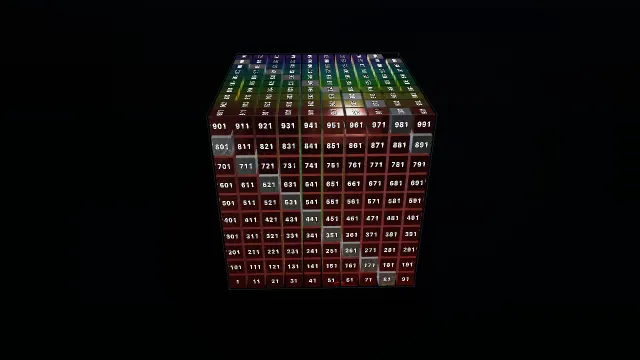
Build decimal place value from equal unit cubes: ten make a row, ten rows a layer, and ten layers a block, with leftovers starting the next group.
Read the lesson →Follow the endpoints of jumps by five, three and eleven inside ten-unit rows, separating the amount added from the cube marking each landing.
Read the lesson →Follow nine-unit landings through rows and layers, connect digit sums to remainders, and distinguish 999 cubes from a completed thousand-cube.
Read the lesson →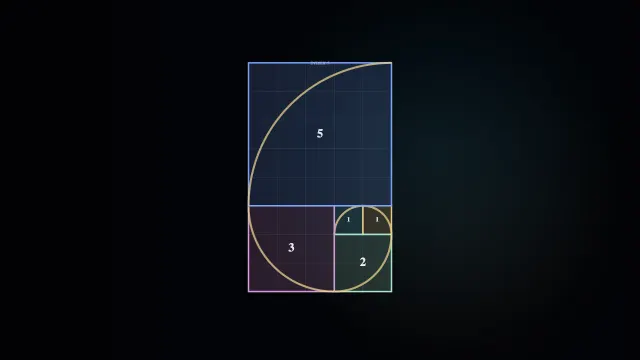
Rearrange fixed collections into lines, arrays, triangular rows and vertices, keeping quantity distinct from shape, visibility and notation.
Read the lesson →Grow triangular numbers one row at a time, then pair a triangle with a reversed copy to explain n(n+1)/2.
Read the lesson →Count the two arms of each new square border without counting its corner twice, then connect odd contributions with squares and neighboring triangular numbers.
Read the lesson →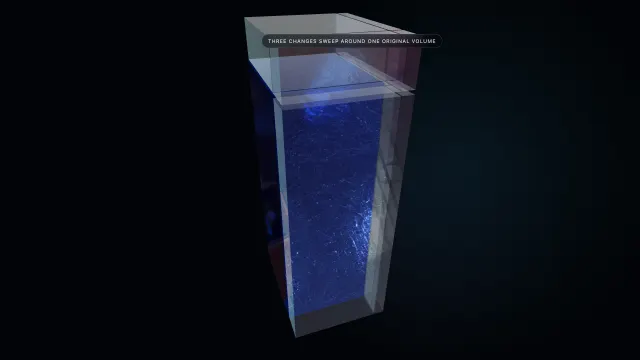
Track how one input changes two side functions by different amounts, then divide the resulting area change by the input step to obtain an average rate.
Read the lesson →Account for both strips and their shared corner in an exact finite area change, then compare how the strip and corner contributions scale as the input step shrinks.
Read the lesson →Start with the exact strips-and-corner identity and take a rate limit to derive the product rule, including why multiplying the two side derivatives gives the wrong answer.
Read the lesson →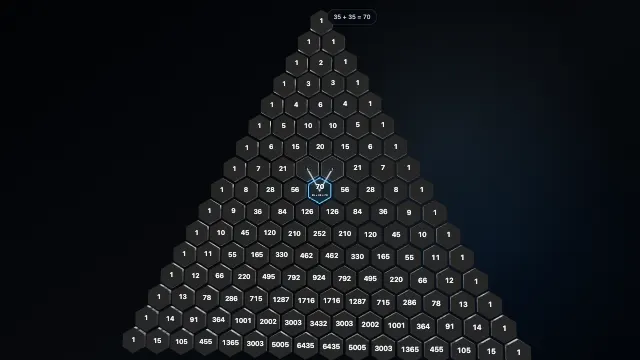
Build interior entries from their two neighbors above, preserve the edge ones, and explain the sum through the two incoming families of paths.
Read the lesson →Match take-or-leave decisions to paths through Pascal’s triangle, count unordered selections, and split them according to their final decision.
Read the lesson →Accumulate entries down a fixed Pascal diagonal, connect the sum to the next diagonal’s parent rule, and interpret triangular contributions as layers.
Read the lesson →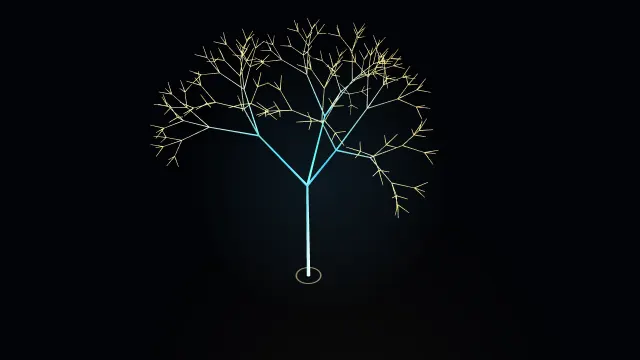
Count each generation and the accumulated tree separately, then compare two-, three- and four-child rules at the same depth.
Read the lesson →Address a branch by its ordered child choices, identify ancestors and siblings from shared prefixes, and separate ancestry from the branch’s screen position.
Read the lesson →Measure one route through a shrinking tree, calculate its finite sum and omitted remainder, and distinguish route length from total tree length or endpoint distance.
Read the lesson →
Locate points from direction and signed radius, trace the cardioid r=2+2 cos θ, and use a negative radius to explain an inner loop.
Read the lesson →Read the same radius value in a rectangular angle graph and a polar curve, distinguishing constant offset, amplitude, sign and angular frequency.
Read the lesson →Trace positive and negative radii to explain odd and even rose-petal counts, half-turn retracing, and the orientation change from cosine to sine.
Read the lesson →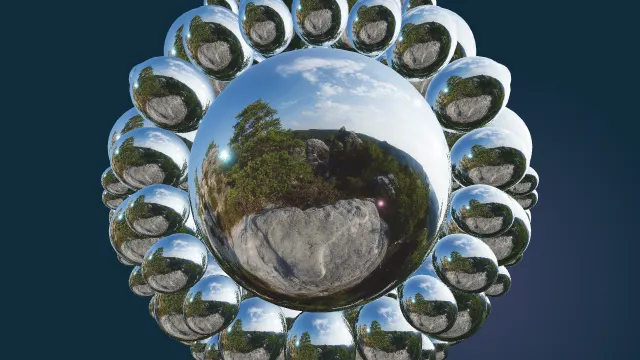
Compare reciprocal radii, check external and internal tangencies, and distinguish the enclosure’s negative curvature from a physically negative radius.
Read the lesson →Determine a circle from three tangent neighbors, check signed curvatures with Descartes’ relation, and verify positions with center distances.
Read the lesson →Build a circle packing by recording the three fixed curvatures and the replaced circle, then reverse a replacement and distinguish construction depth from curvature.
Read the lesson →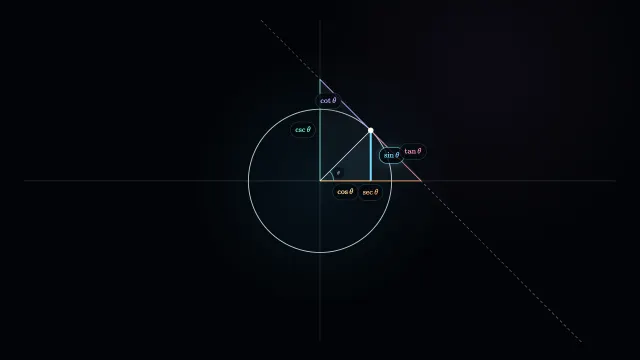
Derive sine and cosine from signed unit-circle coordinates, use the squared-sum identity, and recover a missing coordinate from its magnitude and quadrant.
Read the lesson →Recover the axis values of sine and cosine from quarter turns, then apply the same rotation rule to a point with two nonzero coordinates.
Read the lesson →Split an equilateral hexagon triangle to derive 1/2 and √3/2, then carry those exact coordinate magnitudes around the unit circle by reflection.
Read the lesson →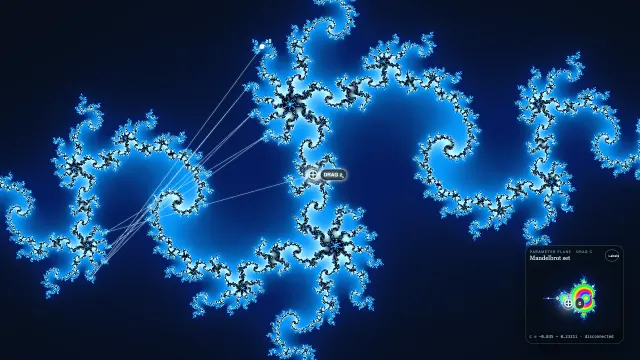
Read complex values as two coordinates, compute actual squaring steps, and distinguish the starting point from the fixed translation parameter in z²+c.
Read the lesson →Compare shrinking, fixed, cyclic and escaping quadratic orbits, including a fixed point exactly on the escape-test threshold and the limits of finite evidence.
Read the lesson →Separate the filled Julia set from its boundary, classify the c=0 disk and c=−2 interval exactly, and distinguish those results from a finite escape-time image.
Read the lesson →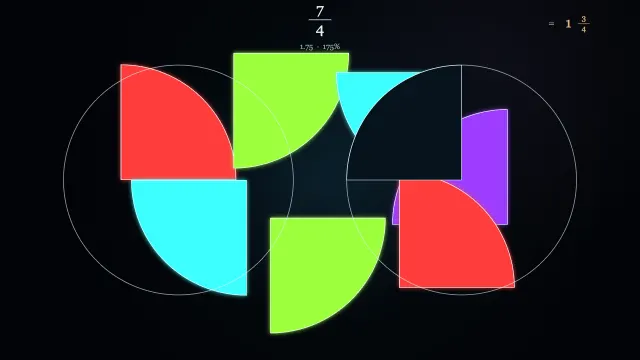
Identify the whole and its equal pieces before reading a fraction, then compare bars, circles and number-line positions, including amounts beyond one whole.
Read the lesson →Preserve a fraction’s endpoint while subdividing its pieces, contrast scaling both counts with adding to them, and apply equivalence beyond one whole.
Read the lesson →Compare close fractions with common subdivisions or missing parts of a whole, identify ties, and extend the same comparisons beyond one.
Read the lesson →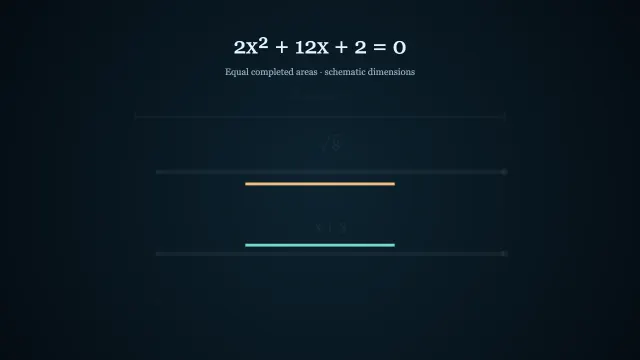
Split the linear term into equal strips, calculate the complete corner, and distinguish that corner from the extra amount needed to balance the equation.
Read the lesson →Take both signed square roots after completing the square, verify the resulting roots, and compare integer, irrational and repeated-root examples.
Read the lesson →Carry signed strip coefficients through completing the square, distinguish a sign change from a branch choice, and calculate the deficit when the constant starts below zero.
Read the lesson →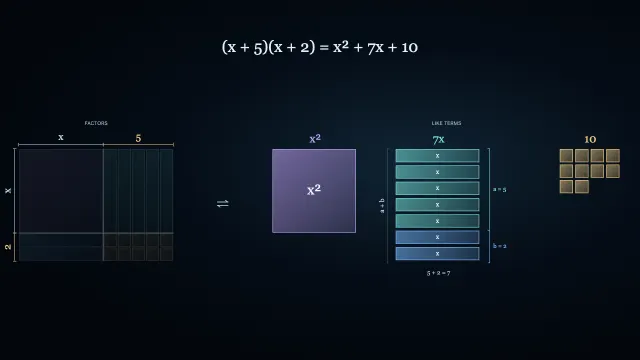
Read the four regions of a binomial rectangle, collect only like terms, and compare products whose corners agree but whose strips differ.
Read the lesson →Search for side constants that satisfy both the required strip sum and corner product, then check the factors by multiplying them back together.
Read the lesson →Factor quadratics with unequal leading side coefficients, tracking the two weighted cross-products and why the allocation of constants matters.
Read the lesson →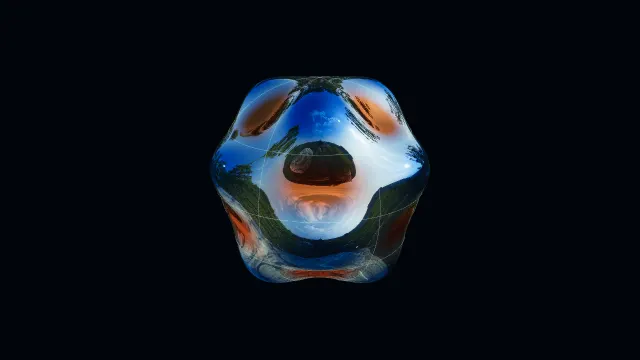
Separate a mode’s spatial pattern from amplitude and phase, distinguish displacement from velocity, and count permanent nodes rather than temporary flatness.
Read the lesson →Turn Bessel-profile roots into nodal-circle radii, add angular diameters, and distinguish changes of mode from amplitude or instantaneous phase.
Read the lesson →Use regularity at the center and a fixed rim to select Bessel modes, calculate their nodal radii, and derive frequencies from the selected roots.
Read the lesson →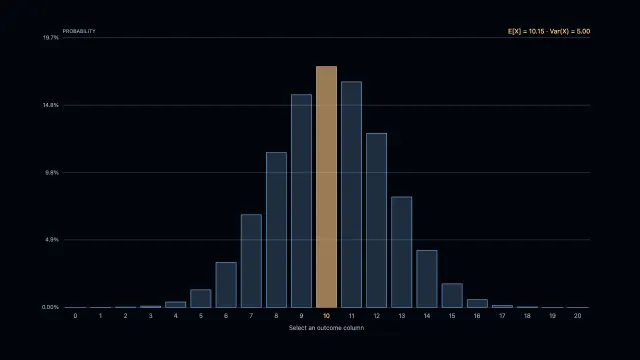
Build events from complete outcomes, combine and complement them, and check when counting outcomes is valid by comparing equal and unequal spinner weights.
Read the lesson →Count ordered pairs for each sum, explain the distribution’s symmetry, combine tail events, and compare two six-sided dice with a four-by-six sample space.
Read the lesson →Compare model probability with observed proportions, distinguish count error from proportion error, and explain why convergence does not make the next independent trial compensate for earlier results.
Read the lesson →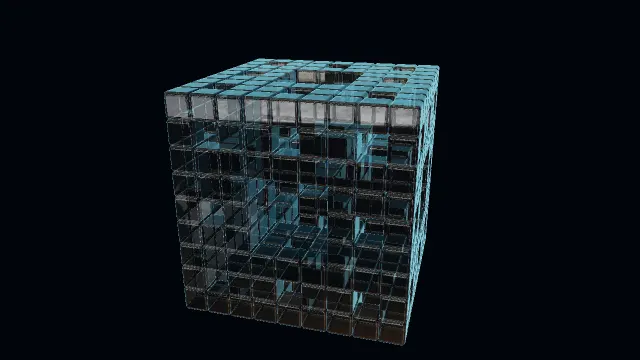
Derive the carpet’s scaling exponent from eight third-width copies, distinguish width from area, and separate a finite tiled approximation from the infinite limiting set.
Read the lesson →Track the Cantor set’s shrinking total length and growing piece count, read ternary addresses, and compare equal- and unequal-scale dimension equations.
Read the lesson →Compare triangle, carpet, corner-square and pentaflake rules using both copy count and linear scale, while keeping dimension distinct from shape and finite display detail.
Read the lesson →