Mathematical reference
- Two fair six-sided dice
- Sum counts for 2 through 12 are 1,2,3,4,5,6,5,4,3,2,1
- Upper tail
- P(sum≥7) = 21/36 = 7/12
- Four-sided plus six-sided
- There are 24 equally likely pairs; sums 5,6,7 each have 4 pairs
Lesson transcript
This is the text of the narrated lesson. References to turning, highlighting or changing an object describe the linked interactive lesson; its demonstrations are not embedded in this reading page.
Count the pairs on each diagonal
Fair dice give equally likely face pairs, not equally likely sums. Begin with sum two: only one and one works. For sum three, the pairs one, two and two, one both work. We will build the distribution by counting these diagonals, then compare the exact counts with repeated rolls.
Select sum three. Two cells are highlighted, each contributing one thirty-sixth, so the probability is two thirty-sixths. Increasing a sum near this end opens another possible first face. The diagonal becomes longer because more ordered decompositions of the total fit within faces one through six.
At sum seven the diagonal has six cells. It is the longest one: first faces one through six each have a valid partner. The next sum begins losing a partner at the edge. The shape of the sum distribution comes from this changing number of allowed decompositions.
Find every allowed partner
Let the first face be a and the desired sum be s. Its partner must then be s minus a. There is no second choice once a is fixed. To count a sum, we can scan the first faces and keep precisely those whose required partner lies between one and six.
For a sum of five, start at first face one: the partner is four. At first face two it is three. At three it is two, and at four it is one. All four pairs are allowed. First face five would require zero, which is outside the die.
For a sum of six, first faces one through five have valid partners. The highlighted diagonal therefore contains five cells. First face six would again require zero. As we increase the sum along this side of the distribution, one additional first face becomes possible.
Now look at nine. A first face of one would require eight, and two would require seven. Both partners exceed six. Valid first faces begin at three and end at six. The four highlighted outcomes are three with six, four with five, five with four, and six with three.
This gives a counting rule without memorizing a triangle. The first face must be at least one and at least s minus six; it must be at most six and at most s minus one. Count the integers between those bounds. At nine the bounds are three and six, giving four.
The second half mirrors the first
For sum eight there are five cells: two with six, three with five, four with four, five with three, and six with two. One with seven is absent because seven is not a face. Counts decrease again beyond the central sum. The boundary of the sample space matters just as much as addition.
At sum twelve only six, six remains. Replacing each face a by seven minus a pairs a sum s with fourteen minus s. This gives a one-to-one correspondence between equally likely outcomes, explaining why two and twelve, three and eleven, and the other reflected sums have equal probabilities.
Explain symmetry with a reversible pairing
Return to the pair one with two, whose sum is three. Replace each face by seven minus itself. One becomes six and two becomes five. The new pair six with five has sum eleven. We will compare those two events by applying the same replacement to every outcome.
Here is the reflected event, sum eleven. Its two cells are five with six and six with five. Apply the replacement again and each returns to its original cell in sum three. Because the operation reverses itself, it misses nothing and cannot merge two different original outcomes.
Both events contain two cells with weight one thirty-sixth each. The reflection therefore preserves probability. More generally, the original sum s becomes fourteen minus s, since the two new faces add to seven minus a plus seven minus b. That explains all the matching pairs of sums.
At sum seven the reflected event is itself. One with six exchanges places with six with one, and the other cells exchange partners in the same way. The individual outcomes can move while the set remains unchanged. This is symmetry of the event, not a claim that the dice stop changing.
Compare sum eight with its reflected sum six. Eight has five cells, just as six did. The central maximum is six cells at seven; immediately on either side the count is five. The familiar symmetric shape follows from allowed face pairs, not from a rule that sums themselves are uniformly distributed.
One experiment, several questions
An event is a set of outcomes. Start with the event that the sum equals seven. Now keep the same collected rolls and ask for sums at least seven. We include the seven column and every column to its right. Their counts add to twenty-one of the thirty-six equally likely pairs. The probability is seven twelfths. Changing the event changes our question; it does not require generating a new experiment.
The complement of exactly seven is every other sum. Its probability is one minus one sixth, or five sixths. Notice that both theoretical mass and observed counts are partitioned by the same event rule. Pause and compare equals, at least, at most, and except. Keep the threshold fixed first, then move it. That separates changing the relation from changing the number to which it refers.
Combine low and high totals
Select sums at most four. This low tail contains the three shortest diagonals, with one, two, and three cells. Their combined probability is six thirty-sixths, or one sixth. A tail probability combines several totals, unlike the single-sum probabilities we used to draw individual bars.
Its reflected high tail is at least ten. The diagonals for ten, eleven, and twelve contain three, two, and one cells. They again total six. Reflection pairs the entire low region with this high region, so their probabilities are equal even though they occupy opposite corners.
The two tails do not overlap: a sum cannot be at most four and at least ten simultaneously. Adding their probabilities gives twelve thirty-sixths, or one third. The control currently highlights the high tail alone; the combined two-tail result is our calculation from the two regions just demonstrated.
Now select at most seven. The first six diagonal counts add to twenty-one, so the probability is twenty-one thirty-sixths. It is greater than one half because it includes all six cells on the central diagonal as well as the fifteen cells below it.
Reduce the boundary to six. Only fifteen cells remain, giving fifteen thirty-sixths. The difference between these two cumulative probabilities is six thirty-sixths, exactly the probability of seven. Subtracting consecutive cumulative totals isolates one bar of the distribution.
Theory and a finite collection of rolls
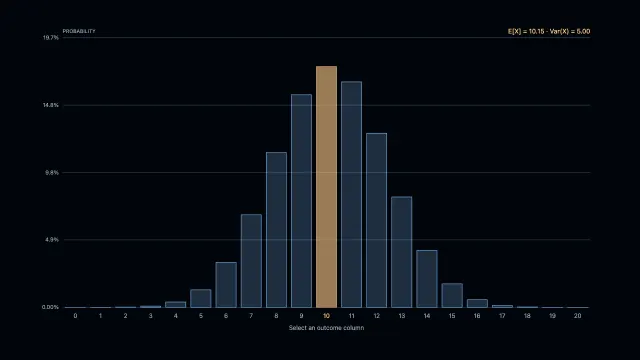
Switch to the histogram and collect one thousand rolls. The solid probabilities come from the thirty-six-cell calculation; the experimental outlines come from this particular reproducible sample. Fluctuations are expected. A short experiment need not rank every neighboring sum correctly or hit one sixth exactly for sum seven.
Now use a four-sided first die and a six-sided second die. There are twenty-four equally likely pairs. Sum five has four partners, and sums six and seven also have four. Different side counts create a flat top rather than one unique central maximum. Return to the grid to check each claim directly; fairness alone does not force the familiar triangular shape.
A flat top from unequal side counts
Stay with a four-sided first die and a six-sided second die. Sum six has four qualifying cells: one with five through four with two. All four first faces work, just as they did for sum five. We have reached a plateau rather than a unique peak.
Select sum seven. All four first faces still have partners: six, five, four, and three. There cannot be more than four such pairs, because fixing a first face fixes its partner. Sums five, six, and seven each reach that upper limit of four.
At sum eight, the first face one would need a seven, which the second die cannot show. Only first faces two, three, and four remain. The count falls to three. Once the longer die’s upper edge is reached, another allowed pair disappears each time the desired sum increases.
The largest sum is ten, produced only by four with six. Its probability is one twenty-fourth. The corresponding smallest sum is two, from one with one. For this rectangle, reflecting the first face around five and the second around seven sends a sum s to twelve minus s.
Return to the histogram to see the plateau in the complete distribution. Use Interact to check a different pair of dice sizes. Predict the number of equally likely face pairs, then count the allowed partners for a chosen total. Explain the bars from the sample space before comparing any experimental frequencies.