Mathematical reference
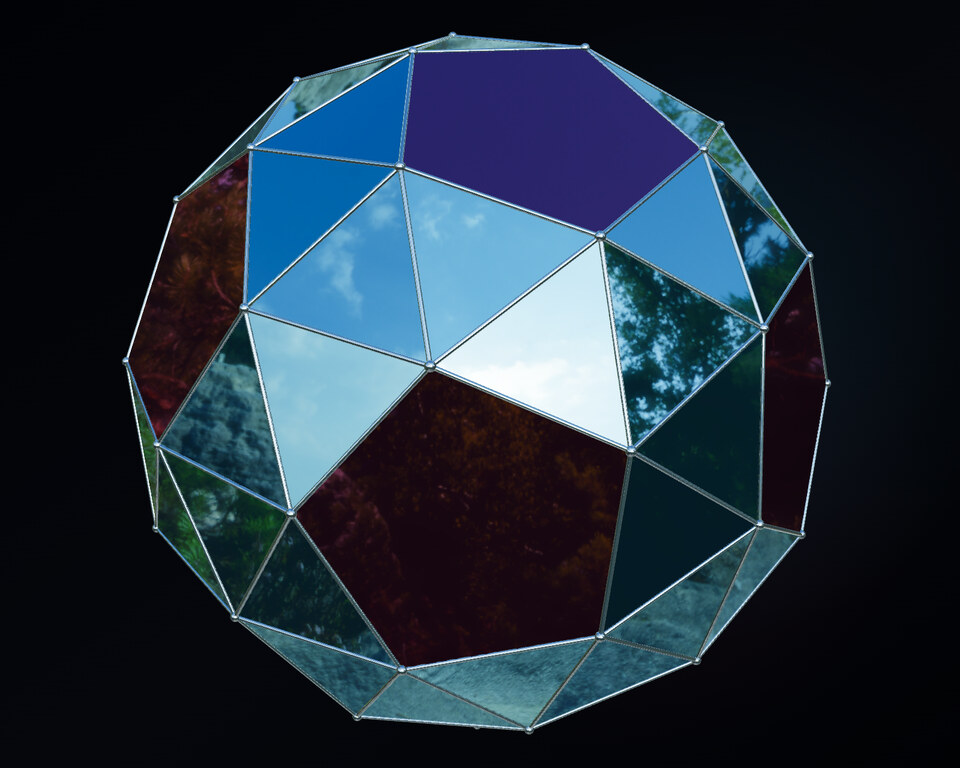
- Cuboctahedron
- 3.4.3.4
- Truncated tetrahedron
- 3.6.6
- Truncated cube
- 3.8.8
Lesson transcript
This is the text of the narrated lesson. References to turning, highlighting or changing an object describe the linked interactive lesson; its demonstrations are not embedded in this reading page.
More than one regular polygon
Approach this cuboctahedron corner. A triangle, a square, another triangle and another square meet here. The faces are regular polygons, but they are not all the same kind. That is the first change from the Platonic solids. We will use the corner-reading method to compare the thirteen Archimedean solids in this World.
This highlighted square is one member of the alternating cycle. It has four equal sides and equal angles, while its neighboring triangles have three. Mixing polygon types does not mean abandoning regular faces. The important question is how those faces meet around a selected vertex.
Now look across the highlighted triangle. The local cycle reads three, four, three, four. Two triangles and two squares meet, with a square between the triangles. The order matters. Counting two of each type without recording their neighboring relationships would leave out part of what the corner shows.
Return to the whole cuboctahedron. This same local pattern occurs at its other vertices. Across the following examples, compare the face sizes and their cyclic order, rather than trying to memorize the outline of each solid. We will use close views to read particular faces and wider views to connect them to the complete surface.
Triangles with hexagons or octagons
At this truncated tetrahedron corner, a triangle meets two hexagons. Read three, six, six. Three faces touch the selected vertex. Their combined eighteen sides are not eighteen edges radiating from that vertex; each entry describes the entire boundary of one incident face. Keep the local meeting point separate from each polygon’s full perimeter.
Here is one of the hexagons. Follow its six-sided boundary. It shares one edge at our selected corner with the triangle, and another with the neighboring hexagon. The name truncated tetrahedron describes the solid, but this view is a comparison of its completed faces; we are not performing a cutting operation.
Compare the truncated cube. Again, a triangle meets two larger faces, but those faces are octagons. Read three, eight, eight. The pattern has the same count of incident faces as the previous example, while the larger polygon has changed. This makes a useful pair to compare rather than memorize separately.
Look across one octagon and follow all eight sides. Some sides appear short because the face is tilted, but its actual edges have equal length. The triangle and the other octagon are outside this selected face, even though they share parts of its boundary. The local cycle keeps these three polygons distinct.
Two hexagons and a third face
The truncated octahedron changes the small face to a square. Two hexagons still meet it at the selected corner. The reading is four, six, six. Compare that with three, six, six on the truncated tetrahedron. One entry changed because one kind of incident polygon changed.
This is the square in that cycle. Its four-sided boundary distinguishes it from the neighboring hexagons. A face can look like a diamond from this viewpoint without ceasing to be a square. Use the actual corners and edges when reading it, and keep the selected vertex as your reference.
Now a pentagon meets two hexagons on the truncated icosahedron. Read five, six, six. This is the familiar pentagon-and-hexagon surface often associated with a football pattern. The mathematical solid here has flat regular polygon faces; an inflated ball is a different curved object.
Inspect the pentagon. Its five sides identify the first entry, five. The two hexagons around our selected corner account for the two sixes. We have compared three local patterns with a pair of hexagons: a triangle, a square or a pentagon supplies the remaining face.
Large faces and alternating faces
At this truncated dodecahedron vertex, a triangle meets two decagons. A decagon has ten sides, so the reading is three, ten, ten. Only three faces meet here despite the long boundaries of the larger polygons. Do not confuse many sides per face with many faces at the corner.
Look across the highlighted decagon and follow its ten-sided boundary. The close view separates the polygon from the surrounding surface. Its edges remain straight, even though a many-sided face can look almost round at a distance. This is a regular polygon, not a circular face.
The icosidodecahedron uses a different pattern: triangle, pentagon, triangle, pentagon. Read three, five, three, five. Four faces meet, and the two types alternate. Compare it with the cuboctahedron’s triangle-and-square alternation. The arrangement has the same alternating structure, but the second polygon has five sides instead of four.
Here is one pentagon in that alternating cycle. At our chosen vertex it neighbors a triangle on each side. Starting the list at this pentagon would give five, three, five, three, which describes the same cycle. Changing the starting face does not change the neighboring relationships.
Four faces need not alternate
Now examine the rhombicuboctahedron. A triangle and three squares meet at this corner. Read three, four, four, four. There are four faces again, but they do not alternate between two types. Two neighboring entries can both be four because square faces can be adjacent around the selected vertex.
Look across one of those squares. Its shape alone does not identify the solid: we have already seen squares on several different surfaces. The arrangement around the vertex supplies the missing context. One triangle and three squares is different from two triangles alternating with two squares.
The rhombicosidodecahedron introduces a pentagon into the four-face cycle. Read triangle, square, pentagon, square: three, four, five, four. The two squares separate the triangle and the pentagon around the selected point. This example uses three polygon types, so recording their order is especially helpful.
Inspect the pentagon in that cycle. Its neighboring faces at our selected vertex are the two squares. The triangle is also incident to the vertex, but it is not adjacent to this pentagon along an edge ending there. Sharing a vertex and sharing an edge are different relationships.
Three different faces at a corner
At this truncated cuboctahedron vertex, three different polygons meet: a square, a hexagon and an octagon. Read four, six, eight. There are only three faces in the cycle, with no repeated face size. The greater variety does not make the reading method more complicated: follow one actual boundary at a time.
This highlighted octagon gives the eight in four, six, eight. Its two neighboring faces at the selected corner have four and six sides. The close view makes the larger polygon readable; the remaining surface still supplies context. We are describing which faces meet, not adding their side counts into a new polygon.
The truncated icosidodecahedron has a square, a hexagon and a decagon at each vertex. Read four, six, ten. Compare it directly with four, six, eight: the largest face now has ten sides. The full surface is more intricate, but the local description remains a short three-entry cycle.
Look across the decagon. Its ten sides identify the last entry of that cycle. A close-up is useful precisely because the complete solid has so many faces. You do not need to count the entire surface to answer the local question about the three polygons meeting at this corner.
Four triangles and one other polygon
The snub cube brings five faces together at a vertex: four triangles and one square. Read three, three, three, three, four. The four triangles form a consecutive run around the selected point before the square completes the cycle. This is different from the triangle-and-square alternation we began with.
Inspect the square in that five-face cycle. It is the one face with four sides among the four incident triangles. The solid’s handedness is a separate question that the World can explore; here our task is to read the polygon arrangement, without treating a camera turn as a comparison of mirror forms.
The snub dodecahedron has four triangles and one pentagon at each vertex. Read three, three, three, three, five. There are still five incident faces. The pentagon replaces the square in the local comparison, while the four consecutive triangular entries remain.
Look across that pentagon. Its five sides distinguish the final entry from the square in the preceding example. Large parts of the solid extend outside this close view, intentionally: we are reading one face and its selected vertex. The following overview will reconnect a local pattern with the larger surface.
Use the cycle as a guide
Return to the complete snub dodecahedron. Its dense surface is easier to approach after reading one vertex closely. The local list does not draw the entire solid for you, but it gives a reliable description of a small neighborhood that repeats through this example. That is the relationship between our close and wide views.
Here is another vertex of the rhombicosidodecahedron: triangle, square, pentagon, square. The location changed, but the cycle remains three, four, five, four. In these Archimedean examples, the regular polygons participate in repeated vertex arrangements. A list of face sizes alone is not a general test of every symmetry a solid might possess.
Compare the cuboctahedron once more. Its triangle-and-square cycle alternates: three, four, three, four. We have now visited all thirteen native Archimedean examples, grouped by related corner patterns. The names can be long; the visible local arrangements give you shorter, more concrete ways to compare them.
Pull back to the complete cuboctahedron. For your own exploration, choose a vertex, follow the incident faces in order and identify each polygon by its boundary. Then compare a second solid by asking exactly which entry or neighboring relationship changes. This carries the corner-reading method from the simplest examples into a much wider family.