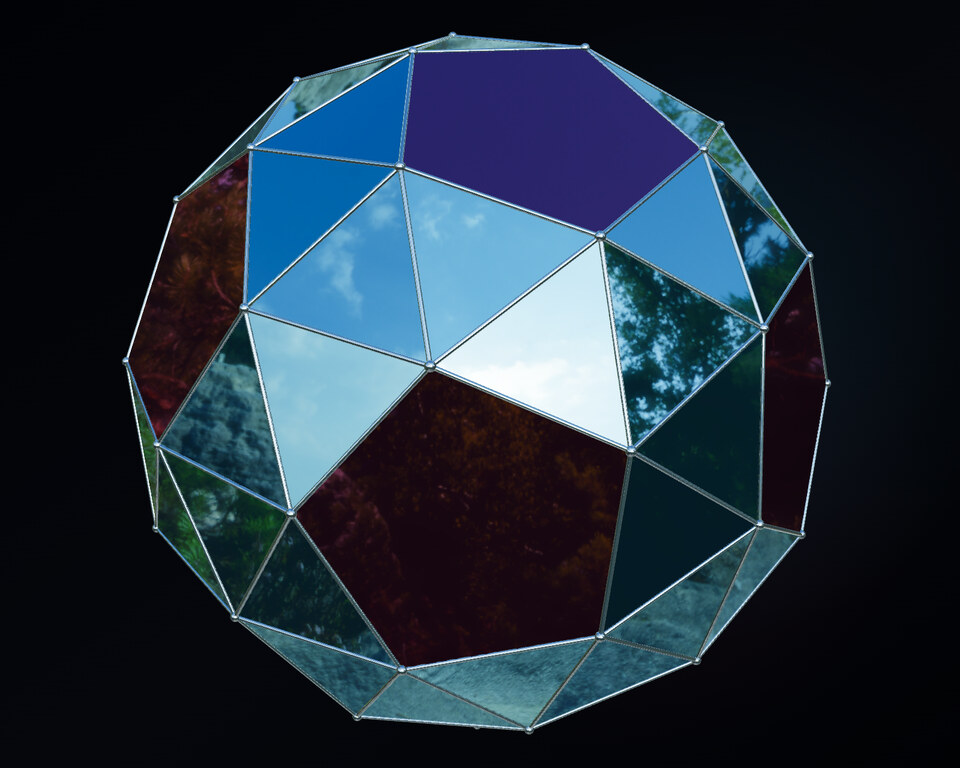
Mathematical reference
- Cube vertex
- 4.4.4: three square faces
- Cuboctahedron vertex
- 3.4.3.4: triangles and squares alternate
- Truncated cube vertex
- 3.8.8: one triangle and two octagons
Lesson transcript
This is the text of the narrated lesson. References to turning, highlighting or changing an object describe the linked interactive lesson; its demonstrations are not embedded in this reading page.
One corner, three faces
Come closer to this corner of the cube. Three flat faces meet at this point. The corner is called a vertex. We will read the arrangement around it, moving from one face to the next. Keep the selected point in view as we approach; the rest of the cube gives it context.
Begin with this highlighted face. It is a square, with four sides. From our sloping viewpoint it does not look like a square drawn flat on paper. Follow its four actual edges. Turning the view changes the picture, but it does not change the shape of the face.
Cross an edge that ends at our selected vertex. The next highlighted face is another square. Its shared edge belongs to both squares. We are moving around one corner, so a face on the far side of the cube does not enter our reading just because it is part of the same solid.
Here is the third square. Cross its other edge at this vertex and you arrive back at the first face. The cycle is complete: three squares surround this corner. A face is a flat region, an edge joins two neighboring faces, and the vertex is the point we have kept selected.
Reading the arrangement
Read this first square as four, because it has four sides. This is the first entry in our description of the corner. We are not counting all the cube’s vertices or edges. Each entry describes one of the faces touching this particular vertex.
Move to the second square and read another four. Two entries now correspond to two neighboring faces. Following their shared edge keeps the order clear. Our viewpoint can move while the incidence stays the same: these two faces continue to meet along this same edge.
The third square contributes the last four. Four, four, four describes the complete cycle. There are three entries because three faces meet, and every entry is four because each face is a square. This is a list of face sizes, not a multiplication and not a sum.
Now move back to see the whole cube. It has six square faces altogether, while only three touch our selected corner. A local description and a whole-solid count answer different questions. The cycle four, four, four tells us about the neighborhood of a vertex; it does not say the cube has only three faces.
Same faces, different corners
Compare a tetrahedron. At this corner three triangular faces meet. Follow their boundaries: each has three sides. The local reading is three, three, three. The faces have changed from squares to triangles, while the count of faces around this particular corner remains three.
Look closely at one of those triangles. Its three edges connect three vertices, but we are reading the arrangement at only the selected vertex. The same triangular face participates in several different vertex neighborhoods. Keeping the chosen point in view tells you which neighborhood you are describing.
The octahedron also uses triangles, but four meet at this vertex. Follow the selected corner as we approach it. There is one more face in the cycle than at the tetrahedron’s corner. The reading is three, three, three, three. Polygon type alone does not determine the corner arrangement.
Pull back and compare the shape with the tetrahedron we just saw. The octahedron has eight triangular faces altogether. Four touch the selected vertex. In the next lesson we will compare the regular solids more fully; here, notice how the local cycle separates two solids built from the same kind of polygon.
Triangles and squares alternate
Now approach a cuboctahedron vertex. Two triangles and two squares meet here. Begin with the highlighted triangle: three sides. We will follow the faces in their actual neighboring order, crossing edges that end at the selected vertex. This order adds information beyond simply naming the face types.
The next face is a square: four sides. It shares an edge with the triangle we just read. Keep following the boundary around the selected point. The sequence begins three, four, and the next highlighted face will show whether the face types continue to alternate.
Another triangle comes next, giving three, four, three. The triangles are separated around this vertex by squares. They are not neighboring faces in this cycle. A different list with two threes together would describe different neighboring relationships, even if it contained the same face sizes.
The fourth face is a square, completing three, four, three, four. Crossing its remaining edge at this corner returns to our first triangle. Two triangles and two squares alternate. The four entries tell us how many faces meet; their values and their order tell us which polygons meet and how.
A cycle has no preferred beginning
Start again, this time on a square. We have not changed the solid or the selected vertex. We have only chosen a different first face for the reading. The first entry is now four. Continue around the same cycle in the same direction.
The next face is a triangle, so our new reading starts four, three. Previously these same two faces appeared at a different place in the list. Starting elsewhere in a cycle shifts the entries without changing which faces are neighbors.
Another square follows, so the reading is now four, three, four. Keep the same direction around our selected vertex. One triangle remains before we return to the square that began this reading. Each face still shares the same edges with its neighbors.
This triangle completes four, three, four, three. It is the face that began our earlier reading. The new list describes the same alternating arrangement as three, four, three, four. The starting entry changed; the cycle did not. Match the two descriptions by following the selected corner.
Move back and look around the complete cuboctahedron. The local reading is compact, but it is not a complete description of every geometric property of a solid. It records the face arrangement at a corner. Later lessons will connect this local information with larger families, symmetry and whole-solid counts.
Count incidences without counting twice
Return to the selected cube vertex and count the edges ending there. There are three. Between neighboring edges lies one of the three incident square faces. The edge count and face count at this corner agree, but they count different objects. Edges are boundary segments; faces occupy the surface regions between those segments. Keep the selected point as the common reference.
Move to a second cube vertex and check the same relationship. Again three edges end here and three squares meet. A single cube edge has two endpoints, so it participates in two vertex neighborhoods. Counting three incident edges at each of eight vertices gives twenty-four endpoint incidences, not twenty-four distinct edges. Each actual edge was counted twice, leaving twelve.
Now approach a cuboctahedron vertex. Four edges end at the selected point, separating two triangles and two squares in alternating order. Each edge here lies between a triangle and a square. The two triangles touch the selected vertex, but they do not share an edge with one another. Sharing a point is a weaker relationship than sharing a complete boundary segment.
Highlight one triangle while keeping the chosen corner visible. Across either of its edges ending at this vertex lies a square. To reach the other triangle in the local cycle, we pass a square first. The list three, four, three, four records that order. Merely listing two triangles and two squares would omit which faces are neighbors.
Move back to the whole cuboctahedron. Its twelve vertices each have four incident edges, giving forty-eight endpoint incidences. Divide by two because every edge has two endpoints, and obtain twenty-four edges. Its fourteen faces are a separate count. Local information can help recover a global total, provided you identify exactly what has been counted more than once.
Read an unfamiliar corner
Try a truncated cube. Approach the selected corner and look at its incident faces before reading a list. One face is small and two are larger. Size by itself does not tell you how many sides a polygon has. Follow the actual boundaries and make your own prediction.
The small highlighted face is a triangle: three sides. It contributes the first entry, three. The other two faces touching the selected point are octagons. Their sides are easier to follow when you look across each face, rather than judging it from the apparent size of its projection.
Here is the first octagon, with eight sides. Follow its boundary around the face. Some edges point away from you, but the polygon remains an octagon. Together with the triangle, this gives the beginning three, eight. One more face touches our selected corner.
The second octagon completes three, eight, eight. There are three faces at the corner, even though two of them have many sides. The length of the list counts incident faces; each entry counts the sides of its corresponding face. We have now visited the complete neighborhood once.
Return to a different corner of the cube. The selected point has changed, but three squares still meet: four, four, four. You now have a method you can reuse. Choose a vertex, follow neighboring faces once around it, and read their side counts in order. Keep that local reading separate from counting the whole solid.