Mathematical reference
- Half the linear coefficient
- x²+6x needs two width-3 strips and a corner of area 9
- Corner versus addition
- x²+6x+1=0 becomes (x+3)²=8 by adding 8 to both sides
- A different existing constant
- x²+6x+4=0 needs 5 more units to reach the same 9-unit corner
Lesson transcript
This is the text of the narrated lesson. References to turning, highlighting or changing an object describe the linked interactive lesson; its demonstrations are not embedded in this reading page.
The missing corner
Watch the two strips arrive around this square. Together they almost make a larger square. One corner is missing. We can predict its area from the strips alone. This is the central idea of completing the square.
Start with the blue square. Its side is x, so its area is x squared. The drawing is schematic: x is still unknown. We are studying the relationship between its side and its area, rather than measuring a value of x from the screen.
The linear term is six x. Split it into two equal strips, each of area three x. Put one along each of two adjacent sides. Each strip has length x and width three. Their total area is still six x; splitting and moving have not changed it.
Look closely where those two strips meet. The missing corner is three wide and three high. Three times three is nine. We did not guess that nine: the equal strip widths forced it. The new outside side will be x plus three.
Keep the equation balanced
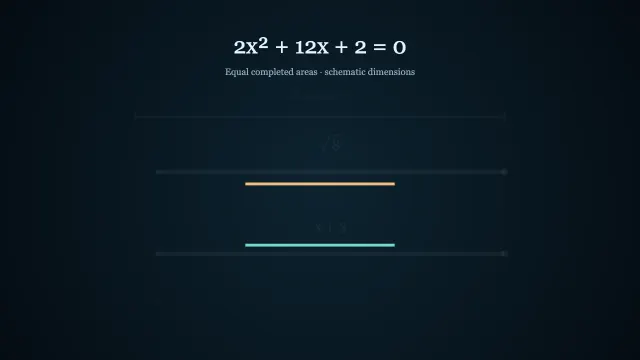
Return to the whole construction. Our equation is x squared plus six x plus one equals zero. There is already one unit of constant area. The corner needs nine units altogether. So eight more units are needed, not nine more.
Complete the corner by adding eight. To preserve an equality, add the same eight to the other side. The left side becomes a complete square with side x plus three. The right side becomes eight. We have x plus three, all squared, equals eight.
Pause here if you want to compare the areas. The original expression and the completed square describe the same equation after adding eight to both sides. Adding a quantity to only one side would generally change which x values solve it.
The corner and the constant are different
Keep the two strips at width three, but begin with four units in the corner. The equation is x squared plus six x plus four equals zero. The strip widths have not changed, so the whole corner is still nine. The existing constant can change without changing the corner required by those strips.
Complete this corner. Nine minus four is five. Add five to both sides, and the result is x plus three, all squared, equals five. The new right-hand area records the added five, not the full nine-unit corner.
Now start with no constant at all. There is no existing patch inside the corner. All nine units must be supplied. This is the special case where the corner area and the amount added happen to agree. Their meanings remain different.
Add nine to both sides. The completed square now equals nine. Compare the two constructions: the same six x gave the same pair of strips, while changing the constant changed the right-hand area. This separation will matter when we solve the equation.
Try another corner
Now change the linear coefficient from six to four. The original equation is x squared plus four x plus one equals zero. Before the corner appears, predict the strip width. Four x shared equally makes two strips of two x. What area must their corner have?
The corner is two by two, so its area is four. One unit is already present; three more are needed. Completing gives x plus two, all squared, equals three. Notice the distinction: the whole corner is four, while the amount we add to both sides is three.
Return to the opening example. Six x gave strip width three and corner nine. Four x gave strip width two and corner four. The rule is now visible: halve the linear coefficient, then square that half to find the corner. Compare it with the constant already present to find the amount still needed.
Choose Interact to try your own example. Use Numerical example, change the linear term, and move through the layers with Next layer. Predict the corner before showing it. Previous layer lets you compare again. Resume returns to this lesson at the same point.
Why the strips must share the coefficient
Start with x squared plus ten x plus sixteen equals zero. We want two equal strips around the original x square. Ten x must be shared between those strips, so each receives five x. The strip width is five because five times x gives the area of each strip.
A frequent mistake is to use ten as the width of each strip. That would describe twenty x altogether, which is a different equation. The two labels here each say five x. Adding their contributions recovers the ten x in the source, so the split preserves the original linear term.
The two widths now meet at a missing square corner. Both of its sides have measure five, so its full area is twenty-five. Halving the linear coefficient and squaring that half-width are separate operations. The first locates the strip width; the second determines the corner those strips require.
Sixteen units were already part of the equation. They count toward the twenty-five-unit corner, leaving nine to supply. The full corner is twenty-five; the missing part is nine. We need both numbers because they answer different questions about the same construction.
Add the missing nine to both sides. The completed left side is x plus five, all squared, and the right side is nine. Keeping the equation balanced is essential: adding tiles to only the left would create a different equation instead of another form of the original one.
The same completed area can have different sides
Compare the equation x squared plus eight x plus seven equals zero. Now the strip width is four and its corner is sixteen. Seven units are present, so the missing part is nine again. The same required addition can arise from different strip widths and different existing constants.
Complete this square. Its side expression is x plus four, while its area is nine. In the previous example the side expression was x plus five and the area was also nine. Equal right-hand areas do not erase the different shifts recorded by the left-hand sides.
Return to the ten x example. The equation reads x plus five squared equals nine. We have not yet solved either equation for x. This lesson is about constructing the square correctly; the next step will have to retain its particular side expression when recovering x.
The whole view gathers the original equation, its strips and corner, and the balanced completion. Follow the five in the strip width into x plus five on the completed side. Follow the difference twenty-five minus sixteen into the nine on the right. Each symbol records a visible role.
A corner that is already complete
Take x squared plus four x plus one equals zero. Two strips of width two require a four-unit corner, but only one unit is present. This smaller example lets us see three missing units clearly. The same procedure works without needing the corner or deficit to match an earlier example.
Add three to both sides. The result is x plus two, all squared, equals three. The completed area need not be a perfect-square integer. Constructing a square expression and later taking its square root are different stages; a non-square number on the right does not invalidate this construction.
Now begin with four units rather than one. The strips still require a four-unit corner, and the existing constant supplies all of it. The deficit is zero. There is nothing left to add, so the original left side was already a complete square expression.
The completed equation is x plus two squared equals zero. Adding zero preserves both sides. This boundary case is useful because it separates the method from a habit of always adding a positive number. Determine what is actually missing, then apply exactly that change to both sides.
Predict the corner before it arrives
Try eight x. Share it between two equal strips. Each receives four x, so each strip has width four. Before revealing the corner, picture the square that would join those two widths.
Reveal the corner. Four times four is sixteen. Seven units were already present, leaving nine to add. Read sixteen as the full corner and nine as the missing amount. They refer to different regions of the same construction.
Complete the square by adding nine to both sides. Its side expression is x plus four and its area is nine. We have not yet chosen a square-root sign. For this lesson, the important relationship is between the strip width, the corner, and the balanced addition.
Return to the first corner. Three by three supplied nine, with one already present and eight still needed. You can now predict each part before revealing it: halve the linear coefficient, square that width, and compare the corner with the existing constant.