Mathematical reference
- Two removals near ten
- 9² = 100−10−10+1 = 81
- Unequal negative offsets
- 8×7 = 100−20−30+6 = 56
- Opposite-signed offsets
- 9×13 = (10−1)(10+3) = 100+30−10−3 = 117
Lesson transcript
This is the text of the narrated lesson. References to turning, highlighting or changing an object describe the linked interactive lesson; its demonstrations are not embedded in this reading page.
Why the corner comes back
Watch a hundred-square lose two strips. The corner is removed twice in the arithmetic, so one copy must come back. That small correction is why nine squared is eighty-one, not eighty.
The hatched regions describe removal from a reference square. They are not pieces with negative physical length. We will make the signs mean something visible, starting with the simpler case of adding or removing one complete strip.
Here is twelve times thirteen: one hundred fifty-six. Keep the thirteen-unit side fixed. Ask what would happen if the twelve-unit side gained one more unit. The new material would be a strip thirteen units long and one unit wide.
Now the first side is thirteen. The area is one hundred sixty-nine, exactly thirteen more. Increasing a factor by one adds one copy of the other factor. The strip gives that familiar statement a specific width, height, and location.
A change has its own rectangle
Keep the second side thirteen and change the first to fourteen. One more thirteen-unit strip gives one hundred eighty-two. Relative to twelve times thirteen, the increase is twenty-six: a two-by-thirteen rectangle.
The four-region view splits that increase around ten. An added strip can have a ten-unit part and a three-unit part; together they still contain thirteen. The reference cut changes the accounting, not the amount added.
Now remove one strip of thirteen from the original twelve-by-thirteen rectangle. The first side becomes eleven. Eleven times thirteen is one hundred forty-three. The total decreased by thirteen because the side that stayed fixed determined the strip length.
This is a useful prediction method. Before recalculating an entire product, identify what changed and what stayed fixed. A small factor change corresponds to a definite rectangle. You can often explain the new area by the old area and that strip alone.
Two removals and their overlap
Return to nine squared near ten. Start with the hundred-square reference. Remove the full strip of width one on the right. Its area is ten. The remaining rectangle would be nine by ten, with area ninety.
Now mark the full ten-unit strip across the top as another removal. These two marked strips intersect in a one-by-one corner. If we subtract ten twice, that corner is counted in both subtractions.
Add one copy of that corner back to correct the double subtraction. One hundred minus ten minus ten plus one equals eighty-one. This does not attach extra material to the nine-square. It repairs our bookkeeping for the same remaining area.
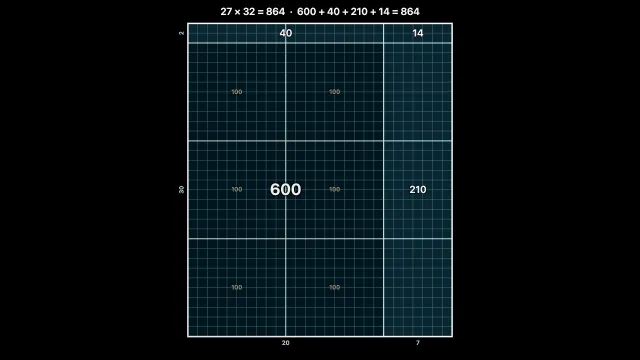
Here is the actual nine-by-nine rectangle in the ordinary partition. It contains eighty-one. Compare that exact area with the signed reference argument. The two views answer the same question: one shows the remaining product, the other explains its difference from one hundred.
The positive corner in the expression has a geometric reason. It is the intersection of two removed strips. A rule about two negative offsets producing a positive product becomes easier to comprehend when that shared corner has a visible address.
Twenty-nine squared
Use thirty as the reference for twenty-nine squared. The reference square contains nine hundred. Each full one-unit strip has area thirty. As the two strips are marked, locate their one-by-one overlap at the corner.
Correct the overlap once. Nine hundred minus thirty minus thirty plus one equals eight hundred forty-one. The corner is still one, because the offsets are still one, even though the reference square is much larger.
Now inspect the same product in its ordinary base-ten partition. Twenty plus nine in each direction gives four hundred, one hundred eighty, one hundred eighty, and eighty-one. These regions also total eight hundred forty-one.
Neither partition changes the product. The nearby thirty-square makes the offsets small; the default twenty-square uses familiar place-value cuts. Choosing a reference is choosing which structure is easiest to describe, not changing the truth of the answer.
For a square just below a convenient reference, two removed strips and their shared corner often provide a short explanation. Always inspect the size of the offsets. A corner is the product of two offsets, not automatically one.
One side below, the other above
Now nine times thirteen near ten. One factor is one below the reference, the other three above. The reference square contributes one hundred. The offsets are negative one and positive three, so the two adjustments have different signs.
Remove a ten-unit strip for the missing width. Add a thirty-unit strip for the extra height. But that added strip should span width nine, not ten. A one-by-three corner was included beyond the desired width, so subtract its three units.
The answer is one hundred seventeen. Another way to see it is ten groups of thirteen, then remove one group of thirteen: one hundred thirty minus thirteen. The finer reference partition splits that removed group into ten and three.
Compare the corner sign with the nine-square. Two negative offsets required a positive overlap correction. Here a positive and a negative offset require a negative corner correction. The physical question is which region our earlier strip accounting included incorrectly.
Equal opposite offsets have an especially beautiful rearrangement, which has its own lesson. Here the unequal offsets prevent cancellation of the two reference strips. Do not use a symmetric shortcut just because one factor is above and the other below.
Unequal offsets and a larger corner
Try eight times seven near ten. Both factors are below the reference, but their offsets are different: two and three. The hundred-square is too large in both directions. Removing the full two-unit strip subtracts twenty; removing the full three-unit strip subtracts thirty. Their intersection must be examined before accepting the result.
The shared corner measures two by three, with area six. Restore one copy of those six units because the two full-strip removals counted it twice. One hundred minus twenty minus thirty plus six equals fifty-six. The correction is six, not two plus three and not one. Its two perpendicular dimensions determine its area.
Compare the ordinary eight-by-seven rectangle. It contains fifty-six unit squares, the same answer as the reference construction. The positive six in the previous calculation did not enlarge this rectangle. It corrected an excessive subtraction from the hundred-square. Distinguish the remaining material from the bookkeeping used to calculate it.
Keep eight and replace seven with twelve. Relative to ten, the first offset is minus two and the second is plus two. The full reference strips now subtract twenty and add twenty. Those two contributions cancel, but the corner still matters. Open the signed regions and locate that corner before declaring the product one hundred.
The corner correction is minus four. The added strip was counted across ten units, while the desired width is only eight. Two columns of height two were included beyond the desired rectangle, so their four units must be removed. The product is ninety-six: one hundred minus four, after the equal strip contributions cancel.
Change eight to seven while leaving twelve fixed. The offsets are now minus three and plus two. The strips contribute minus thirty and plus twenty, so they no longer cancel. The unwanted corner measures three by two and contributes minus six. The complete result is one hundred minus thirty plus twenty minus six, or eighty-four.
Compare eighty-four with the previous ninety-six. The difference is twelve, because one complete strip of the unchanged twelve-unit side was removed. In the reference expression, the negative thirty differs from negative twenty by ten, and the negative six differs from negative four by two. Together those changes account for the same twelve-unit decrease.
Show the ordinary seven-by-twelve rectangle to check the signed argument against actual area. It contains eighty-four unit squares. The reference method and the ordinary partition must agree because they measure the same product. If a shortcut gives a different result, inspect the reference strips and their corner before trusting a remembered sign pattern.
Choose the reference you can explain
Return to twelve times thirteen near ten. Both offsets are positive, so both strips add and the corner adds. One hundred plus twenty plus thirty plus six gives one hundred fifty-six. No overlap correction is needed for disjoint added regions.
Now the two negative offsets of nine squared. Both reference strips subtract, but their overlap must be restored once. One hundred minus ten minus ten plus one gives eighty-one. The positive corner here serves a different role from an attached corner in outward growth.
Finally nine times thirteen again. One reference strip subtracts, the other adds, and the corner subtracts. One hundred minus ten plus thirty minus three gives one hundred seventeen. The regions tell us why each sign belongs.
When you choose a reference, first locate the exact factors on either side of it. Then identify the strips and inspect the corner. A useful mental method is one you can reconstruct geometrically, including its corrections, rather than a shortcut whose signs you hope to remember.