Mathematical reference
- Eleven cubed
- 11³ = 1000 + 300 + 30 + 1 = 1331
- Twelve, centered on ten
- 12³ = 1000 + 6×100 + 12×10 + 8 = 1728
- Same exterior, different cuts
- 10+2 and 1+10+1 both give side 12; moving the cuts preserves the total volume
Lesson transcript
This is the text of the narrated lesson. References to turning, highlighting or changing an object describe the linked interactive lesson; its demonstrations are not embedded in this reading page.
The geometry inside 1,728
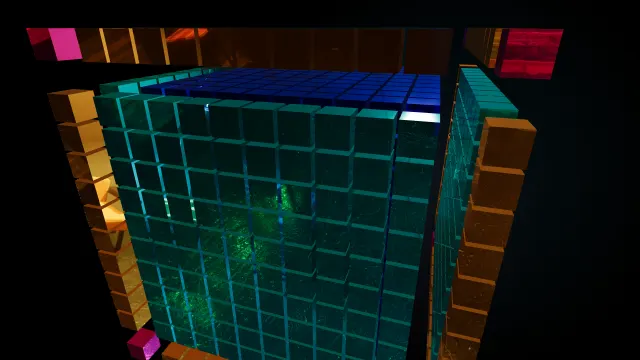
Look at this cube opening. One thousand seven hundred twenty-eight. Inside that number are six faces, twelve edges, and eight corners. We are going to see why.
The middle is a ten-by-ten-by-ten cube. The surrounding pieces complete a cube twelve units along every edge. Nothing is an approximation. Every piece has a place, and every unit in the answer belongs to one of these pieces.
Bring the pieces together. This is the whole object we will comprehend. We will first see eleven cubed, then compare two ways of constructing twelve cubed. The difference is where we put the additional length: on one side, or on both sides.
Now begin with just the ten-cube. Ten across, ten high, ten deep. One layer contains a hundred unit cubes, and there are ten layers. Keep that thousand in view. We will not throw away this structure when we enlarge the cube.
Build eleven in three directions
Start with the original thousand. We are about to extend all three dimensions by one unit. Watch the new lengths grow, not merely the camera move. The old cube remains inside the construction while the surrounding space fills.
Now every edge is eleven units long. This really is eleven times eleven times eleven. Open the pieces to see what was added. Three broad slabs appear beside the old cube, with thinner bars between them and a small cube at their meeting.
Look at the three face slabs. Each is ten by ten by one. One hundred in each slab, three hundred altogether. These slabs cover the three outward faces of the original cube. They do not yet account for the bars or the corner.
Why do the bars remain? A face slab extends in just one of the new directions. An edge bar occupies two new directions at once. Its long dimension still follows the original ten. Three such bars contribute ten plus ten plus ten.
And where all three new directions meet, one unit cube completes the construction. If you forget this corner, you do not have an eleven-cube. Look from the corner back along its three adjoining bars and toward the three slabs.
Read 1,331 as a whole
Read the whole inventory now: one thousand, three hundred, thirty, one. One thousand three hundred thirty-one. The answer is a compact description of the colored geometry. You can see one original cube, three face pieces, three edge pieces, and one corner.
Watch those pieces join. The number of unit cubes does not change when we move the pieces. Separation makes the inventory visible; assembly shows that the inventory fills the whole eleven-cube without gaps or overlaps.
Open it once more. This time, find the thirty before the narration points it out. Which pieces could contain ten units each? Look for the long narrow bars rather than the broad slabs. Their dimensions tell you what they count.
Here are the three bars. Their ten-unit lengths give thirty. The three hundreds are the face slabs, not the faces of the final eleven-cube, which have area one hundred twenty-one. Distinguish a piece used to build the cube from the entire outside face.
When you hear eleven cubed, try to recall this whole structure rather than only a memorized answer. The calculation and the object support one another. Next we will change the construction, not simply say a larger number over the same picture.
Twelve as ten plus two
Keep the central ten-cube and grow two units outward in each direction. The new side is ten plus two: twelve. Watch the full thickness develop. We are enlarging the solid, so its volume changes; this is different from merely pulling its pieces apart.
The complete twelve-cube is now present. Separate its regions. Each of the three face pieces has thickness two and a ten-by-ten base. Two hundred in each piece gives six hundred from the faces.
The three edge pieces are thicker too. Each has a two-by-two cross-section and length ten. Four times ten is forty. Three forties make one hundred twenty. Increasing the thickness affects both short dimensions of an edge piece.
The corner is two by two by two: eight, not two. Every dimension of that corner belongs to the new addition. One thousand, six hundred, one hundred twenty, and eight make one thousand seven hundred twenty-eight.
This is a valid way to see twelve cubed. But there is another partition that brings the entire geometry of a cube into view. Join these pieces first. We will keep this same twelve-unit exterior while changing the cuts inside it.
One on each side of ten
Watch the cuts move inside the twelve-cube. Instead of keeping both extra units on one side, put one on each side of the central ten. Along each dimension the length becomes one, ten, one. The exterior stays twelve; the total stays one thousand seven hundred twenty-eight.
Now open the centered construction. The central thousand has a layer on its left and right, above and below, in front and behind. These are the six faces of the original ten-cube, each receiving one hundred new units.
Follow the cube around. A hidden face does not disappear from the count. Three faces may be easy to see from one viewpoint, but centered growth covers all six. Six hundreds give six hundred. This is where the face count enters the arithmetic.
The distinction from one-sided growth matters. Ten plus one on one side makes eleven. Ten with one on both sides makes twelve. The addition control has the same value, one, but the chosen mode tells us how many ends receive that addition.
Twelve edges and eight vertices
Now look at the edge bars. There is a bar along each of the twelve edges of the central cube. Each bar is ten units long, one unit wide, and one unit thick. Twelve tens give one hundred twenty.
These are not twelve pieces of length twelve. The bars run along the original ten-unit edges. The extra units beyond their ends belong to the corner pieces. Separating these roles prevents counting a corner twice.
Find the eight corners. Each is a one-by-one-by-one cube. At a vertex, three outward directions meet; that is why the last piece has three short dimensions. Eight vertices contribute eight unit cubes.
Now see all four families together. The center contributes one thousand. Six faces contribute six hundred. Twelve edges contribute one hundred twenty. Eight corners contribute eight. Their sum is one thousand seven hundred twenty-eight. The faces, edges, and vertices are doing the calculation.
Bring the pieces home. Every face layer, edge bar, and corner fits. One thousand seven hundred twenty-eight is the volume of this twelve-cube because these regions partition it completely. The sum is exact, not a visual estimate of how much material seems to be present.
Two numbers you can see
Return to eleven cubed. One unit on one side of ten in every direction gives this eleven-cube. Open it and describe the original thousand, the three hundreds, the three tens, and the one. That is the geometry behind one thousand three hundred thirty-one.
Now twelve cubed, with one on each side of ten. Notice that the displayed whole has changed. Its centered partition reveals six hundreds, twelve tens, and eight ones around the original thousand. That is one thousand seven hundred twenty-eight.
Both decompositions are three-dimensional multiplication. We did not replace arithmetic with an illustration. We exposed what the arithmetic counts. An expression becomes easier to comprehend when every term has an address in the object.
Before leaving, locate one face piece, one edge piece, and one corner. Explain their dimensions. Then assemble the whole in your mind as the pieces join on screen. You now have a way to reconstruct the answer rather than depend on remembering its digits.