Mathematical reference
- The added shell
- 10³−9³ = 271 cubic units
- Faces, edges and corner
- 3×81 + 3×9 + 1 = 271
- One direction at a time
- 81 + 90 + 100 = 271; the intermediate solids are not cubes
Lesson transcript
This is the text of the narrated lesson. References to turning, highlighting or changing an object describe the linked interactive lesson; its demonstrations are not embedded in this reading page.
Where do 271 new cubes go?
Nine cubed becomes ten cubed. Watch the shell grow. Seven hundred twenty-nine becomes one thousand. One more along each edge adds two hundred seventy-one unit cubes. Where do all those new cubes go?
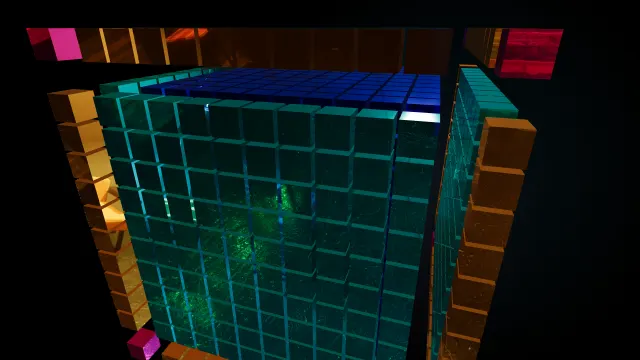
Open the shell. The change is not one slab and not one unit. Three dimensions changed together. The old nine-cube remains, while faces, edges, and a corner account for everything needed to complete the ten-cube.
This lesson compares two ways of partitioning that shell. First we count the three kinds of new regions. Then we extend the dimensions one at a time. The sums look different because their pieces differ, but their total must be the same.
Keep seven hundred twenty-nine visible in the center. Nine times nine is eighty-one, and nine such layers make seven hundred twenty-nine. We know the completed ten-cube contains one thousand. So the new shell must account for the difference, two hundred seventy-one.
Eighty-one, nine, and one
Each new face slab is nine by nine by one. That is eighty-one units. The three slabs contribute eighty-one plus eighty-one plus eighty-one, or two hundred forty-three. Notice the long and short dimensions of one slab while it is emphasized.
The three bars each have length nine and a one-by-one cross-section. Together they contribute twenty-seven. They occupy the places where two new directions meet. Face slabs alone would leave these spaces unfilled.
One unit at the outer corner completes the shell. Two hundred forty-three plus twenty-seven plus one is two hundred seventy-one. Add the original seven hundred twenty-nine, and the total is one thousand.
Join the pieces and follow one bar into its place between the slabs. This is why nine cubed plus three times eighty-one is not enough. The whole ten-cube includes growth in pairs of directions and in all three directions, not only three isolated face layers.
Extend one direction at a time
Start again with the nine-cube. This time extend only its width, from nine to ten. Height and depth remain nine. The new slab is nine by nine by one, with volume eighty-one. The resulting solid is ten by nine by nine, not yet a cube.
Here is ten by nine by nine. Its volume is eight hundred ten: seven hundred twenty-nine plus eighty-one.
Now extend the height to ten, keeping the depth nine. This next slab spans the full ten-unit width already created.
The second slab is ten by nine by one. Its volume is ninety, not eighty-one. The solid now measures ten by ten by nine and contains nine hundred units. Earlier growth has changed the size of the next face.
Extend the final depth from nine to ten. The last layer covers a ten-by-ten face, so it adds one hundred. Now all three dimensions are ten. The completed cube contains one thousand.
We added eighty-one, then ninety, then one hundred. Their sum is two hundred seventy-one. These are successive rectangular layers, not three successive squares. The middle layer is nine by ten. Its dimensions are the reason for its ninety.
The same shell, counted differently
Open the face-edge-corner partition again. Its shell is two hundred forty-three plus twenty-seven plus one. The successive-direction partition was eighty-one plus ninety plus one hundred. Both account for exactly the same added material.
In successive growth, the second layer includes a nine-unit bar beside an eighty-one-unit face. Eighty-one plus nine is ninety. The last layer contains an eighty-one-unit face, two nine-unit bars, and the corner: eighty-one plus eighteen plus one is one hundred.
So the bars have not disappeared from the second argument. They are grouped with the later face layers. This is a useful question whenever two calculations seem different: did the quantity change, or did we change which pieces we counted together?
Keep that distinction in mind for thicker growth. An edge piece will no longer be a thin line of unit cubes, and a corner will no longer be a single unit. We must read all three dimensions rather than remember the previous numerical terms.
Two-unit growth, one direction at a time
Start with a four-by-four-by-four cube, containing sixty-four units. This time each dimension will gain two, producing a six-cube. Before growing all three directions together, extend only the width. A two-unit addition acts on a four-by-four face, so this first step adds thirty-two units.
The current solid measures six by four by four and contains ninety-six units. Now extend its height by two. The new layer spans a six-by-four face because the width has already grown. Six times four times two is forty-eight. The second contribution is larger than the first even though the added length is the same.
With width and height both six, the last layer covers a six-by-six face. Increasing depth by two adds seventy-two units. The completed six-cube contains two hundred sixteen. The three additions were thirty-two, forty-eight and seventy-two, which total one hundred fifty-two beyond the original sixty-four.
Open the completed cube into its usual families. Three face pieces contribute ninety-six, three edge pieces forty-eight, and the corner eight. Their sum is the same one hundred fifty-two. Sequential layers and face-edge-corner pieces group the material differently, but each accounts for every part of the identical shell.
Equal side increments give unequal volume increments
Begin with a five-cube and extend each dimension by one. The old volume is one hundred twenty-five and the new six-cube has two hundred sixteen. The shell therefore contains ninety-one. Its size depends on the starting cube as well as on the one-unit extension.
Open that shell. Three slabs of twenty-five give seventy-five; three bars of five give fifteen; one corner completes ninety-one. Read the old five-unit dimensions in the slabs and bars. Those dimensions will change in the next comparison, while the added thickness remains one.
Now begin from six and grow to seven. The volume goes from two hundred sixteen to three hundred forty-three, an increase of one hundred twenty-seven. The change in side length is still one. A larger starting face receives a larger layer, and longer old edges receive longer bars.
Separate the pieces to check that larger shell. Three slabs of thirty-six give one hundred eight, three bars of six give eighteen, and the corner gives one. Together they give one hundred twenty-seven. Repeated equal additions to the side of a cube do not form an arithmetic sequence of equal volume additions.
Distinguish a layer from its face
Return to four plus two and emphasize the face family. One slab has a square face of area sixteen, but its thickness is two. Its volume is thirty-two cubic units. The square face and the solid slab are different objects to measure, even when they occupy the same place in this view.
Move to the edge bars. Each has length four and a two-by-two cross-section. Its volume is sixteen, and the three bars contribute forty-eight. Calling it an edge piece identifies its location; it does not mean that it is a line with no width or thickness.
Approach the corner cube. It has side two and volume eight. In the earlier one-unit examples a corner contributed one, but that was a consequence of its dimensions. There is no general rule that a corner piece contributes one unit regardless of the added thickness.
Join all the regions again. The full object has side six and volume two hundred sixteen. Neither the screen size nor the number of colored pieces is a volume measurement by itself. We obtain the volume by multiplying the three dimensions of each disjoint solid and summing the results.
Five cubed as three plus two
Now see five cubed as three plus two in each direction. The original three-cube contains twenty-seven units. Two more along each edge completes a five-cube. We use this smaller example to inspect thickness, not as a substitute for the larger structures already seen.
Each face piece is three by three by two. Nine times two is eighteen. Three face pieces contribute fifty-four. The thickness multiplies the original square face; it does not replace either of the face dimensions.
Each edge piece is three by two by two. Its two-by-two cross-section contains four units, and three such cross-sections run along its length. Twelve in each bar, three bars, thirty-six altogether.
The corner is two by two by two, containing eight. Now read twenty-seven plus fifty-four plus thirty-six plus eight. The sum is one hundred twenty-five. Five cubed is accounted for by every visible region, including the thick edges and the thick corner.
Join the five-cube. If you doubled the added thickness, the face contributions would double, the edge contributions would multiply by four, and the corner contribution by eight. Different numbers of short dimensions explain the different responses.