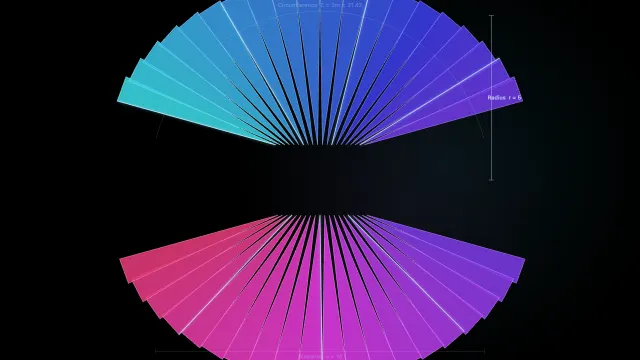
Mathematical reference
- Circle area
- A = πr²
- One-circle limiting arrangement
- Base πr; height r
- Radius doubled
- Area multiplied by 4
- Finite inscribed triangles
- Total area is less than the full circle area
Lesson transcript
This is the text of the narrated lesson. References to turning, highlighting or changing an object describe the linked interactive lesson; its demonstrations are not embedded in this reading page.
Start with the pieces actually drawn
Begin with eight straight-sided triangles inside the circle. Each triangle reaches from the center to two points on the boundary. Together they form an inscribed octagon. Look at the small curved gaps outside its straight edges: this finite polygon has slightly less area than the circle.
Open the two rows of triangles. They move without stretching, so each triangle retains its area. Gaps between the separated pieces are empty space; they are not extra area added to the original collection.
Join the rows. The triangles interleave into a shape with straight boundaries. The same eight triangles are still present. Rearrangement changes where the area is located, while preserving how much area the pieces contain.
This is a finite comparison, not yet an exact rectangle made from the full circle. Eight straight chords leave visible gaps at the original boundary. We will make those gaps smaller by using more triangles, then connect the limiting base and height with the circle.
Use narrower triangles
Return to the circle with twenty-four triangles. Each spans a smaller angle. Its chord follows the circular boundary more closely than an edge of the octagon. The total triangle area has increased toward the area of the circle.
Open these narrower pieces into rows. Each straight side from the center remains a radius. The lengths and areas of the individual triangles are unchanged by their travel across the screen.
Bring the rows together again. Their interleaving makes a longer, thinner arrangement. The top and bottom each draw their boundary from one half of the original polygon. Narrower triangles make the ends less slanted.
Compare ninety-six triangles in the joined arrangement. The finite base and height are now closer to their limiting values. More pieces improve the approximation; moving the camera closer would only magnify the same approximation.
Read the limiting base and height
Return to the ninety-six-piece circle and emphasize a radius. Each triangle has two sides of that length. Its perpendicular height falls a little short of the radius because its boundary edge is a chord.
Open and inspect the narrow triangles. As their angle becomes smaller, that perpendicular height approaches the radius. The limiting joined arrangement will therefore have height r. The finite height is still slightly less.
Join the two rows. Half the polygon boundary supplies one long side. As the polygon approaches the circle, its perimeter approaches the circumference, so this base approaches half the circumference: pi times radius.
Read the displayed dimension guides as the limiting circle relationship: base pi r, height r. For a finite collection of straight triangles, both dimensions are a little shorter. The distinction lets us connect the visible approximation with the exact circle formula without confusing them.
Multiply the two dimensions
Keep radius five. In the limiting arrangement the base is five pi and the height is five. Multiplying gives twenty-five pi square units. The two factors of radius come from two perpendicular lengths.
Return those same triangles to the circle. Their combined finite area is preserved as they move. With one hundred sixty triangles the difference from the circle is small, but it is not zero. The circle-area expression describes the limiting full circle.
Use radius three. The limiting base would be three pi and the height three, giving nine pi square units. The diameter is six, but multiplying pi by the diameter gives a circumference, not an area.
Use radius four for one more comparison. The base approaches four pi and the height four, so the area approaches sixteen pi. Keep the units visible in your reasoning: length times length gives square units.
Account for the curved gaps
Return to eight triangles at radius five. Their outer sides are straight chords, while the circle continues along curved arcs outside them. The gaps are small regions of genuine circle area that are not part of the triangles. Rearranging only these pieces cannot recover area that was never included.
Open the eight triangles again. Their combined area is fifty times square root of two, approximately seventy point seven one square units. That number is a spoken calculation about the pieces shown here. The full circle has area twenty-five pi, approximately seventy-eight point five four, so the difference remains meaningful.
Join the same pieces. The arrangement can make their total easier to read, but its motion has not filled the missing curved gaps. Conservation of the triangles’ area and approximation of the circle’s area are separate claims. The first is exact for the rigid pieces; the second improves when we change the subdivision.
Return to the circle with twenty-four triangles. Their total area is about seventy-seven point six five square units, closer to the same circle area. The triangles are narrower and their chords follow the arcs more closely. We changed the mathematical approximation, not merely where the pieces were arranged.
With ninety-six triangles the remaining gaps are smaller again. No finite straight edge is exactly a circular arc. The exact formula pi times radius squared describes the circle reached in the limit, while every finite inscribed polygon here remains slightly smaller.
Why both dimensions scale
Use radius two on a fixed scale referenced to radius four. The fine subdivision is already separated; now join its rows. The limiting base is two pi and the limiting height is two, so the circle area is four pi square units. Both the horizontal and vertical dimensions belong in that multiplication.
Now double the radius to four on the same drawing scale. The limiting base doubles to four pi and the height doubles to four. The area becomes sixteen pi, four times the previous amount. Doubling two perpendicular dimensions produces two factors of two, not just one.
Return the radius-four pieces to their circle. The increase in area belongs to the larger mathematical circle and persists through this rearrangement. A camera enlargement would instead change screen size while leaving the radius and its measured area unchanged. The fixed reference scale lets this example show actual size comparison.
The radius-two circle returns at the same drawing scale. Its circumference is half as long, but its area is one quarter as large. Boundary length uses one radius factor; area uses two. Reading the two-dimensional pieces helps keep these different scaling relationships separate.
An extra copy is not a larger radius
Start with one radius-four circle and its triangle collection. Its limiting area is sixteen pi. We will compare adding a second copy with enlarging the radius. These are different operations: copying adds another equal collection, while scaling changes both dimensions of every piece.
Here are two radius-four copies. Their total limiting area is thirty-two pi, twice as much as one circle. Neither radius has changed. Counting copies contributes a factor of two to the total area, but it does not put a factor of two inside each radius.
The two collections have been opened; now join their rows. The limiting long side uses the full circumference, eight pi, and the height remains four. Their product is thirty-two pi. This base differs from the half-circumference base of the one-circle construction because there are twice as many pieces.
Return to one radius-four collection in its joined view. Its base approaches four pi and its height four, giving sixteen pi. Before multiplying a displayed base and height, identify which collection they enclose. The number of circles and the radius of each circle must both remain explicit.
Keep track of one circle and two copies
Now begin with two matching radius-five circles. Each contains the same finite triangle collection. Adding a second copy doubles the total area of the pieces; it does not change the radius of either circle.
Open both collections. Follow the pieces from each copy into their separate rows. The whole collection contains twice the area of one inscribed polygon, throughout this motion.
Join the rows. This two-copy construction approaches a base equal to the full circumference and a height equal to the radius. Its limiting area is two pi r squared, because it contains two circles.
Increase the subdivision to one hundred sixty. At radius five, the two-circle limit is fifty pi; each circle contributes twenty-five pi. You can now connect the original circle, the finite triangles, and the limiting base-times-height expression while keeping the number of copies explicit.