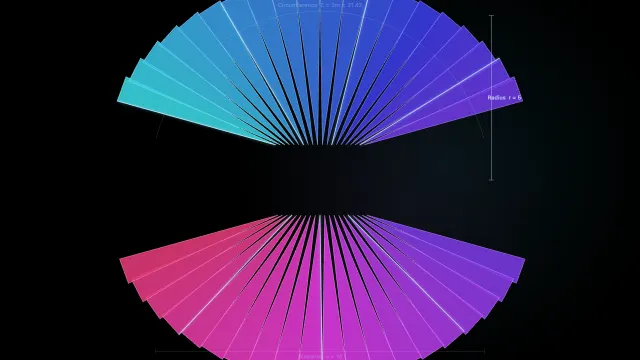
Mathematical reference
- Angle in radians
- θ = s/r
- Arc length
- s = rθ, with θ in radians
- Complete turn
- 2π radians
- Radius 4, angle 3 radians
- Arc length 12
Lesson transcript
This is the text of the narrated lesson. References to turning, highlighting or changing an object describe the linked interactive lesson; its demonstrations are not embedded in this reading page.
A radius becomes an arc-length unit
A radius gives us a length belonging to the circle itself. Instead of choosing inches or centimeters around its boundary, use that radius as the measuring length. Here the radius is five units. The amount of turning will come from comparing an arc with that radius.
Watch one radius-length piece bend onto the boundary. When it has settled, the arc is as long as the straight radius. The central turn from the top of the circle to the end of that first arc is one radian.
Keep that first arc in view. Its length is five, and the radius is five, so arc length divided by radius is one. A radian measures a turn through this ratio. It is not a fixed length such as one centimeter.
Add a second radius-length arc. Two such arcs make a length of ten along the boundary, and the central turn is two radians. The straight diameter also has length ten, but it is a different path. Equal lengths do not have to trace the same shape.
Count radius-length arcs around a full turn
Add a third radius-length arc. Three radians take us close to a half-turn, but not quite there. Keep following the accumulated arc from the top in the same direction; do not measure a new angle from each colored boundary.
Continue to six complete radius-length arcs. They nearly fill the circumference. A small piece remains before the endpoint returns to the top. Six radians are therefore a little less than a full turn.
Fill the remaining arc. The total boundary contains two pi radii, so a full turn is two pi radians. Its approximate value is six point two eight three. The remainder after six radians is about zero point two eight three radians.
The same full turn is three hundred sixty degrees. Degrees divide a turn into three hundred sixty equal parts; radians use arc length divided by radius. These are two descriptions of the same turn. Neither changes the circle.
Half and quarter turns
Look at the diameter across the circle. It divides the boundary into two equal half-circles. Half of a full turn is half of two pi radians, which is pi radians. In degrees, that half-turn is one hundred eighty.
The upward radius and the right half of the diameter bound the upper-right quarter of the circle. A quarter-turn is pi divided by two radians, or ninety degrees. Both straight sides of this corner are radii; the curved side is the quarter-circumference.
Return to the first three radius-length arcs. Their turn is three radians, a little short of pi. This gives a useful comparison: a half-turn is slightly more than three radians, rather than exactly three.
Complete the full circumference again. Two half-turns or four quarter-turns reach the same endpoint as two pi radians. The fractions of the turn remain the same whichever notation we use.
The same angle on different circles
Use a circle of radius three on a fixed drawing scale. Bend one radius-length piece onto its boundary. That arc is three units long. Dividing its length by the radius gives one, so its turn is one radian.
Now use radius six on that same scale. The matching arc is six units long. The circle and the arc are twice as large, but their ratio is still one. The endpoint lies in the same direction from the center: the angle has not doubled.
On this larger circle, add a second radius-length arc. Its accumulated length is twelve, giving twelve divided by six, or two radians. The angle counts radii along the boundary, not the numerical arc length alone.
Return to radius three with two arcs already marked. Their accumulated length is six. Six divided by three again gives two radians. Similar circles preserve angles while their actual lengths change.
Equal arc lengths can make different turns
On a radius-two circle, mark three radius-length arcs. Each piece is two units long, so the accumulated arc has length six. The angle is three radians because that arc contains three copies of this circle’s radius. Keep the starting direction fixed as the pieces accumulate.
Now compare a radius-three circle on the same scale. Mark two radius-length arcs. Their total length is also six, but the turn is only two radians. Equal arc lengths do not guarantee equal angles when the circles have different radii.
Return to radius two with its three arcs already marked. The same six units go farther around this smaller circle. Dividing the arc length by the smaller radius gives a larger ratio: six divided by two is three, rather than six divided by three, which is two.
The larger circle returns with its two arcs. An angle compares arc length with radius; it is not determined by the numerical arc length alone. This distinction lets us move between physical lengths and turns without treating a radian as a fixed measuring stick.
Add a third arc on this larger circle. Its turn now matches three radians on the smaller circle, but its arc length is nine. Equal angles require proportional arc lengths when the radius changes. Both numerator and denominator grow together, leaving their ratio unchanged.
Read turns beyond a half-circle
Start again at three radians. The endpoint has traveled almost halfway around the circle. A half-turn is pi radians, slightly more than three. The direction of the endpoint matters here; the straight distance between endpoints would answer a different question from the arc traveled around the rim.
Add the fourth radius-length arc. The accumulated turn now passes the half-circle. Four radians is more than pi but less than two pi. Keep counting from the original starting radius, rather than switching to the shorter remaining route back to the start.
Continue to five radians. The endpoint is closer to returning to the beginning, yet the amount already traveled has increased. An endpoint alone does not tell you which arc you intended: a short return path and the long accumulated path connect the same two positions.
Six radians leave a small gap. Filling that remaining gap completes two pi radians, not seven radians. The final colored piece is shorter than a full radius-length arc. Its role is to close the turn, and its length is exactly the circumference minus six radii.
Separate the turn from the length
Take a radius-six circle and mark two radius-length arcs. The arc length is twelve, and dividing by six gives two radians. The numerical value twelve belongs to a length. The numerical value two belongs to the turn expressed as an arc-to-radius ratio.
On radius four, three radius-length arcs also total twelve. The turn is now three radians. This is another way to solve the same relationship backward: when arc length and radius are known, their quotient identifies the angular measure without first converting to degrees.
Keep those three arcs visible. The expression arc length equals radius times angle assumes the angle is in radians. Inserting a degree number directly would count the wrong number of radius-length pieces. A full turn checks the convention: radius times two pi must recover the circumference.
Remove one of the marked arcs, leaving two. At radius four, the remaining arc length is eight. We changed the angle from three radians to two while holding the radius fixed, so length changes in the same proportion. Compare this with our earlier change of radius: either factor can change the arc length, but only the angle determines what fraction of the circle has been traversed.
Complete this radius-four circle. The full arc is eight pi units and the full angle is two pi radians. Those two expressions differ by the radius factor of four. Keeping that factor visible connects angular measurement with the circle’s actual size rather than memorizing an isolated conversion.
Read an arc length from its turn
For a radius-four circle, one radian corresponds to four units of arc length. Watch the first piece settle. The relationship is arc length equals radius times angle, when the angle is expressed in radians.
Extend to three radians. Each radius-length piece is four units long, so the three pieces total twelve. Multiplying four by three gives the same answer. The visible pieces supply the meaning of the multiplication.
For the entire circumference, the angle is two pi. Multiplying radius four by two pi gives eight pi. The familiar circumference formula is the arc-length relationship applied to one complete turn.
Choose a different radius and predict the length of one, two, or three radius-length arcs. Keep three quantities distinct: radius, arc length, and turn. Dividing arc length by radius gives the turn in radians; multiplying radius by that turn recovers the arc length.