Mathematical reference
- Fives in a ten-unit row
- Landings alternate between the fifth and tenth positions
- Threes cross row boundaries
- 3,6,9,12,… shift their landing positions because 3 does not divide 10
- Eleven
- One full ten-unit row plus one unit in the next row
Lesson transcript
This is the text of the narrated lesson. References to turning, highlighting or changing an object describe the linked interactive lesson; its demonstrations are not embedded in this reading page.
Two bright beats
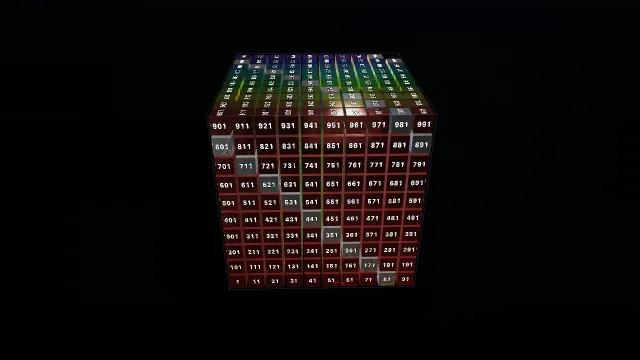
Look at this! Five more, five more, five more. The landing cubes are making two repeating walls. Let us find the tiny rule behind that big pattern. There are two things to follow: the amount of material, and the places where each jump finishes. A jump adds five unit cubes, but only its last cube is an endpoint. The walls are made of endpoints from many different jumps. They are not walls that we built with a separate instruction.
Every bright cube marks the end of one jump. We will rewind, then build the pattern ourselves. The early part of a pattern is easier to read when we return to small quantities. Keep the two walls in mind as we rebuild. We will see the same two positions in a single row, then in several rows, and finally across layers. The large shape grows out of the small repeated action.
Five, ten, fifteen
Five. Our first group fills half a row. The row has room for ten equal units. Five occupies exactly half that length. We have made one jump, not five jumps: the jump size is five. The label on its endpoint gives the total reached, while the spaces behind it show what that total contains.
Ten. Another five completes the row. We have used two equal jumps to fill the ten available spaces. Look at the end of the row and its label. The zero in ten says there are no units left over after making one full row. It does not say that the completed row has vanished.
Fifteen. Five more, halfway across the next row. The first row remains complete underneath this description of the total. Fifteen means one group of ten and five more units. The new endpoint is in the same column as our first endpoint at five. Moving into a new row changed the tens part, while the halfway position returned.
Twenty. Two complete rows now. Look from the last cube along the two row ends. Ten and twenty finish at matching positions. Four jumps of five made these twenty units. Two counts are useful here: four counts the jumps, and twenty counts the unit cubes. Multiplying four by five connects the two.
Twenty-five. Halfway across another row. Five jumps have now produced twenty-five units. There are two complete rows and half of a third. The final five again describes that unfinished row. The larger total changes at every jump, but the last digit repeats because the endpoint keeps returning to the same two places.
Thirty. Three rows, made with six jumps of five. Count the complete rows first: each contributes ten. Then count the two five-unit jumps needed for each row. Three pairs of jumps make six jumps. This is the same collection described at two scales, by its rows or by the smaller equal steps that built them.
Hide the cubes between the landings. See the two positions? Halfway across, and at the end. That is why the last digit alternates between five and zero. The empty-looking spaces still belong to the represented quantity. This control hides the non-endpoints so the route is easier to see. Follow the labels from one row to the next. Five, zero, five, zero is a pattern in the last digit; it is not a claim that the whole total repeats.
Let the fives build
Now keep adding five. Follow the new landing cubes as they drop into place. Half a row, a whole row; half a row, a whole row. Each finished row is followed by another. Then the count climbs into a new layer, and the same two positions return above the earlier ones. You do not have to say every number. Watch what stays the same while the total grows. The bright endpoints collect into two families, like walls passing through the box. It is the little pattern from our first six jumps, repeated many times. Predict where the next white cube will arrive, then watch it land. At a layer boundary, the next row begins above the layer we just filled. The row length has not changed. That is why the old two-column pattern continues in height. Look along a wall, then across to the other one: the spacing comes from five inside a row of ten.
Three hundred. Sixty jumps of five have landed. Two landing positions in every row, repeated through three layers. Each hundred-unit layer contains twenty jumps of five. Three such layers therefore contain sixty jumps. Only sixty endpoint cubes are displayed by this filter, although they describe a count that reached three hundred. The labels retain the totals at which those endpoints arrived.
Bring back the other cubes. Now you see all three hundred units. Filtering changed what we could see, not the total. The spaces between the endpoint walls have returned. Nothing in the arithmetic changed when we toggled that display. Keep that distinction when comparing the next skip: a different route through a quantity can be interesting even when the final amount is exactly the same.
Threes travel differently
Three. A jump of three units. We have restarted the count so the first jump is visible by itself. Three fills less than half this ten-unit row. Unlike five, three does not divide the row into a whole number of equal jumps. That mismatch will appear as shifting endpoint positions.
Six. Add another three. Two jumps occupy six spaces. Look at the gap between the first endpoint and the second: it still represents three units. The new endpoint is farther across the row, but the operation has not changed. We are repeating one equal addition.
Nine. There is one space left in the row. The next jump needs three spaces, and this row has only one remaining. Before we add it, separate those two facts: the row is almost full, and the jump size is still three. A row boundary does not shorten the addition.
Twelve. This group crossed the row boundary. Ten units in the first row, and two in the next. One of the three new cubes completed the first row; the other two began the next row. The endpoint now sits in column two. The jump crossed the boundary without changing its size. This is carrying seen as the placement of actual units, rather than an unexplained change of digits.
Now follow many threes. Each new white cube is another landing. The row has ten spaces, but our jump has three units, so a landing does not stay in the same column. Sometimes a jump fits inside a row; sometimes it crosses into the next one. The count keeps going, and a repeating route emerges. Look across one layer, then look at the layers above it. The pattern shifts as the count climbs. Unlike fives, threes eventually visit every column. Watch the moving endpoint instead of chasing every numeral. You are seeing one small addition create a large, organized pattern through repetition. The row positions tell us about the remainder after making tens. Passing a row end changes the tens count, while the part left in the new row gives the units digit. The endpoints trace both pieces together. Several rows are needed before the route returns to its starting column.
Three hundred again, but this time we took one hundred jumps of three. More landings, and a different pattern, for the same total. Compare this with the two walls made by fives. The amount is still three hundred, but the three-unit jumps are smaller, so more jumps were required. One hundred endpoints now mark the route. The selected columns spread through the construction instead of remaining in only two positions.
One row and one more
Eleven. A full row of ten, and one more cube. Ten of the units fill the first row. The eleventh begins the second, so the endpoint sits one place beyond a row boundary. Read the two ones by their positions: one complete ten and one additional unit. They represent different group sizes even though the symbols match.
Twenty-two. Another row and another unit. The second jump contributes another ten and another one. Two complete rows and two extra units now make twenty-two. The endpoint has moved one row and one column relative to the previous endpoint. Those two changes together account for all eleven added units.
Thirty-three. The landing moves sideways as it moves into the next row. Three jumps give three tens and three ones. The matching digits are a consequence of these early additions, not a separate counting rule. The endpoint moves diagonally through the rows because each eleven combines the row length of ten with one extra unit.
Jump ahead to ninety-nine. Predict what one more eleven will do at this boundary. Nine full rows and nine additional units leave one space in this layer. A further eleven is more than that remaining space. Predict both parts of the change: completing the current layer, then placing the rest above it. This boundary will break the simple repeated-digit appearance.
One hundred ten. The jump crossed into a new layer. The rule is still add eleven, even when the neat repeated digits stop. One unit finished the hundred-layer. The other ten made a complete row in the layer above it. Read one hundred ten as one hundred, one ten, and no loose units. The final zero records the completed upper row; it does not mean the last jump added nothing.
Let the elevens keep coming. A diagonal grows, reaches a boundary, and wraps through the construction. Eleven is ten plus one. Usually that moves the landing one row and one position across. When the extra one itself crosses a row boundary, another carry happens. So do not expect one unbroken straight line forever. Look for repeated diagonal sections and for the places where they restart. Layer after layer, the same addition is doing the work. You can follow it in the depth of the box as well as across its face. This is why we show many jumps: the large pattern tells us more than the first few numbers alone. A carry changes the way the same addition is distributed between place sizes. The endpoint can cross a row or a layer, but its label still advances by exactly eleven. Follow a diagonal until it meets a boundary, then look for where the sequence resumes. The broken line is part of the pattern.
Nine hundred ninety. Ninety jumps of eleven. Try your own count now: choose Skip, use Play for many jumps, or Next for just one. Predict a landing before you press it. Read the final amount as nine hundreds, nine tens and zero units. Ninety jumps of eleven give the same total as nine groups of one hundred ten. You can compare the endpoint route with the fives and threes by changing the skip, keeping track of which total and which jump size you are using.