Mathematical reference
- One short of a row
- 9 = 10−1; repeated jumps shift the endpoint through ten-unit rows
- Decimal remainder
- 10 ≡ 1 (mod 9), so a decimal integer and its digit sum have the same remainder modulo 9
- Last multiple below 1000
- 111×9 = 999; one more unit completes the thousand-cube
Lesson transcript
This is the text of the narrated lesson. References to turning, highlighting or changing an object describe the linked interactive lesson; its demonstrations are not embedded in this reading page.
A hidden diagonal
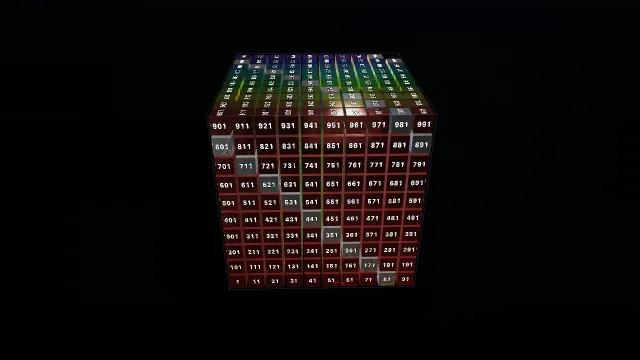
Look at the nines racing into this nearly full cube. Each bright landing leaves a trace. What shape is hiding inside? A cube that marks a landing is not an extra cube added on top of the quantity. It is one of the units already present. Its special role is that a nine-unit jump finished there. By keeping those endpoints visible, the count leaves a spatial record we can examine after the motion settles.
Now hide the other cubes. The landings remain, suspended in diagonal sheets. Let us discover why. Notice that the sheets have depth. Some endpoints are nearer, and others are farther back or higher in the block. We will connect this arrangement to the small step of adding nine. Start with the row length: every row has ten positions, so nine is just short of completing one.
One less than a row
Nine. One unit short of a row of ten. The empty position at the end makes the difference between nine and ten visible. Keep that one missing space in mind. Each later jump adds nine again, so the relationship to a full row will keep appearing even when several rows or layers are already present.
Eighteen. Add another nine. A full row and eight more units. One new unit closed the first row, leaving eight of the new units in the second. Read eighteen as one ten and eight ones. The endpoint moved into the next row, but its column is one position earlier than the endpoint at nine. The addition stayed positive even though the units digit became smaller.
Twenty-seven. Two full rows and seven units. The ones digit moved backwards again. The ones digit now describes seven units beyond two complete rows. From eighteen to twenty-seven, a ten was gained in the tens place and one was lost in the ones place. Together those changes add nine. The retreating column is a visible consequence of that regrouping.
Adding nine is adding ten and subtracting one. The landings shift one column backwards while moving through the row order. Look along the selected endpoints rather than at the entire quantity. Their positions make a sloping route through consecutive rows. Thinking of nine as ten less one predicts that slope. We have not actually removed a cube on each jump; this is a way of describing the same positive addition.
Here is ninety, after ten jumps. Nine complete rows. We have moved ahead to examine the next carry. The units digit is zero because the endpoint completes a row. The total is ninety, not ten: ten counts how many jumps were made, while nine is the size of each jump. Nine complete rows of ten contain the same ninety units as ten groups of nine.
Ninety-nine. Nine tens and nine ones. What comes next? The next jump needs nine units, but there is only one space left in the hundred-layer. The first of those units will complete the layer. The remaining eight will begin the next one. Predict the new place-value description before looking at the changed arrangement.
One hundred eight. A complete hundred-layer, with eight extra cubes. Ninety-nine plus nine is one hundred eight. The hundred is a complete lower layer, not a larger individual unit. Above it lie eight of the same unit cubes. The zero in the tens place means the upper layer contains no complete ten-unit row yet. One hundred plus eight accounts for the full quantity after the jump.
Every nine to a thousand
Now start again and watch the entire count by nines. Every jump is shown. Keep your eyes on the new bright landing as each group drops. The full collection grows behind it, so you can see both the amount and the path. In each row the endpoint shifts; at a row boundary it wraps; at a layer boundary the count climbs. The same rule keeps working. We are not changing the skip or sneaking in larger jumps. Nine more, and nine more, all the way through the box. Notice how the landings in later layers line up with earlier ones. Soon we will remove the ordinary cubes and look inside. For now, follow this repeated motion until the count reaches its last multiple of nine below one thousand. At first you can track individual endpoints. As the collection grows, let your attention shift to their relative positions: backward through columns, onward through rows, then upward through layers. Those are different scales of the same count. The full units remain visible in this passage so an endpoint is always connected to the amount it represents.
Nine hundred ninety-nine. One hundred eleven groups of nine. We stop here: one thousand itself is not a multiple of nine. Another nine would take us past it. Read the total as nine hundreds, nine tens and nine ones. These place-value groups contain different amounts, although the same digit appears in each position. Their sum is the quantity reached by the last jump. The next complete thousand-block is still one unit away, rather than another full nine-unit jump away.
Why the digits agree
Look at eighteen. One plus eight equals nine. The digit sum is nine. There is one complete row and eight extra units. Adding the digits uses the one that counts rows, rather than the ten units inside that row. Why can this tell us anything? Because a ten contains one complete group of nine and leaves one unit after that group is removed.
Now one hundred eight. One plus zero plus eight equals nine again. The zero contributes no extra tens. The complete hundred contributes one to the remainder after dividing by nine, while the eight individual units contribute eight. Together those remainders make another nine, so there is no leftover remainder. We are reading the displayed groups, not changing the quantity.
Here is one hundred ninety-eight. One plus nine plus eight equals eighteen. The digit sum is not always nine, but it is still a multiple of nine. The one counts a hundred, the nine counts tens, and the eight counts units. For the remainder calculation, replace each complete place-size group by its leftover one. The eighteen obtained from the digits can itself be grouped into two nines. A digit sum need not be a single digit to be useful.
Nine hundred ninety-nine has digit sum twenty-seven. Nine plus nine plus nine. Twenty-seven is three nines. The twenty-seven is not the amount of material in the block. It is the result of adding the three written digits. Its relationship to nine is what matters. Repeated place-value regrouping changes the amount by whole groups of nine, which is why this smaller calculation retains the same remainder.
Why does this happen? Look at this row of ten. Ten is one group of nine with one left over. For remainders after division by nine, a ten behaves like a one. Look at the ten actual units in this row. Nine of them form one nine-unit group; a single unit remains. That one is what the tens place contributes to a remainder calculation. We still count the whole row as ten when describing the quantity itself. The shortcut applies only to the remainder.
Here is one hundred, a layer of ten rows. A hundred is eleven groups of nine with one left over too. Each decimal place contributes its digit to the remainder. That is why adding the digits tests the original number. Ten rows give ten of those leftover ones, which can be grouped into another nine with one remaining. This makes the hundred leave the same remainder as the ten: one. The visible grouping explains why the values one, ten and one hundred have the same effect on this particular remainder calculation.
Take away the rest
Return to all nine hundred ninety-nine cubes. The bright cubes are the landings of our count by nine. The total and the sequence are separate pieces of information. Nine hundred ninety-nine tells us how many unit cubes are present. A skip of nine tells us which totals were endpoints on the route here. We can keep the amount fixed while choosing to show all its units or only those endpoints.
Now hide everything except those landings. All one hundred eleven endpoints remain. We removed cubes from view, not from the count. Look through the openings. The selected cubes can now be seen behind one another, instead of being hidden by the intervening units. This view makes their alignment visible. It does not convert the represented amount into one hundred eleven; that smaller value counts the displayed endpoints.
A faint gold guide passes through the middle sheet. Watch the view turn along it. These cubes really occupy a plane in three dimensions; this is not just a diagonal drawn on the front face. A diagonal line on a screen can come from several different spatial arrangements. Turning the camera lets us distinguish them. Here endpoints at different heights and depths remain aligned with the same flat guide. The guide passes through their centers, so its role is to expose an alignment already present in the construction.
There are parallel sheets on either side. Each cube position advances by one unit across, ten through the rows, or one hundred up a layer. Each of those changes has remainder one after division by nine. Matching coordinate sums therefore select matching remainders. That is the spatial version of the digit-sum rule. Moving one position in any coordinate changes the remainder in the same way, even though it changes the quantity by a different place value. Combinations of coordinate steps can therefore keep the same remainder. The resulting alignments extend across more than one direction, which is why a sheet appears instead of only a single line.
Remove the guide. The pattern is still there. Repeated addition selected the cubes; the guide only helped our eyes see their plane. A mathematical pattern should persist when a temporary guide is removed. The endpoint positions did not move when the guide disappeared. You can still look along their alignment and compare the neighboring sheets. This separates the pattern created by repeated addition from the visual aid used to read it.
One cube short
One thousand. A complete ten by ten by ten cube. Look at the upper corner nearest us. Every row, every layer and the full stack is now complete. The corner cube is one ordinary unit, with the same size as the first unit we counted. At this scale it is easy to overlook that single contribution, so look at the corner rather than judging only the overall silhouette.
Take away one cube. Nine hundred ninety-nine remains. That missing corner is the difference between a thousand and our final nine. The change is local: one occupied corner became an opening. The other nine hundred ninety-nine units remain in their original positions. This is an actual subtraction from the quantity. Contrast it with filtering endpoints, where many units disappeared from view but the underlying count did not change.
Restore the cube. One thousand again. This time we really changed the quantity, unlike the landing filter. The corner closes and the total returns to a thousand. A single unit controls whether the block is complete, even though it is a small fraction of the whole. Watching that corner makes the difference between a nearly full block and a full block concrete.
Return to nine hundred ninety-nine, counted by nines. Nine hundreds, nine tens, nine ones: the three nines describe the place-value groups. The written digits connect to three sizes of group in this same construction. A nine in the hundreds place describes far more units than the nine in the ones place. Their equal remainders after grouping by nine connect the notation to the endpoint pattern without making the place values equal.
And reveal its landings once more. Now the opening mystery has a reason: adding nine creates a route, a digit-sum rule, and these diagonal planes. Choose one of those connections and explain it in your own words. The route came first, through repeated equal jumps. The digit relationship and the sheets describe two aspects of that route. You can return to a small example, a full layer or the nearly complete block and find the same rule at work. Choose the view that makes the connection clearest to you.