Mathematical reference
- Row, layer, block
- 10 units; 10×10 = 100 units; 10×10×10 = 1000 units
- Reading 101
- One full layer, zero complete extra rows, and one extra unit
- After a full block
- 1001 is one thousand-unit block plus one unit starting the next block
Lesson transcript
This is the text of the narrated lesson. References to turning, highlighting or changing an object describe the linked interactive lesson; its demonstrations are not embedded in this reading page.
Ten units make a row
Begin with one small cube. Look at the space it occupies. We will build everything in this lesson by adding cubes of this same size. A larger shape will contain more units, but our unit itself will stay the same.
The digit on this first cube is one. Here the label records the count when that cube joined the construction. We will keep these labels visible, so the route through the shape can be read as well as seen.
Watch the row grow one cube at a time. Every new cube extends it in the same direction. Follow the new end of the row. There is no multiplication rule to remember yet: each arrival simply contributes one more unit. The spaces are equal because the cubes are equal.
One more cube completes the row. Follow its arrival at the end. In our present arrangement, a row has room for ten units. That choice is called base ten. It tells this World where to begin a new row.
Now the row is full: ten units together. We can describe this shape as ten separate cubes or as one complete row. Both descriptions refer to the same quantity. Grouping the cubes has given us a shorter way to keep track of them.
Complete rows and leftover units
Add one more. The full row stays in place, and the new cube begins the next row alongside it. We have not enlarged the original cubes or made them disappear. We have changed where the next unit is placed.
Eleven is one complete row and one extra unit. Look between the two parts: ten here, and one beside it. This is the beginning of place value as a visible arrangement. The two digits describe different sizes of group.
Continue adding units to the new row. Its length grows until it matches the first row. You can watch the open space diminish without counting the entire construction again. The completed first row remains our group of ten throughout this passage.
Twenty: two full rows, with ten cubes in each. There are no extra units beyond those rows. The two in twenty counts complete groups of ten; the zero says that no units remain outside those complete groups.
Now add three more cubes. They begin a third row. Notice how the complete rows and the unfinished row can be read separately. This is useful whenever the total becomes too large to recognize immediately as one little collection.
Twenty-three is two tens and three ones. In the construction, that means two complete rows and three cubes in the next row. Twenty plus three names exactly what is visible. An equation can record this relationship after the arrangement has already shown it.
Ten rows make a layer
We are moving to a larger starting example: ninety cubes. This is a jump to a new example, not a single addition. Find the complete rows. There are nine of them, each containing ten units. One row is still needed to fill this layer.
Look across the flat arrangement. Nine rows of ten make ninety. The next group of ten will occupy the remaining row. We can anticipate the shape of the completed layer before its last units arrive.
Watch that final row fill. Each arriving cube is still just one unit. The construction has grown, but the meaning of adding one has stayed the same. Follow the last open space as the row approaches the edge of the layer.
The next cube fills the remaining space. We have reached the end of a row and the end of a layer together. Watch the corner close, then look across the whole square arrangement.
One hundred is ten rows of ten. A full layer contains one hundred unit cubes. We can count it by ones, by its ten rows, or as one whole layer. Ten times ten records the row length and the count of rows that you can see.
Add another unit. It begins the next layer above the first. The completed hundred remains beneath it. This is the same kind of boundary we crossed after ten, but now a new layer begins instead of just another row.
A layer, rows, and units
One hundred one: one complete layer and one unit above it. There are no complete rows in the new layer yet. The zero in the middle of the written total records that absence; it does not mean the whole construction is empty.
Keep building above the first layer. A row fills, the next row begins, and then a further row starts. Watch the structure in the upper layer while keeping the full lower layer in view. Each size of group has its own role in describing the growing quantity.
One hundred twenty-five. Read it from the largest complete group down: one layer, two rows, and five units. That is one hundred, plus twenty, plus five. The unfinished top layer is not another hundred. It contains only the rows and units that have actually arrived.
Now let the upper layer continue filling. Follow the advancing edge while the lower layer stays complete. More units finish a row; more rows fill the layer. The construction lets us keep the whole quantity visible without reciting every total along the way. Look for the repeating work: add a unit, finish a row, begin another row. As the last open spaces close, the upper layer takes the same shape as the lower one. Nothing new has happened to the size of a unit. Repetition alone has made a larger group.
Two hundred is two complete layers. Each layer contains ten rows of ten, so each contributes one hundred units. If you want to examine the construction, pause and turn it. Resume when you can distinguish the two layers from the individual rows within them.
Ten layers make a block
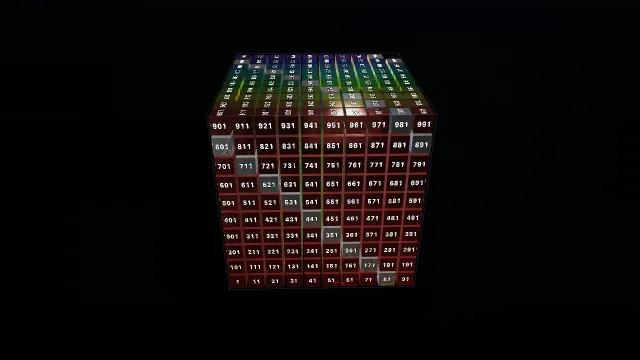
Here is another larger starting example: nine hundred. We have jumped forward to nine complete layers. Each is the same hundred-unit layer we just built. The stack is nearly a complete block, with space for one more layer above it.
Look at the stack from this angle. Its height counts the completed layers, while each layer still has ten rows of ten. Nine layers contribute nine hundreds. The last layer will bring the total to ten hundreds.
The last layer is beginning to fill. Follow its growing rows above the completed stack. At this scale it is useful to watch the boundary of the new material, rather than try to read every small label at once. Each row still takes ten unit arrivals. Row after row fills the available square. The earlier layers remain present beneath it, so you can see both the work already completed and the unfinished part. This final layer is made by exactly the same additions as the first layer. The larger block does not require a different kind of unit.
Only the final row remains. Watch the small opening shrink toward the corner. A nearly complete block can look complete at a glance; following these last arrivals keeps the distinction visible. We are still counting actual cubes, not merely the outside dimensions of an imagined finished box.
Add the last cube. The corner closes. We have completed ten rows in each of ten layers, with ten units in every row.
One thousand: ten times ten times ten. Each factor describes a direction through this block. A complete block contains ten layers, each containing one hundred units. The multiplication describes the grouping already in front of us; it does not change the cubes.
The same grouping rule at another size
Now add one more unit. It begins another block beside the completed thousand. The next cube cannot fit inside a block whose ten layers are already full. Watch where the new construction starts.
One thousand one is a complete thousand-unit block and one extra unit. The grouping rule continues beyond the first block. A completed group helps us describe the total; it never stops the count.
Return to our earlier example of one hundred twenty-five. In base ten, we read this arrangement as one layer, two rows, and five units. Keep the quantity in mind while we change the size of the groups.
Change the base to five and follow the same cubes as they regroup. A row now holds five units, a layer holds five rows, and a block holds five layers. The unit cubes move into new positions. No units are being added or removed.
The same one hundred twenty-five units now fill one block: five times five times five. Its base-five label is one, zero, zero, zero. That label counts one block, no extra layers, no extra rows, and no extra units. In base ten, a full block contained one thousand units; here it contains one hundred twenty-five. The rule stayed the same, but the group size changed. Later lessons will develop those different bases. For now, follow the common idea: full rows build layers, full layers build blocks, and every visible group is made from the original unit.