Mathematical reference
- Sum and product together
- For x²+7x+12, constants 3 and 4 satisfy 3+4=7 and 3×4=12
- Repeated factor
- x²+6x+9 = (x+3)²
- Zero corner
- x²+5x = x(x+5)
Lesson transcript
This is the text of the narrated lesson. References to turning, highlighting or changing an object describe the linked interactive lesson; its demonstrations are not embedded in this reading page.
One corner, several arrangements
Look at all these possible rectangles. Their corner products agree, but their x-bars do not. Only the correct strip total will fit our target, x squared plus seven x plus twelve. Factoring means finding side expressions whose multiplication produces every term of that target.
Twelve corner units can be arranged one by twelve, two by six, or three by four, with orientations and signed alternatives also shown. A twelve-unit corner alone does not decide the answer. Compare the strip totals beside the arrangements. The positive pairs give thirteen, eight, and seven x-bars.
Build the two by six candidate. Its corner is twelve, but its strips total eight x. The target asks for seven x. A match in the constant term is necessary, but it is not sufficient. Both the sum and product of the side constants must agree.
Change the corner to three by four. Its area is still twelve and its strips now total seven x. The whole quadratic matches. These factors are x plus three and x plus four. The construction checks the square coefficient, the strip coefficient, and the constant together.
Verify by multiplying
Assemble those side expressions as a multiplication rectangle. This reverses the factoring question. Factoring proposes sides; multiplication checks them. Reassembling and collecting must preserve the same pieces, so a successful factorization reproduces the entire original polynomial.
Collect: x squared, seven x, twelve. This verifies the factorization. Factoring does not change the polynomial into a different quantity; it gives the same quantity a different form, with the multiplicative structure exposed.
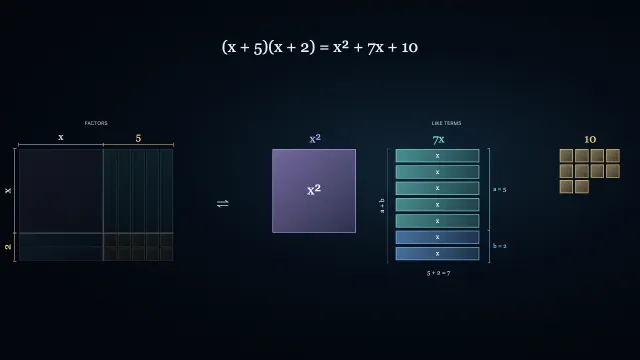
Try x squared plus seven x plus ten. Its constant is ten. Compare one by ten with two by five. The first pair gives eleven x-bars; the second gives seven. Predict which arrangement matches before checking the next construction.
Build two by five. The corner is ten and the strips total seven x, so the factors are x plus two and x plus five. Notice that two different quadratics can share the same middle coefficient: our earlier example had constant twelve, while this one has constant ten.
The sum and product work together
Keep the target x squared plus seven x plus ten. Its corner requires a product of ten. The positive integer options are one with ten and two with five. Their strip totals differ, so the gallery gives us more information than a list of divisors alone.
Build one with ten. The units match, but the strips total eleven x. That candidate produces x squared plus eleven x plus ten. Locating the mismatch is useful: it shows that the constant condition passed while the middle coefficient condition failed.
Change to two with five. Their sum is seven and their product is ten, so both conditions agree. The leading coefficient is one because each leading side is x. These three checks together establish that the proposed rectangle matches the complete target.
Open the corresponding multiplication. Reassembling and collecting gives the same polynomial. This reverse check is more reliable than remembering a factor pair without its context: the full product tells us whether every coefficient has been accounted for.
A repeated factor makes a square
Consider a custom target, x squared plus six x plus nine. The corner has nine units. One with nine gives a strip total of ten, while three with three gives six. The equal constants are the pair that matches the requested middle coefficient.
Build three with three. Both side expressions are x plus three, so the rectangle is a square. The factors repeat, and we can write their product as x plus three squared. Repeated factors are a structural feature of this particular polynomial.
Multiply the two equal sides. The strips still contribute separately: three x from one direction and three x from the other. Their total is six x, not three x. The nine-unit corner alone would not have identified the square without that strip check.
Compare the earlier target with constant twelve. Its matching constants are three and four, so the factors are different. The same method locates either equal or unequal sides. We do not need a separate search rule just because a repeated factor is possible.
Search without skipping a condition
Let the target be x squared plus eight x plus twelve. The leading square tells us to start with one x on each side. The twelve-unit corner restricts the positive integer constants to factor pairs of twelve. We can now examine those pairs systematically rather than guessing unrelated numbers.
Start with one and twelve. Their corner is correct, but the strips contribute thirteen x. That is five x-bars too many for this target. A candidate can pass one condition and fail another; identifying the failed coefficient tells us why it is not yet a factorization.
Next try two and six. Their product is twelve and their sum is eight. Both the corner and the strip total now agree. Together with the leading coefficient of one, these checks account for every term, so x plus two times x plus six is the requested factorization.
Three and four are also factors of twelve, but they give only seven x-bars. They match the corner of this target and miss its middle coefficient in the other direction. Stopping as soon as two constants multiply to twelve would therefore accept several answers that do not multiply back correctly.
Multiply the successful pair, two and six, and collect its pieces. We recover exactly x squared plus eight x plus twelve. This forward check closes the search: the proposed factors are useful because their complete product is the original expression, not simply because their constants looked plausible.
The same middle term is not enough
Change the target to x squared plus eight x plus fifteen. The middle coefficient is still eight, but the constant has changed. Reusing two and six would preserve the eight x-bars and leave only twelve units. We have to satisfy the new corner as well as the unchanged middle term.
Three and five have the same sum of eight, while their product is fifteen. Here both conditions fit. The new rectangle has different side constants from the previous target. The shared middle coefficient did not force the complete polynomials, or their factorizations, to be the same.
Inspect the product before collection. The three x strip and five x strip contribute the eight x-bars, while their meeting corner contains fifteen unit tiles. Reading those pieces separately shows why one pair of numbers controls two different coefficients through two different operations.
Collect once more to check the target. The corner uses multiplication of the constants; the strips use addition because the leading coefficient on each side is one. Keeping those two roles distinct is more reliable than remembering a pair of numbers without the rectangle that explains it.
Complete another search
Try x squared plus nine x plus twenty. Begin with the positive factor pairs of twenty. One and twenty would give twenty-one x-bars, far above nine. The corner alone cannot decide the answer; it merely gives a short set of candidates whose strips we still need to inspect.
Two and ten reduce the strip total to twelve, but twelve still does not match nine. This is progress through a finite list of candidates, not a rule that the next pair must always work. Each proposed rectangle must be checked against the actual requested coefficients.
Four and five give nine x-bars and twenty units. The leading square is still one x squared. All three conditions agree, so the target factors as x plus four times x plus five. Exchanging those complete factors describes the same answer in the opposite order.
Collect the successful rectangle and then compare its parts with the target one final time. We have searched positive integer constants in these examples. Later lessons examine signed coefficients and cases without an integer factorization. The habit that carries forward is unchanged: test the entire product.
Factor out a common x
Now the target is x squared plus five x, with constant zero. A factor of x is visible in both terms. The side expressions x and x plus five produce the required square and five x-bars without any constant corner.
See the same factors in multiplication. The zero constant leaves an absent corner, but the strip remains. Factoring out x means identifying a factor shared by each term; it does not mean deleting x from the value of the expression.
Collect to check. One x squared region and five x-bars give the original target exactly. The zero-constant case has its own useful shortcut, but multiplying back is still the final check. A proposed factorization must preserve every term, including absent ones.
Return to the target with seven x-bars and twelve units. The gallery is again organized by possible constant corners. Use the same habit across both cases: identify what each coefficient asks for, propose the sides, and multiply them to see whether all three conditions agree.