Mathematical reference
- Weighted cross-products
- (2x+3)(x+2) = 2x²+4x+3x+6 = 2x²+7x+6
- Both leading parts larger
- (2x+1)(3x+2) = 6x²+7x+2
- Recover a different factorization
- 3x²+11x+6 = (3x+2)(x+3)
Lesson transcript
This is the text of the narrated lesson. References to turning, highlighting or changing an object describe the linked interactive lesson; its demonstrations are not embedded in this reading page.
More than one x on a side
Choose the general factor form. Our sides are now two x plus three and x plus two. The first long part contains two x, so its product with x is two x squared. The other regions are four x, three x, and six. The same four-region reasoning still applies.
Collect the equal terms. Two x squared stays in the square family; four x and three x combine into seven x; six remains the unit area. The result is two x squared plus seven x plus six. Reading the region dimensions is more reliable than memorizing an order of letter pairs.
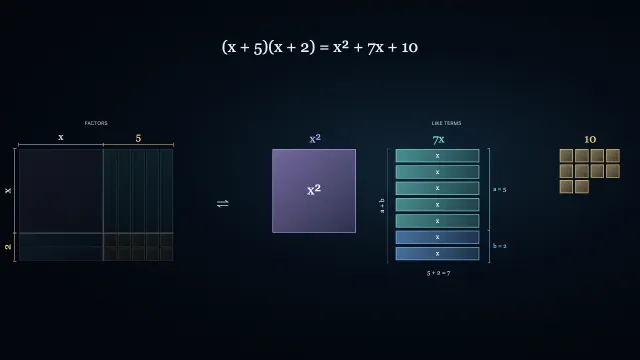
Return to the opening rectangle, x plus three by x plus four. You can now explain all three coefficients: one comes from x times x, seven from the two strips, and twelve from the corner. Use Interact, hide the answer, and change a slider. Predict every region before choosing Collect like terms.
A corner can fit while its strips do not
Now the target begins with two x squared: two x squared plus seven x plus six. We need leading side parts whose product is two x squared. Choose two x and x. The constant corner must have area six, but the strips now depend on which constant meets which leading part.
With two on the first side and three on the second, the strips give two x and six x: eight x in total. The corner is correct but the middle term is wrong. Equal corner area does not make the orientation irrelevant when the leading side parts differ.
Exchange the constants: three on the first side and two on the second. The strips are now three x and four x, totaling seven x. The factors are two x plus three and x plus two. Multiply to check all three coefficients.
A different leading coefficient
Try three x plus two times x plus three. The large region now contains three x squared pieces. The two cross products are nine x and two x, and the constant corner contains six units. Predict the collected polynomial from those four contributions.
Collect to get three x squared plus eleven x plus six. The middle coefficient is eleven because the constant three meets three x, while the constant two meets only one x. Adding the constants two and three would miss the unequal leading multipliers.
Exchange only the constants. The factors become three x plus three and x plus two. Their leading product and corner product stay the same, but the strips are now six x and three x. The middle coefficient becomes nine. This partial exchange changes the product.
Return the constants to their original sides. We recover the eleven x-bars. Swapping complete factors preserves a product; swapping just their constant parts need not. Distinguish those two operations by following which parts actually meet in the rectangle.
Both leading parts can be larger
Set the sides to two x plus one and three x plus two. The leading region contains six x squared pieces because two times three is six. The strips contribute four x and three x, and the corner contributes two units.
Collect the product: six x squared plus seven x plus two. Read the three coefficients in order. Six comes from multiplying the leading parts; seven comes from adding the cross products; two comes from multiplying the constants. Each coefficient has a distinct geometric source.
Swap the complete factors. The sides are now three x plus two and two x plus one. Their roles reverse, but the collected polynomial remains six x squared plus seven x plus two. Every pairwise product is still present, even though its orientation has changed.
Reassemble these factors and inspect the two unequal strips. They need not have equal counts to belong to the same group. Four x and three x are like terms because their positional algebraic unit is x. The coefficient records how many copies of that unit occur.
The leading region has its own factor pairs
Consider two x plus three times two x plus one. Each side begins with two copies of x, so their leading region contains four x squared tiles. The constant corner contains three units. Between them, one strip has two x-bars and the other has six.
Collect to obtain four x squared plus eight x plus three. There are now three independent targets for a reverse search: four leading tiles, eight x-bars and three units. Choosing constants that add to eight would ignore the fact that each constant is multiplied by a leading coefficient.
Keep the constants three and one, but change the leading split to four x and x. The leading product remains four x squared, and the corner remains three. The cross strips become four x and three x, so their total falls to seven. Matching the outside coefficients has not fixed the middle.
Exchange the constants within that four-and-one leading split. The factors are four x plus one and x plus three. Now the strips contribute twelve x and one x, totaling thirteen. This is another rectangle with the same leading and constant products, and a different middle coefficient.
Return to two x plus three and two x plus one. The eight x-bars return with that complete choice of four side coefficients. General quadratic factoring must consider how the leading parts and constant parts meet, not just choose their products independently and hope the middle follows.
Read the two weighted strips
Use three x plus one times two x plus four. The leading parts produce six x squared tiles. Now follow the constant four across the three copies of x: it contributes twelve x. The constant one meets two copies of x, contributing another two x.
The collected middle coefficient is fourteen, while the constants alone add to only five. That difference is not an exception to distribution. It is exactly what distribution requires: multiply each constant by the leading part on the opposite side before adding the two cross products.
Change only the second constant from four to five. The first side remains three x plus one. The extra unit of side length adds three x-bars and one unit tile. Consequently the middle coefficient rises from fourteen to seventeen and the corner rises from four to five.
The six leading tiles did not change because neither leading coefficient changed. Different regions respond to different side parameters. This is useful when checking an answer: if a constant changes, a changed leading coefficient would signal that something other than the intended side part had also been altered.
A complete exchange still preserves the product
Revisit three x plus one times two x plus four. The four contributions are six x squared, twelve x, two x and four. Each is a pairing between one part of the first side and one part of the second. Keeping those pairings visible makes an exchange easy to check.
Exchange the complete factors to two x plus four and three x plus one. The twelve x and two x strips trade orientation. The leading rectangle and corner also exchange their side descriptions, but each amount remains the same. A complete exchange differs from moving only the constants.
Collect to see six x squared plus fourteen x plus four again. In general, the leading coefficient is the product of the leading side coefficients. The middle coefficient adds the two cross products, and the constant multiplies the two constants. Every term has a specific source in the rectangle.
Reassemble before returning to the reverse problem. We have compared changed constants, changed leading splits and exchanged complete factors. Those operations need not have the same effect. In each case the rectangle tells us what changed by showing which side parts now meet and which contributions they produce.
Recover all four side coefficients
Use the target three x squared plus eleven x plus six. Choose a leading split of three x and x. The constant corner must still multiply to six, but its allocation matters because the leading parts are unequal. We can test a candidate without guessing the whole answer at once.
The constants three and two give only nine x-bars in this allocation. The leading coefficient and constant are correct, but the middle coefficient is not. Keep those successful conditions fixed while looking for the changed cross products that would give eleven.
Exchange the constants to two and three. Now the cross products are two x and nine x, totaling eleven x. All three coefficients match the target, so the factors are three x plus two and x plus three.
Multiply those factors once more. The general rule is the same as the simple rectangle: multiply every part of one side by every part of the other and collect equal kinds of term. Unequal leading coefficients require closer attention to those products, not a different meaning of multiplication.