Mathematical reference
- Four contributions
- (x+3)(x+4) = x²+3x+4x+12 = x²+7x+12
- No constant corner
- (x+3)x = x²+3x
- Same corner, different strips
- (x+1)(x+12) = x²+13x+12, not x²+7x+12
Lesson transcript
This is the text of the narrated lesson. References to turning, highlighting or changing an object describe the linked interactive lesson; its demonstrations are not embedded in this reading page.
Four regions become one polynomial
Watch this rectangle separate into its four regions and collect equal pieces. Its sides are x plus three and x plus four. One blue square, seven x-bars, and twelve units emerge. The product is x squared plus seven x plus twelve. Let us see why the rectangle forces those quantities.
Reassemble the same pieces. Along one side you have x and three; along the other, x and four. A rectangle has area equal to its two side measures multiplied. Cutting each side into two parts divides that area into four regions without adding or losing anything.
The x by x region contributes x squared. The x by four strip contributes four x. The three by x strip contributes three x. The remaining corner is three by four, so it contributes twelve units. Every part of one side has met every part of the other.
Collect the two kinds of x-bars. Four x plus three x is seven x because each bar represents the same unit, x. The x squared tile cannot join them as another x-bar: its dimensions and algebraic meaning are different. The twelve unit squares form their own group.
Change a side and predict
Change the second constant from four to two. Now the sides are x plus three and x plus two. Predict the new x coefficient before collecting. Which strips change? The two strips have areas three x and two x, while their common corner has area six.
Collect them to check. The result is x squared plus five x plus six. Both the sum and the product of the two constants matter: their sum counts the x-bars, and their product counts the corner units. Interchanging the two sides preserves this product.
Swap the constants. Two is now on the first side and three on the second. The strips trade roles, but the total remains x squared plus five x plus six. This is multiplication being commutative: changing the order of the factors does not change their product.
Set both constants to three. The rectangle is now a square with side x plus three. Before collecting, look for the two equal strips. Each is three x, so together they contribute six x. The corner contributes nine. Squaring a sum does not mean squaring only its two separate parts.
Collect to reveal x squared plus six x plus nine. Leaving out the six x would omit both strips from the square. This is why the square of x plus three differs from x squared plus nine. The regions expose exactly what that tempting shortcut misses.
Only one side changes
Return to x plus three times x plus four. Keep the first side fixed while we compare the second side. The product has one x squared tile, seven x-bars and twelve unit tiles. These three groups record different kinds of contribution, so we count each group separately.
Now raise the second constant to five. The first side remains x plus three. The added strip has width one along the changed side and extends across x plus three on the other side. Its contribution is one x-bar and three unit tiles.
Collect the new product. The x coefficient rises from seven to eight, and the constant rises from twelve to fifteen. The x squared coefficient remains one. Adding one to a side did not add one to the product; it added the entire unchanged side.
Return the second constant to four. One x-bar and three unit contributions disappear from the comparison. Distributing multiplication describes this change exactly: the difference between the two products is x plus three. Follow that relationship through the regions instead of treating each expansion as an unrelated exercise.
A missing corner is meaningful
Set the second constant to zero. The factors are x plus three and x. The rectangle still has an x squared region and a strip of three x, but no constant corner. Zero in the second constant removes the products that would have used that constant.
Collect the remaining pieces. The product is x squared plus three x. No unit tiles remain because three times zero is zero. An absent constant term is not a forgotten part of the expansion; it is the exact result of a zero-sized contribution.
Now set the first constant to zero as well. Both factors are x. Only the x by x region remains, giving x squared. This limiting case connects ordinary area multiplication with the algebraic product: no additional strips or corner are required.
Bring back a constant of two on the second side. The factors are x and x plus two. The new strip contributes two x, while the corner remains absent. The same distributive rule handles a full four-region rectangle and these simpler cases without exceptions.
The same corner can belong to different rectangles
Look at x plus one times x plus twelve. The long strip contributes twelve x and the short strip contributes one x. The corner still contains twelve units. Follow those regions as separate contributions before asking for a single collected expression.
Collect the strips. There are thirteen x-bars, together with one x squared tile and twelve units. The number twelve describes the corner only. It does not say how the two side constants divide that corner into rows and columns, or how many strips meet it.
Change the constants to two and six. The corner again contains twelve units, now arranged with a different pair of side measures. The cross strips contain two x and six x. A different rectangle can therefore have the same constant corner without representing the same complete product.
Bring those strips together. Their total is eight x, compared with thirteen x in the previous example. Neither collection loses or creates tiles. The different middle coefficients come from the different side expressions we chose before collection, not from the rearrangement itself.
Three and four give a third twelve-unit corner. This time the strips total seven x. The three examples share a constant product, yet their middle coefficients are thirteen, eight and seven. Keep that distinction in mind when the next lesson reverses the question and asks which sides produced a given polynomial.
Exchange complete sides
Begin with x plus two times x plus five. One direction supplies the two x strip and the other supplies the five x strip. In this uncollected view you can trace each strip back to the side constant that created it, while the corner records two times five.
Now exchange the complete factors. The sides are x plus five and x plus two. The five x and two x strips exchange their roles. The ten units can be read as five rows of two instead of two rows of five; the amount of each kind of tile is unchanged.
Collect after that exchange. You still get x squared plus seven x plus ten. Multiplication is commutative: exchanging the complete factors changes how we describe the rectangle, but not its product. The two separate cross products remain present even when their order in the calculation changes.
Reassemble those same pieces. This return is useful because the collected polynomial no longer displays the two side constants as separate labels on a product. The rectangular arrangement recovers that information. A sum of terms and a product of factors are two descriptions of the same quantity.
Why unlike regions stay separate
Compare a square example: x plus two times x plus two. The matching strips lie in different directions, but both represent copies of x. There are two x-bars in each strip. Equal side constants do not allow either strip to be omitted; each comes from a different pair of side parts.
Collect the two strips into four x. The four unit tiles remain a separate group. Four x and four have equal numerical coefficients but different algebraic units. Combining them as eight x would replace unit tiles with x-bars, which is not the rearrangement happening here.
A larger square, x plus four times x plus four, makes the distinction especially clear. Its two strips total eight x, while its corner contains sixteen units. Doubling each constant doubles the combined strip count but quadruples the corner count, because both corner dimensions have doubled.
Return to the rectangular arrangement before the final comparison. The x squared part, the two cross strips and the constant corner have remained identifiable throughout. Reading multiplication region by region prevents a familiar-looking coefficient from standing in for the entire product.
Read another rectangle independently
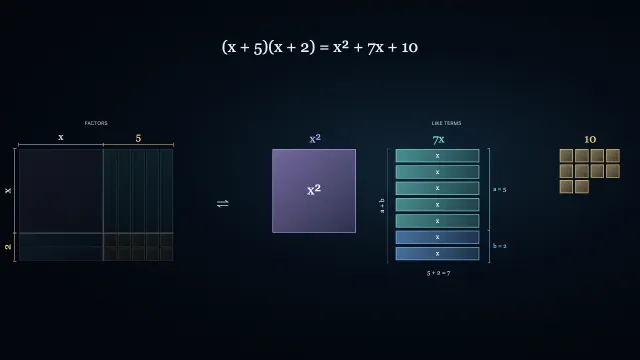
Try x plus two times x plus five. Before collecting, identify the x squared region, the two x strip, the five x strip and the ten-unit corner. Two separate questions matter: how many x-bars appear, and how many unit tiles appear?
Collect the pieces. The strips give seven x, and the corner gives ten. The answer is x squared plus seven x plus ten. This shares its x coefficient with x plus three times x plus four, but the constant term differs.
Compare that earlier product again. Three and four also add to seven, but their product is twelve. Equal sums of the side constants can therefore produce equal x-bar totals without producing equal unit corners. Matching just the middle term does not determine an entire quadratic.
Reassemble the rectangle. In the next lesson, the polynomial will be given first and the side expressions will be the unknowns. The regions tell us what must be matched: the square coefficient, the combined strips, and the constant corner. Multiplication supplies the check on any proposed factors.