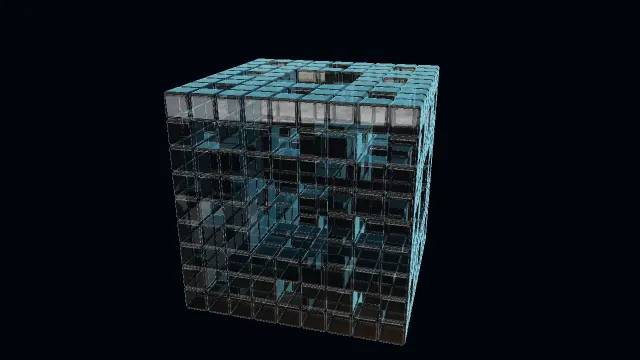
Mathematical reference
- Middle-third construction
- At stage n: 2ⁿ intervals of length 3⁻ⁿ; total length (2/3)ⁿ
- Dimension
- 3ᴰ=2 gives D=log 2/log 3 ≈ 0.631
- Unequal contractions
- For the separated left-third/right-quarter rule, (1/3)ᴰ+(1/4)ᴰ=1
Lesson transcript
This is the text of the narrated lesson. References to turning, highlighting or changing an object describe the linked interactive lesson; its demonstrations are not embedded in this reading page.
A line with gaps at every scale
An interval seems like the simplest possible shape. Yet repeating one deletion produces gaps inside gaps at every scale. Watch the surviving pieces separate. We will use this construction to distinguish length, number of points, and dimension. These are three different questions. A set can have zero total length without being empty, and a fractional dimension describes how its structure scales rather than how many points a finite picture contains.
Begin with one interval. Divide it into thirds and remove the open middle third, keeping the endpoints. Two closed intervals remain, each one third as long. The guide line runs through the construction to show its original direction; it is a visual reference, not an extra interval retained by the rule. The surviving pieces are the thicker mathematical objects you should count.
Repeat inside both survivors. We obtain four intervals, each one ninth as long as the original. At the next step there are eight, each one twenty-seventh as long. Multiplying the count by two and dividing each length by three are separate operations. Predict both numbers for the fourth step. You should get sixteen intervals, each one eighty-first of the original length.
Less length at every step
Two intervals of length one third have combined length two thirds, if the original length is one. At the second step the total is four ninths. Each new stage multiplies the previous total by two thirds. This differs from counting the intervals: the count grows, but the combined length shrinks. More pieces do not necessarily mean a greater total amount.
After n steps, the total length is two thirds raised to n. Repeatedly multiplying by a positive number smaller than one drives the result toward zero. It never becomes zero at a finite step. This distinction matters: the limit of the lengths is zero, while every finite stage still has some length. Observe the growing gaps without mistaking a screen-resolution cutoff for the mathematical limit.
The limiting Cantor set consists of points that survive every step. The original endpoints survive, and so do the endpoints created by each deletion. So zero total length cannot mean that no points remain. There are also surviving points that are not endpoints. We will describe them by their successive choices of left and right, rather than trying to list dots that a screen cannot resolve.
Finding a point by its address
At the first step, choose the left surviving interval or the right one. Inside that interval make another left-or-right choice, then repeat. A finite sequence identifies a small surviving interval. An infinite sequence identifies a single limiting point because the containing intervals shrink to zero length. This is a recursive address: each symbol tells us which child to enter.
The colors help reveal repeated address structure, but there are only a few palette colors. A color is not a unique name for every interval. Two pieces may share a color without sharing their full address. Notice the distinction between an aid for following recursion and a complete encoding. You can always identify a finite interval by the entire sequence of left and right choices leading to it.
As a conceptual consequence, infinitely many binary choices give uncountably many possible addresses. The finite image cannot demonstrate that cardinality by displaying all the points. It demonstrates the repeated two-choice rule from which the mathematical argument follows. Zero length and uncountably many points are compatible: length measures coverage along the line, while cardinality asks a different question about the size of a collection.
An address written with ternary digits
The left-third and right-third choices can also be expressed in base three. On the unit interval, a first ternary digit zero selects the left third and a first digit two selects the right third. A digit one selects the open middle part that is deleted. Repeating the choice at every position gives a description of Cantor points using ternary expansions with only zeros and twos. The recursive intervals on screen are finite prefixes of those addresses.
Endpoints require care because some numbers have two positional expansions. One third can be written as zero point one in ternary, but it also equals zero point zero followed by twos forever. The latter expansion uses only the allowed digits, so the endpoint survives. This is the same kind of phenomenon as a decimal ending in recurring nines. A rule based on whether any chosen expansion contains a one would therefore be too careless.
For an interior example, alternately choose left and right forever. Its ternary digits alternate zero and two. That infinite sequence determines a point even though no finite stage isolates it as a visible dot. The geometry and the digit description encode the same nested choices. This is an explanation of the infinite construction, not a claim that the finite display contains an individually labelled point for every possible address.
Between a point and a line
For the dimension, two copies at scale one third give three to the power D equals two. Three to the power zero is one and three to the power one is three. The required exponent lies between zero and one. Its exact value is log two divided by log three, approximately zero point six three one. This agrees with neither the number of intervals nor their total length.
Why does the exponent stay fixed when the iteration changes? At stage two, four copies have scale one ninth. The equation is nine to the power D equals four. Squaring both sides of the first equation gives exactly this second equation. Every additional stage repeats the same relationship. We are finding the exponent of a rule, not assigning a new dimension to each finite row.
Compare the rule with an ordinary line segment, which needs three one-third copies to reproduce itself. The Cantor set needs only two. Its count grows more slowly as resolution increases, so its dimension is below one. It still needs more than the one copy that contracts to a point, so its dimension is above zero. These comparisons explain the interval containing the answer before evaluating any logarithms.
Change the scale, then the count
Cantor quarters still keeps two pieces, but each is one quarter as long. Four to the power D equals two, giving D equal to one half. The copy count did not change, yet the dimension did. This is a useful counterexample to the idea that counting survivors alone determines dimension. We must always state the contraction scale as well.
Cantor fifths keeps three of five pieces. The exponent is log three divided by log five, approximately zero point six eight three. Compare it with the thirds construction. Both the count and the scale changed, so a glance at the larger gap is not a reliable way to rank their dimensions. Write the two scaling equations, then compare their solutions.
Try this prediction before returning to thirds: which has greater dimension, two quarter-scale copies or two third-scale copies? With the same count, the stronger contraction requires the smaller exponent to balance the equation. The quarter construction has dimension one half, less than the approximately zero point six three one of thirds. A precise comparison is better than saying one picture simply looks denser.
When the copies have different lengths
The unequal Cantor rule keeps a left third and a right quarter. Now there is no single common scale to put beneath a logarithm of two. The two contributions must be added: one third to the power D, plus one quarter to the power D, equals one. The unequal lengths are visible at the first stage and repeat inside each later piece.
We can locate the answer without guessing an average length. At exponent zero, both terms are one, so the sum is two. At exponent one, the sum is seven twelfths, less than one. Each term decreases continuously as the exponent increases. Therefore there is exactly one solution between zero and one. The World computes that solution numerically; averaging the two familiar dimensions would not solve this equation.
Finish by choosing one of the four interval rules and explaining three things separately: how many pieces survive, how their lengths scale, and how the dimension follows. Then distinguish total length from number of surviving points. Use Pause and Interact to inspect a stage or change rules. Increasing the iteration should make your explanation more visible without changing the rule you are describing.