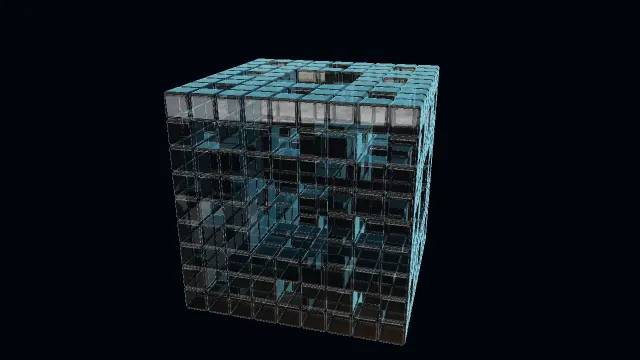
Mathematical reference
- Carpet exponent
- 3ᴰ=8, so D=log 8/log 3 ≈ 1.893 for the limiting carpet
- Width versus area
- A square scaled to 1/3 width has 1/9 of the original area
- Finite versus limiting set
- A finite union of positive-area filled tiles is two-dimensional; the fractional exponent describes the infinite rule
Lesson transcript
This is the text of the narrated lesson. References to turning, highlighting or changing an object describe the linked interactive lesson; its demonstrations are not embedded in this reading page.
A square with dimension below two
Watch the eight surviving squares separate. The central gap repeats inside every surviving square. There are holes within holes, but a single number describes how the number of pieces grows as their size shrinks. That number is the scaling dimension. Let us discover why it need not be a whole number.
The rule keeps eight of nine squares. Each surviving square is one third as wide as its parent, not one eighth. Count and width are different ingredients. Separation makes the retained pieces easier to see; it does not change the rule whose dimension we are calculating.
Repeat the rule. Eight times eight gives sixty-four smaller squares. Each is one ninth of the original width. Eight and one third have both been applied twice. Increasing the iteration reveals more of the same rule; it does not give that rule a new dimension.
Before calculating anything, make a prediction. A filled square has dimension two. These holes remove area at every scale. Would you expect this rule to have dimension below two? Keep that prediction in mind as we first work out what the ordinary integer dimensions mean.
What the exponent counts
Here every one of the nine squares survives. The picture fills the square again. Three copies fit across and three fit up: three squared equals nine. The exponent two records how the count responds to a change in linear scale.
Now keep three squares in one row and repeat that rule. The limiting set is a line segment. Three third-size copies reconstruct its length, so three to the power one equals three. At a finite iteration the squares still have a little height; that height tends to zero under continued repetition.
Keep just one square. Each iteration replaces it by a smaller copy at the same relative position. The limiting set is a point. Its dimension is zero, and three to the power zero equals one. That equation counts the one surviving copy; it does not say the visible finite square already has zero area.
Returning to the full square makes the pattern clear. One, three and nine copies correspond to exponents zero, one and two when the scale is one third. The exponent is what we seek. A logarithm will let us solve for it when the copy count falls between those familiar powers.
Width is not area
There is an easy mistake hidden in the phrase one-third size. Look at one of these nine squares. Its width is one third and its height is one third of the parent. Its area is therefore one ninth, not one third. Nine such areas fill the parent area. The linear scale is the number that belongs in the dimension equation; the exponent accounts for how many directions contribute to area.
With only eight squares retained, the total area after one step is eight ninths of the original. Repeating the rule multiplies by eight ninths again. At step two the fraction is sixty-four eighty-firsts. The remaining-area readout follows the finite construction. Separation and rounded display corners help us see pieces, but those display treatments are not part of the ideal area calculation.
Compare a two-by-two rule retaining every square. The width scale is now one half and the count is four. Two squared equals four, just as three squared equals nine. We changed the subdivision but recovered dimension two, because both constructions fill a square. Dimension is not a property of the number three. It is the scaling relationship between linear size and the required count.
Why divide the logarithms?
In the carpet equation, three to the power D equals eight. A logarithm reverses exponentiation: log base three of eight means the exponent that turns three into eight. This is a question with a definite answer even though that exponent is not a whole number. The rule card writes the answer using familiar logarithms so a calculator does not need a separate base-three button.
Taking the logarithm of both sides brings the exponent down as a multiplier. D times log three equals log eight. Dividing by log three isolates D. You may use natural logarithms or base-ten logarithms, provided you use the same base in both places. The ratio is unchanged. What would go wrong if you divided eight by three instead? That compares two numbers directly; it does not solve an exponential equation.
The decimal one point eight nine three is a convenient label, not a different definition. Rounding it slightly changes the result of exponentiation. The exact expression log eight divided by log three avoids that rounding. When the display writes an ellipsis after a longer decimal, it indicates that the digits continue. Use the copy-and-scale explanation to justify the equation first; the logarithm is the final algebraic step.
The picture and the limiting set
At any fixed iteration, this carpet is made of filled squares with positive area. Taken literally as a finite set of tiles, it has dimension two. The fractional number at the top describes the infinite rule: repeat the same deletion indefinitely. Those are different objects. The computer shows a finite approximation so that we can examine the rule without pretending to draw infinitely small holes.
Increasing the iteration shows more gaps but leaves the dimension label unchanged. Zooming changes which details are visible, and Deep zoom can resolve additional levels. Neither action changes the selected limiting rule. A closer camera is not a new mathematical exponent. Ask two separate questions: what finite detail is currently rendered, and what infinite set does this repeating construction define?
To check your explanation, return to the four-corner rule. State its count, its linear scale, and its dimension equation before reading the answer. Then explain why moving the four cells preserves the exponent but can change the arrangement. Finally explain why the finite picture still contains filled squares. If you can separate these three claims, you have a much stronger account of fractional dimension than memorizing a decimal.
Solving three to the power D equals eight
Return to eight surviving squares. We ask for the exponent D that makes three to the power D equal eight. Because three to the first power is three and three squared is nine, this exponent must lie strictly between one and two. That comparison is useful before touching a calculator.
The answer is log eight divided by log three, approximately one point eight nine three. The expanded equation shows three raised to that decimal exponent, continuing beyond the displayed digits, equals eight. A rounded decimal gives an approximation; the logarithmic expression gives the exact value.
At the next iteration, the same exponent makes nine to the power D equal sixty-four. Both scale and count have been squared. The exponent stays the same. This is why we calculate the dimension from the repeating rule rather than from how crowded one screenshot happens to look.
For these separated, equal-scale copies, the scaling calculation also gives the Hausdorff dimension of the limiting set. That agreement needs the separation of the copies. Counting arbitrary overlapping copies is not enough. Here the grid rule supplies the separation, and the repeated gaps remain visible.
Equal dimension does not mean equal shape
Keep the four corner squares instead. Four is greater than three and less than nine, so the dimension again lies between one and two. It is log four divided by log three, approximately one point two six two. Notice how much more disconnected this pattern appears than the carpet.
Here is a different selection of four cells. The locations have changed, and so have the visible arrangement and connections. The count is still four and the linear scale is still one third. Therefore the dimension has not changed. Dimension measures scaling, not every property of a shape.
Try a prediction with five cells. Its exponent should be larger than the four-cell exponent but smaller than two. The displayed calculation confirms log five divided by log three, approximately one point four six five. Explain the direction of the change before relying on its decimal value.
You can now explain the opening carpet. Eight copies, each one third the width, determine an exponent below two. Iteration exposes the repetition; it does not alter the limiting dimension. Pause and choose another nonempty selection in the rule card. Predict an interval for its exponent, then use the equation to check your prediction.