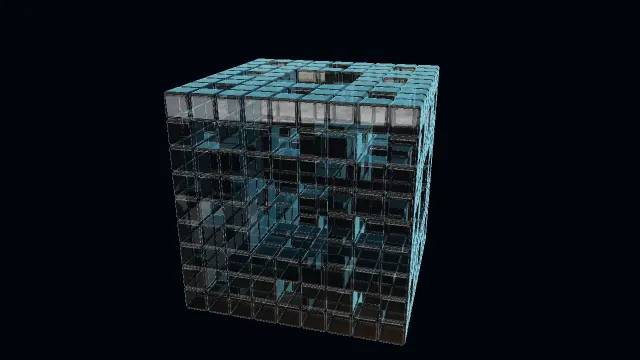
Mathematical reference
- Sierpiński triangle
- Three half-scale copies: D=log 3/log 2 ≈ 1.585
- Sierpiński carpet
- Eight third-scale copies: D=log 8/log 3 ≈ 1.893
- Pentaflake
- Six copies with r=(3−√5)/2 give D=log 6/log(1/r)
Lesson transcript
This is the text of the narrated lesson. References to turning, highlighting or changing an object describe the linked interactive lesson; its demonstrations are not embedded in this reading page.
Two ways to leave holes
These three half-size triangles repeat their arrangement inside themselves. A different rule, the carpet, repeats eight third-size squares. Both produce holes at every scale, yet the scaling dimensions differ. We will compare the rules through their visible pieces, then ask what their dimensions do and do not tell us. The outline of the parent is only the starting shape; the retained pattern is the mathematical subject.
At the first triangle stage, retain one half-size triangle at each corner. The central inverted triangle is missing. Three copies survive, each with half the parent edge length. Each small triangle has one quarter of the parent area, so the total retained area is three quarters. The count three and the area fraction three quarters are different quantities, and they answer different questions.
At the first carpet stage, retain eight squares around the missing center. Their width is one third and their individual area is one ninth of the parent. Together they retain eight ninths of its area. The carpet loses a smaller proportion of area per step than the triangle. That comparison suggests a difference in how densely their rules occupy the plane, but we still need the scaling equation for a precise dimension.
Why the triangle is not dimension one
The triangle rule gives two to the power D equals three. A line at half scale requires two copies; a filled square requires four. Our count of three lies between them, so the exponent lies between one and two. Solving gives log three divided by log two, approximately one point five eight five. The fact that its parent has three sides is not the reason for that answer.
Repeating the rule gives nine quarter-size triangles at the second stage. At the third stage there are twenty-seven eighth-size triangles. Three choices are made independently at each depth. These are counts of retained copies, not counts of every triangle you might discover by combining outlines in the picture. Use the recursive construction, rather than a visual puzzle count, when forming the dimension equation.
An increasing iteration does not thicken the set into a filled triangle. It removes the middle from each survivor. At every finite stage there are filled triangular pieces; in the limit their total area tends to zero because the multiplier is three quarters each time. Dimension between one and two is compatible with zero planar area. The exponent measures scaling, not a percentage of the parent that remains.
Why eight matters together with thirds
The carpet equation is three to the power D equals eight. Its solution, about one point eight nine three, is closer to two than the triangle exponent. We must compare both count and scale: eight is not intrinsically more two-dimensional than three. The denominator log three accounts for the stronger contraction in the carpet. Comparing the two logarithmic ratios gives the meaningful result.
At iteration two, sixty-four squares have width one ninth. Iteration three has five hundred twelve squares of width one twenty-seventh. Their area is eight ninths cubed of the original. The remaining-area readout and the dimension label tell different stories: one changes with the finite stage, while the other describes the unchanged limiting rule. Watch which display responds when the iteration changes.
A useful check is to imagine restoring the missing central square at every scale. Then nine third-scale squares would fill the parent, and the exponent would be exactly two. The workshop shows that full nine-cell rule directly. The carpet lies just below that count, but the difference repeats indefinitely. One missing first-level cell is therefore the instruction for gaps at every later level, not a single isolated hole.
Self-similarity is a precise correspondence
Self-similarity means more than noticing that two parts look vaguely alike. In the triangle rule, each corner region is a copy of the complete limiting pattern at half scale. The correspondence preserves angles and scales all lengths by the same factor. At a finite stage, the child has one fewer displayed level than the parent, so their rendered detail is not literally identical. The equality belongs to the infinite rule.
An address specifies a child at each depth. In the carpet there are eight choices at every step, yielding eight squared addresses of length two and eight cubed addresses of length three. Every address of a fixed length has the same contraction scale. Address coloring is a repeated palette that helps reveal this hierarchy, not an assertion that all pieces of the same color occupy the same location or have the same full address.
If you select a new rule with the same dimension, there need not be a similarity taking the whole first pattern onto the second. Equal dimension is much weaker than geometric equivalence. Compare the four-corner dust with the Koch boundary: their common equation is three to the power D equals four, but one is a dust of separated pieces and the other is a connected boundary curve. The shared exponent does not supply a correspondence between their points.
Arrangement is more than dimension
Now compare four corner squares with the five-square cross. The corner rule has four third-scale copies and dimension approximately one point two six two. Its pieces are separated. The cross retains the center and the four edge-center squares, giving five copies and dimension approximately one point four six five. Both use thirds, so increasing the count increases the exponent in this comparison.
The cross creates a different pattern of contacts and passages. Its dimension does not encode those contacts by itself. A different five-cell selection can have the same count and scale while arranging its gaps differently. This is why the lesson compares geometry as well as numerical labels. The equation condenses one scaling property; it does not reconstruct the entire set from that number.
Here a five-cell square rule uses the four corners and center instead. Its exponent matches the cross exactly, because both keep five one-third copies. Look for a visible distinction that the equal exponents do not record. You might describe which regions touch, where the large gaps lie, or how symmetry appears. Your explanation should name a geometric feature rather than claiming equal dimension means equal shape.
A non-integer contraction ratio
The pentaflake extends the same idea beyond square grids. Five corner pentagons surround an inverted central pentagon. Six copies survive, each scaled by three minus the square root of five, divided by two. That factor is approximately zero point three eight two. The rule still uses equal-scale similarities even though its contraction is not the reciprocal of a whole number.
The dimension equation says six times the contraction factor raised to D equals one. Equivalently, D is log six divided by log of the reciprocal contraction. The reciprocal is approximately two point six one eight. Keeping track of which quantity is the scale and which is its reciprocal prevents a negative dimension caused by putting the wrong sign into the logarithmic formula.
Observe the inverted central pentagon and then its own smaller copies. The orientation of a copy can change while its scale remains the same. Rotation and reflection of a similarity do not change that scale factor. Counting the six pieces and identifying their common contraction is the essential dimension calculation; their placement and orientation supply the specific geometry of the pentaflake.
Read a fractal without guessing
Use the triangle as a final reading exercise. Identify one parent, its three children, and the repeated missing middle. Then explain why nine children at the next depth do not mean the dimension is nine. State the reciprocal scale at that depth and form the corresponding exponent equation. The answer should agree with the first-stage calculation because both describe the same rule.
For the carpet, separate three claims: the infinite limiting dimension, the remaining area of the finite stage, and the amount of detail the screen currently resolves. A larger view can reveal a small hole without changing either the chosen rule or its exponent. Additional iterations change the finite approximation. Appearance controls can help you see structure but are not themselves operations in the fractal definition.
Return to a whole view and choose a different planar rule. Predict its dimension interval using familiar powers before looking at the decimal. Then compare it with a rule of similar dimension and identify a geometric difference. You have a reusable method: count copies, identify their linear contraction, check separation, solve the scaling equation, and distinguish that result from the finite picture used to study it.