Mathematical reference
- Close fractions
- 2/3−5/8 = 16/24−15/24 = 1/24
- Use a smaller common denominator
- 5/12−3/8 = 10/24−9/24 = 1/24
- Compare missing pieces
- 8/9 > 7/8 because 1/9 < 1/8
Lesson transcript
This is the text of the narrated lesson. References to turning, highlighting or changing an object describe the linked interactive lesson; its demonstrations are not embedded in this reading page.
Two quantities that are close
Compare five eighths with two thirds. The bars share the same unit reference, so their selected endpoints can be compared directly. Two thirds extends a little farther. The difference is small enough that a common subdivision will help us describe it exactly, rather than relying only on an impression.
Align both quantities using twenty-fourths. Each eighth contains three twenty-fourths, so five eighths becomes fifteen twenty-fourths. Each third contains eight twenty-fourths, so two thirds becomes sixteen twenty-fourths. The pieces now have the same size, and the selected counts differ by one.
Approach the two selected endpoints. Fifteen twenty-fourths stops one common piece before sixteen twenty-fourths. Two thirds is therefore larger than five eighths by one twenty-fourth. The comparison now has an exact numerical description that follows the visible alignment of equal-sized pieces.
Return to both complete bars. The subdivision did not increase either amount. It gave us a common unit for describing their difference. A common denominator is useful because it makes the piece sizes agree; after that, the numerators can be compared as counts of the same thing.
Another common subdivision
Now compare three fourths with two thirds. Three fourths extends farther. Divide the common whole into twelfths: each fourth becomes three twelfths, while each third becomes four twelfths. The selected amounts become nine twelfths and eight twelfths. Their difference is one twelfth.
Look near the endpoints again. This extra piece is one twelfth of the whole, not one fourth and not one third. It belongs to the common subdivision. Naming the difference requires the same care as naming an original fraction: count the pieces and specify their size relative to the whole.
Keep the full comparison in view. Both numerator and denominator changed when we renamed each amount in twelfths. Three fourths became nine twelfths; two thirds became eight twelfths. Comparing three with two before doing that would ignore the different sizes of the pieces being counted.
Compare one half with two thirds. Sixths provide a common subdivision here. One half gives three sixths, and two thirds gives four sixths. The larger amount is again two thirds, but its excess is now one sixth. The method stays the same even though the fractions and the common piece size change.
A shared numerator is not enough
Compare three eighths with three fourths. Both numerators are three, but the selected amounts are unequal. A fourth is twice as large as an eighth of the same whole. Three fourths therefore extends twice as far as three eighths. Equal piece counts do not imply equal quantities.
Align the comparison in eighths. Three eighths stays three eighths, while three fourths becomes six eighths. The selected counts are now three and six for pieces of the same size. This exposes why the second amount is twice the first without depending on a rule about numerator size alone.
Now compare one third with one fifth. Both fractions select one piece, but a third is larger because only three such pieces are needed to fill the whole. Fifths are smaller pieces. A larger denominator here means a smaller unit piece, because the reference whole has stayed fixed.
The common subdivision into fifteenths makes the difference explicit. One third contains five fifteenths, and one fifth contains three fifteenths. The difference is two fifteenths. Read the counts only after establishing their common piece size; that ordering makes the arithmetic describe the picture.
Different expressions can tie
Compare three fourths with six eighths. Their selected endpoints agree. In eighths, both amounts contain six pieces, so neither is greater. A comparison can establish equality as well as a direction. Different numerators and denominators do not force the quantities to be different.
Move closer to the aligned endpoints. The boundaries coincide because both fractions select the same share of the common whole. This is equivalence seen as a comparison. It provides a geometric check on simplification: reducing six eighths to three fourths must preserve the endpoint.
Compare two thirds with four sixths. These endpoints also agree. Each selected third contains two sixths, so the two thirds account for all four selected sixths. The equality uses the same subdivision principle as the previous example, with a different fraction and a different counting unit.
Now compare two thirds with five sixths. The second amount reaches one sixth farther. A small change in the numerator of one expression can break an equality, because it selects another piece. Always compare the actual quantities rather than carrying an earlier conclusion forward after the parameters change.
Use a common subdivision without multiplying more than needed
Compare three eighths with five twelfths. The second amount is slightly larger. Eighths and twelfths can both be described in twenty-fourths: each eighth contains three, while each twelfth contains two. A common subdivision need not use the product of the two original denominators when those denominators share factors.
The selected counts become nine twenty-fourths and ten twenty-fourths. Their difference is one twenty-fourth. Approach the endpoints and locate that one common piece. The comparison is exact even when the original bars were close enough that estimating their lengths by sight was difficult.
Now compare seven tenths with two thirds. Here thirtieths give twenty-one pieces for seven tenths and twenty for two thirds. The first amount is larger by one thirtieth. The larger numerator alone did not establish that fact; the common unit gives a justified comparison of twenty-one with twenty.
Keep both complete bars visible. One twenty-fourth in the previous example and one thirtieth here are different-sized differences. Saying that the counts differ by one is incomplete unless we also name the shared piece size. The denominator belongs to the answer about the difference as well as to each starting amount.
Return to three eighths and five twelfths. Cross-multiplying gives thirty-six and forty; the second product is greater. Those products correspond to a finer common denominator of ninety-six. Reducing the difference four over ninety-six gives one twenty-fourth, agreeing with the native common-piece comparison shown here.
Compare what remains before one whole
Compare seven eighths and eight ninths. Both are near one whole. Seven eighths is missing one eighth, while eight ninths is missing one ninth. Since a ninth of the same whole is smaller than an eighth, the second fraction is missing less and therefore covers more. Comparing remainders reverses the direction of the missing-piece inequality.
Use the common subdivision into seventy-seconds. Seven eighths contains sixty-three of these pieces, and eight ninths contains sixty-four. The second fraction is larger by one seventy-second. That small difference explains why the endpoints nearly coincide; closeness does not establish equality.
Compare four fifths with five sixths in the same way. They are missing one fifth and one sixth respectively. The smaller missing sixth leaves the larger selected amount. Thirtieths give twenty-four and twenty-five selected pieces, a difference of one thirtieth. This second example checks the reasoning with different subdivisions.
Return to seven eighths and eight ninths and approach the endpoints. Neither amount has crossed one. A fraction can increase because its unselected remainder decreases, and that can be easier to reason about than the larger selected counts. The reference whole must remain common for this missing-piece argument to work.
Finally compare seven eighths with fourteen sixteenths. Both are missing the same amount, one eighth or two sixteenths, so their selected endpoints agree. The remainder method can establish equality too. Whether we count selected pieces or unselected pieces, both descriptions must account for exactly the same whole.
Compare amounts beyond one
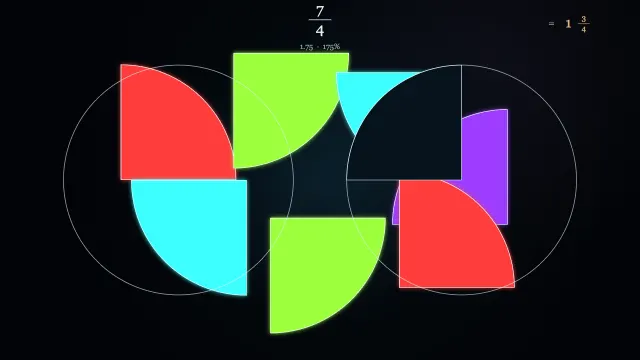
Compare seven fourths with three halves. Both quantities exceed one whole. In fourths, three halves becomes six fourths. Seven fourths is larger by one fourth. The common-piece method works beyond one without changing its meaning: the same reference unit defines every piece.
Read the mixed descriptions as a second check. Seven fourths is one and three fourths. Three halves is one and one half. Both contain a complete whole, so the comparison reduces to the remaining three fourths and one half. The extra quarter is visible in either description.
Compare five fourths with four thirds. Twelfths turn them into fifteen twelfths and sixteen twelfths. Four thirds is larger by one twelfth. These fractions both exceed one but remain close, showing why an exact common subdivision is useful even when the bars appear nearly aligned.
Return to five eighths and two thirds. Name their common pieces and explain which endpoint extends farther. Fifteen twenty-fourths is less than sixteen twenty-fourths. In the next lesson, those same common pieces will let us combine or remove amounts, extending comparison into addition and subtraction.