Mathematical reference
- Fixed numerator, different pieces
- 3/8 is half of 3/4 when both use the same whole
- Five thirds
- 5/3 = 1+2/3: five pieces, but only one completed whole
- Number-line unit
- The interval from 0 to 1 defines the whole; count equal intervals rather than boundary marks
Lesson transcript
This is the text of the narrated lesson. References to turning, highlighting or changing an object describe the linked interactive lesson; its demonstrations are not embedded in this reading page.
The whole and its equal pieces
Begin with this complete bar as one whole. It is divided into four equal parts, and three are selected. Three fourths names the selected amount relative to the entire bar. Before reading any fraction, locate its whole. The piece count alone does not tell you how much has been selected.
Move closer to one of the boundaries. Each part has the same length, so each is one fourth of this whole. Equal parts are essential. Four arbitrary pieces would not necessarily be fourths. The denominator tells us the subdivision of one whole, while the numerator counts pieces of that size.
Return to the complete bar and select just one fourth. The whole has not changed, and neither has the size of a piece. Only the selected count changed, from three pieces to one. That is why changing the numerator can change the quantity without changing the subdivision.
Now three fourths returns. Identify the full bar, one fourth, and the three selected fourths. These are three different roles in the picture. A fraction connects all of them: a reference whole, a unit piece defined by the denominator, and a count of those pieces supplied by the numerator.
The shape can change
The same three fourths now appears in a circle. Four equal sectors divide one full circle, and three are selected. The shape has changed from a bar to a circle, but the selected share is still three out of four equal parts of a whole.
Approach the meeting point of the sectors. Each sector contributes one fourth of the circle, including the portion that spreads outward. A sector is an area, not just a curved edge. Three selected sectors together cover three fourths of the circle even though their boundaries look different from the bar.
Return to a bar. You do not need the pieces to be circular or rectangular for the notation to work. You need a clearly specified whole and equal parts of that whole. Here both drawings provide those conditions, so three fourths is an appropriate description in either representation.
Compare one half in the same bar representation. Two equal parts make one whole, with one selected. A half-piece is larger than a quarter-piece, but one selected half is smaller than three selected fourths. Piece size and selected amount are different quantities. Read both the size of each piece and how many have been selected.
A fraction is also a position
Three fourths now appears on a number line. The distance from zero to one defines one unit. Four equal steps divide that interval, and three steps reach three fourths. Read a position along the line rather than counting the printed marks. Marks locate boundaries; the intervals between them have length.
Follow the equal steps toward one. The first step reaches one fourth, the second one half, and the third three fourths. One more equal step would complete the unit. The endpoint of the selected distance therefore carries the same quantity that the bar and circle showed as selected pieces.
Let the full subdivision appear. Three fourths lies between one half and one, closer to one. This positional description gives a useful check on the fraction. If a drawing placed three fourths beyond one or below one half, it would not match the fraction we have been describing.
Return to the bar and keep that endpoint in mind. The selected bar ends at the same share of the whole. A number line, a bar, and a circle emphasize different features, but the reference quantity remains one whole and the selected amount remains three fourths.
Changing the piece size
Now keep three selected pieces but change the subdivision to eighths. The quantity becomes three eighths. Each eighth is half as large as a fourth of the same whole, so three eighths covers half as much as three fourths. The unchanged numerator does not preserve the selected amount.
Look closely at the smaller equal pieces. The denominator eight says that eight such pieces would fill one whole. It does not say that eight pieces have been selected. The numerator three gives the selected count. Reading these two roles separately prevents a common reversal of the fraction.
Return to three fourths. We have changed the piece size back, while keeping the selected count at three. The selected amount grows. For a fixed positive numerator, increasing the denominator makes each piece smaller, provided that we keep the same whole. This comparison depends on that shared reference.
Select four fourths. All four pieces are now selected, so the fraction equals one whole. The numerator and denominator have distinct meanings even when their values agree. Four counts the selected pieces, and four also states how many equal pieces fill a whole. Together they describe complete coverage.
Zero, one and the reference whole
Divide one whole into fifths and select zero of them. The fraction is zero fifths, which equals zero. The denominator still describes the available piece size; the numerator says that none of those pieces are selected. An empty selection does not make the whole disappear or make the denominator meaningless.
Now select one fifth. The complete bar remains the same reference whole, while one of its five equal pieces becomes selected. The change from zero fifths to one fifth adds exactly one piece of size one fifth. We can read this as a quantity change without changing the whole or its subdivision.
Select all five fifths. Their combined amount is one whole because the selected count equals the number of equal parts needed to fill the bar. The statement five fifths equals one compares two names for this full coverage. It does not mean that a single fifth suddenly grew into a whole.
Show that same full quantity as one over one. The unit piece is now the whole itself, and one such piece is selected. Fractions with denominator one count complete wholes. Changing from five fifths to one over one renames the amount and its counting unit together.
Use three over one on the number line. Three complete unit intervals reach the position three. The denominator one is allowed; it says that each counted piece is a whole unit. Whole numbers fit into the fraction notation naturally, so fractions are not limited to amounts smaller than one.
Count pieces and completed wholes separately
Choose five thirds in the circle representation. Five pieces of size one third contain three pieces for a completed whole and two pieces left over. The amount is one and two thirds. The total selected count is five, while the number of completed wholes is only one; those are different counts.
Read five thirds on the number line. Its endpoint lies between one and two. Three equal steps reach one, and two further steps reach one and two thirds. The step size stays one third after crossing a whole-number boundary. Reaching one does not restart the numerator or redefine the unit.
Compare two thirds on the same kind of number line. This amount has only the two remaining pieces and is less than one. Five thirds exceeds it by three thirds, exactly one whole. The numerator difference three has a quantity meaning only after we attach the shared unit piece, one third.
Return to five thirds in circles. The written mixed amount one and two thirds is addition: one whole plus two thirds of another whole. It is not one times two thirds. Counting the completed group and the remaining pieces gives the same total as counting all five thirds directly.
Now select six thirds. Two complete groups of three pieces give two wholes with no remainder. The fraction six thirds equals two. Compare the selected count six, the pieces-per-whole count three, and the resulting whole count two. Division connects them because we are asking how many complete groups of three the six pieces contain.
More pieces than fit in one whole
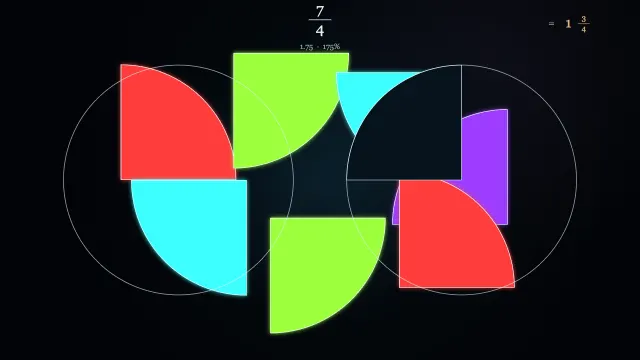
Seven fourths contains seven pieces of size one fourth. There are enough pieces to make more than one whole. Watch four gather into a complete circle, leaving three fourths in another. The fraction is one and three fourths. Its denominator still defines the same size of piece.
Move closer to the remaining three fourths. Seven fourths and one and three fourths are two descriptions of the same quantity. The first counts all seven pieces together. The second counts a completed whole and the pieces left beyond it. Neither description changes how much is present.
Eight fourths makes two complete wholes. Nine fourths will make two wholes and one extra fourth. First look at the exact completion here: two groups of four pieces account for all eight. A fraction with a numerator larger than its denominator is perfectly meaningful; it describes more than one whole.
Here are the nine fourths: two wholes and one fourth. Finish by naming the whole, the piece size, and the selected count. Those three roles also apply to the earlier three fourths. In the next lesson, we will change the subdivision while deliberately preserving the selected amount.