Mathematical reference
- Subdivide fourths
- 3/4 = 6/8 = 9/12
- Subdivide fifths
- 2/5 = 6/15; three times as many pieces, each one third as large
- Beyond one whole
- 7/4 = 14/8
Lesson transcript
This is the text of the narrated lesson. References to turning, highlighting or changing an object describe the linked interactive lesson; its demonstrations are not embedded in this reading page.
Subdivide without adding quantity
Start with three fourths of a bar. We are about to cut every fourth into two equal pieces. The outline of the whole will stay fixed, and the selected amount will stop at the same place. What changes is the subdivision inside the bar, not the quantity covered by it.
Follow one selected fourth into its two smaller pieces. Each smaller piece is an eighth of the whole. Across three selected fourths there are now six selected eighths. The count doubled because each piece became half as large. Six eighths therefore covers precisely the same amount as three fourths.
Return to the full bar and compare the original boundaries with the finer subdivision. Four fourths fill the whole, and eight eighths fill that same whole. Three selected fourths correspond to six selected eighths. Both numerator and denominator change by the same factor because the subdivision applies throughout the whole.
Now display six eighths directly. The selected endpoint has not moved. We have changed how the amount is counted and named, not how much is selected. Equivalent fractions are different expressions for the same quantity, with a common whole keeping their comparison meaningful.
The same quantity in twelfths
Return to three fourths and divide every fourth into three equal pieces. Follow the new boundaries as they appear. Each original fourth becomes three twelfths, so the three selected fourths become nine selected twelfths. The entire whole contains twelve of these smaller pieces.
Move across one selected group of three twelfths. Those three smaller pieces still occupy one fourth of the bar. Subdivision has not created extra coverage. Three such groups give nine twelfths, which reaches the same endpoint as both three fourths and six eighths.
Read nine twelfths as an ordinary fraction. Its numerator counts nine selected pieces. Its denominator states that twelve pieces fill the whole. To recover fourths, group the twelfths in threes. Nine selected pieces make three groups, and twelve pieces in the whole make four groups.
Three fourths returns. This regrouping explains simplification: divide the numerator and denominator by the same positive common factor. We have not thrown pieces away. We have chosen larger groups as our counting units while preserving the amount that all the selected pieces cover together.
What equivalence does not mean
Compare three eighths with the three fourths we just used. Three eighths selects only three of the smaller pieces, rather than the six needed to preserve the amount. Keeping the numerator fixed while doubling the denominator halves this selected quantity. It is a different fraction, not an equivalent name.
Now select six eighths. Adding the other three eighths restores the quantity three fourths. This contrast separates two operations: changing the subdivision of the same amount, and selecting more or fewer pieces of a fixed size. They can look similar in the notation, but their pictures behave differently.
Select six fourths instead. Doubling only the numerator of three fourths doubles the quantity. There is now one whole and another half. Doubling numerator and denominator together produced six eighths and preserved the amount; doubling only one of them did something else.
Return to three fourths of one whole. The test is whether the selected amount remains unchanged. Matching digits are not enough, and a larger numerator does not by itself imply more quantity. Compare the units being counted and the selected endpoint before deciding that two fractions are equivalent.
Apply the relationship to new amounts
Begin with one half and divide each half into three equal pieces. One selected half becomes three selected sixths. The whole contains six sixths. One half and three sixths are equivalent even though neither expression mentions fourths or eighths. The same subdivision principle applies to a new fraction.
Now take two thirds and split every third into two pieces. Each third becomes two sixths. The two selected thirds therefore become four sixths. Notice that three sixths and four sixths share a piece size but name different amounts. Equivalence preserves a particular amount; it does not make every fraction equal.
Read four sixths directly. Two selected sixths can be grouped into one third, leaving two selected groups out of three groups in the whole. Simplifying four sixths gives two thirds. The common factor two describes the grouping that changes both counts together.
Read two thirds again. The simplified expression is often convenient, but the finer expression can be useful when comparing or combining fractions with the same piece size. Neither is more true than the other. They offer different counting units for exactly the same quantity.
Keep the endpoint while changing the counting unit
Start with two fifths and divide each fifth into three equal pieces. Five old pieces become fifteen new pieces across the same whole. The two selected fifths become six selected fifteenths. Watch the subdivision change while the selected endpoint stays fixed: the selected region has not become three times longer.
Approach the selected pieces. Three adjacent fifteenths fill one old fifth, so six selected fifteenths make two such groups. The number of pieces multiplied by three while each piece became one third as large. Those coordinated changes explain why the quantity remains two fifths.
Read six fifteenths directly. Both counts share the factor three: six selected pieces form two groups of three, and fifteen pieces per whole form five groups of three. Grouping gives two fifths. A common factor describes an actual equal grouping across the selected amount and the entire reference whole.
Return to two fifths and instead divide each fifth into four. The equivalent name is eight twentieths. We did not have to use three as the subdivision factor. Different valid subdivisions can supply different names for the same endpoint, provided the change applies uniformly to every old piece.
Show eight twentieths as an ordinary bar. Its endpoint agrees with six fifteenths and two fifths even though the small boundaries differ. To compare equivalent fractions, follow the amount covered rather than expecting all interior marks to line up. The endpoint and common whole identify the quantity that is preserved.
Adding to both counts does not preserve a fraction
Use four tenths, which equals two fifths. Dividing both counts by two groups the tenths into fifths and preserves the amount. We will contrast this common-factor operation with adding the same number to the numerator and denominator. Those operations have different effects and should not be confused.
Add one to each written count, giving five elevenths. The selected amount is now larger: five elevenths is not equal to four tenths. In exact comparison, fifty is greater than forty-four after using a common denominator of one hundred ten. That arithmetic describes the change; the displayed bar still uses eleven pieces.
Return to two fifths and split each fifth in two. This gives four tenths, the original equivalent name. Multiplication or division by a common positive factor changes how the same region is counted. Adding one selected piece while also changing the total subdivision does not generally keep that region fixed.
Try zero fifths and divide each fifth into two. Zero selected fifths become zero selected tenths, and the selected quantity stays zero. The whole still has a valid positive denominator. Zero selections can be equivalent, but division by a zero denominator would not define an equal subdivision of this whole.
Finish this comparison at two fifths. A fraction already in simplest form has no common integer factor greater than one in its two counts. It can still have many equivalent finer names. Simplest refers to the counts we write, not to a more accurate quantity or a different endpoint.
Equivalence beyond one whole
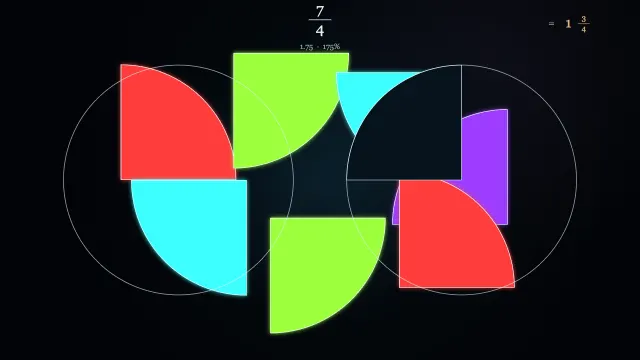
Seven fourths can also be subdivided. Split each fourth into two eighths and follow the completed whole and the remaining pieces. Seven selected fourths become fourteen selected eighths. The amount still consists of one whole and three fourths beyond it; equivalence does not stop at one.
Display fourteen eighths directly. Eight eighths complete the first whole and six eighths remain. Six eighths is three fourths, so this agrees with the earlier mixed description. Grouping the selected pieces into wholes gives another way to check that the quantity has been preserved.
Return to seven fourths on the number line. Its endpoint is one and three fourths. An equivalent fraction must reach that same position when the unit interval is unchanged. The endpoint is a useful reference even when circles or bars make the internal subdivision more obvious.
Finish with three fourths again. You have seen six eighths and nine twelfths represent this same amount, and contrasting changes that did alter it. The next lesson uses this freedom to choose a common piece size, so two different quantities can be compared without confusing the sizes of their pieces.