Mathematical reference
- Lengths versus area
- 3 unit lengths × 4 unit lengths = 12 square units
- Grouped counting
- 5×6 = 30 unit squares
- Equal area, different shape
- 3×8 = 4×6 = 24; area alone does not determine the side lengths
Lesson transcript
This is the text of the narrated lesson. References to turning, highlighting or changing an object describe the linked interactive lesson; its demonstrations are not embedded in this reading page.
Two lengths determine one area
Twelve unit squares fill this rectangle. Its sides measure three and four unit lengths. Follow one direction first, then the other. Multiplying three by four counts how many unit squares cover the interior. A side length measures an edge; the product measures area. Those are connected quantities with different meanings.
Look along one row of three. There are four equal rows, so three plus three plus three plus three gives twelve. The multiplication groups equal contributions rather than introducing a new kind of object to count. Every unit square belongs to one row, and every row has the same length.
Return to the complete rectangle. You could instead organize it into three columns of four. Four plus four plus four also gives twelve. The units have not changed; only the direction of grouping changed. This is the visible connection between three times four and four times three.
Here the factors are exchanged. The rectangle is turned in its proportions, but it still contains twelve unit squares. Multiplication of these positive lengths is unchanged by swapping their order. That agreement follows from counting the same complete rectangular array in the two directions.
Lengths and area are different
Four times four makes a square containing sixteen unit squares. Equal side lengths produce the square shape. The side length four is not the area sixteen. One describes how far an edge extends; the other counts how much two-dimensional space the tiles cover.
Approach a corner and follow its neighboring unit squares. Each small tile has width one and height one. Four tiles along an edge account for a length of four. Counting the whole interior requires all four rows, not only the tiles touching one edge.
The complete square returns. Sixteen can be written as four squared because both factors are four. The exponent two records that repeated factor. It does not say to double four. Four plus four would count only two rows here, while four times four counts all four.
Compare three by five. Its area is fifteen, although one side is longer than a side of the four-square. A longer single edge does not guarantee a larger area if the other edge is shorter. Both dimensions matter to the product.
Count groups before counting units
Five by six contains thirty unit squares. Six equal rows of five give the total. Keeping the grouping visible lets you avoid counting thirty individual tiles from the beginning. You can recognize a row, then count how many equal rows belong to the rectangle.
Follow a row of five and then the neighboring row. Every additional complete row contributes another five. This is repeated addition with equal-sized groups. If row lengths varied, one multiplication by a common row length would no longer describe the entire collection without further grouping.
Return to the whole thirty. The boundary encloses a complete rectangle with no missing tiles and no leftovers. That completeness makes the two side lengths sufficient for the area count. The grid verifies the regular arrangement on which the multiplication relies.
Reverse the factors to six by five. The area remains thirty. The number of rows and the number per row exchange roles. You can read the multiplication in whichever direction makes the grouping easiest to perceive, while retaining the same total.
Use a familiar larger group
Ten by ten contains one hundred unit squares. The ten-unit grouping gives a familiar reference for larger rectangles. Each row contains ten, and ten such rows make a hundred. The product is an area count, even when the grouping makes it unnecessary to recite every individual tile.
Approach part of the grid. A small square still represents one unit of area. Enlarging the picture on the screen makes those cells easier to inspect; it does not enlarge their mathematical value. The side labels retain the exact lengths while the view changes.
Return to the complete hundred-square. A larger product can be compared with this known region. The reference is useful because its area is easy to identify, not because every multiplication must begin at ten. Other equal-row groupings remain valid descriptions.
Twelve by ten contains one hundred twenty. The extra width beyond ten contributes two more columns, each ten units high. The two-column contribution is twenty. The hundred-square and those twenty units account for the complete rectangle.
Read a larger rectangle in parts
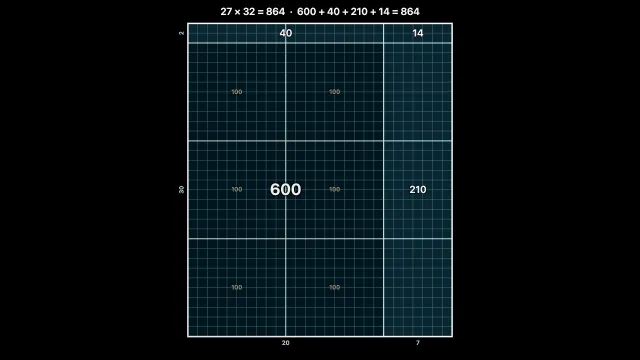
Twelve by thirteen contains one hundred fifty-six. The visible cuts separate the side lengths into ten plus two and ten plus three. These cuts provide a way to organize the area around a hundred-square. We will develop this partition carefully in the next lesson.
The corner beyond both ten-unit cuts has width two and height three. Its area is six. It is a small rectangle with its own pair of lengths, so the same multiplication idea applies within the larger product. The corner is not five, because we are multiplying its dimensions rather than adding them.
Return to all four regions. The hundred, the two strips and the corner fill the original rectangle. The cuts divide its area without changing it. The total remains twelve times thirteen, one hundred fifty-six. Different groupings can account for that same collection of unit areas.
Exchange the factors. Thirteen times twelve gives the same one hundred fifty-six. The unequal strips exchange their roles, while the whole product stays fixed. This comparison connects the equal-row interpretation with the more detailed partition we are about to study.
Different shapes can contain the same area
Here is a three-by-eight rectangle, containing twenty-four unit squares. It is long in one direction and narrow in the other. Read the two side lengths before judging its area from its shape. Three equal units across and eight equal groups along the other direction account for all twenty-four cells.
Compare four by six. The proportions changed, but the area is still twenty-four. This is a different arrangement with the same number of unit squares. The factors three and eight differ from four and six, so an area value alone does not determine a unique pair of side lengths.
Use two by twelve for a third rectangle of area twenty-four. It is even narrower and longer. Equal area does not force equal shape or equal boundary length. These comparisons count the interior units; they do not claim that the new outline has the same perimeter as the previous outlines.
Return to four by six. The product tells us how much two-dimensional space is covered, while the individual factors also tell us its proportions. When solving a problem, decide whether you were given an area, a side length, or a full pair of lengths. Those descriptions carry different amounts of information.
Count each dimension that changes
Start again with three by four, area twelve. Double just the first side to six while keeping the other side four in your prediction. Every row will contain twice as many unit squares, with the same number of rows. The expected area is therefore twice twelve, or twenty-four.
Here is six by four, containing twenty-four. Now predict doubling the other side as well. There will be twice as many rows of this same six-unit length, so the area must double again. Two separate doublings of length contribute two factors of two to the area.
The rectangle is now six by eight, area forty-eight. Both original side lengths doubled, so the new area is four times twelve. This is a mathematical size change, recorded in the side labels and the count of unit cells. Enlarging the camera view alone would not change either factor or the product.
Compare three by seven, with area twenty-one. Its perimeter is twenty because twice three plus twice seven equals twenty. A five-by-five square also has perimeter twenty, but its area is twenty-five. Holding the sum of the side lengths fixed is different from holding their product fixed.
Here is that five-by-five square. Its twenty-five interior units exceed the previous twenty-one, even though the two perimeters agree. Boundary length and area measure different features. Counting along edges adds lengths; counting a complete array multiplies its two perpendicular dimensions. The distinction remains essential as our rectangles become larger and their partitions more elaborate.
Explain a product from its rectangle
Return to three by four. State what each factor measures, then describe the product. Three and four are side lengths in unit lengths. Twelve is the area in unit squares. Naming the units prevents a numerical answer from losing its geometric meaning.
Compare three by five. The fixed side of three determines the size of an added row when the other side increases by one. The new area is fifteen, three larger than twelve. You can predict that change from the visible dimensions before recalculating the entire product.
Here is four by five, with area twenty. A different side increased this time, so the added contribution is five. The size of a one-unit extension depends on the other side. Changes in a rectangle provide a practical way to reason about neighboring products.
Finish with five by six and thirty. You can count rows, count columns or compare with a nearby rectangle. Choose a description you can connect to the actual unit areas. Next we will split both side lengths and show how the smaller products fit together without losing or duplicating any region.