Mathematical reference
- Four area pairings
- (a+b)(c+d) = ac+ad+bc+bd
- Twelve by thirteen
- (10+2)(10+3) = 100+30+20+6 = 156
- Twenty-three by twenty-seven
- 400+140+60+21 = 621; the two strips combine to 200
Lesson transcript
This is the text of the narrated lesson. References to turning, highlighting or changing an object describe the linked interactive lesson; its demonstrations are not embedded in this reading page.
The rectangle contains the calculation
Watch these two strips come together. Twenty-three times twenty-seven becomes four hundred, two hundred, and twenty-one. Six hundred twenty-one. Why does this multiplication fit together so neatly?
The pieces moved, but their areas did not change. We will come back to this rearrangement. First we will see how a rectangle tells us what multiplication counts, then learn to choose groups that make the product easy to recognize.
Begin with a ten-by-ten square. Ten rows of ten unit squares give one hundred. A side length and an area are different kinds of quantity. Ten tells us how far an edge extends; one hundred counts the unit squares covering the interior.
Instead of abandoning that hundred when the sides change, keep it as a familiar region inside a new square. Multiplication can then become a question about what surrounds an amount we already comprehend. The picture will expose each contribution before we collect the answer.
Eleven squared and twelve squared
Now the square measures eleven on both sides. Its cuts show ten plus one in each direction. Open the four regions. Keep the hundred-square, then locate the two thin strips and the small corner.
Each strip is ten by one, so each contributes ten. The corner is one by one and contributes one. One hundred plus ten plus ten plus one is one hundred twenty-one. Both dimensions increased; that is why there are two strips and a corner.
Change both side lengths to twelve. This is a different square, now partitioned as ten plus two in each direction. Each strip is ten by two, with area twenty. The corner is two by two, with area four.
The total is one hundred forty-four. A common mistake is to count the hundred and the four but omit the two strips. Another is to add the strips but forget the corner. Locate all four regions so neither error can hide inside the arithmetic.
Let the regions join. The cuts divide a single square; they do not create extra area. Twelve times twelve and one hundred plus twenty plus twenty plus four describe precisely the same quantity.
Twelve times thirteen
Keep the first side twelve and change the second to thirteen. The object is now a rectangle rather than a square. Its sides split into ten plus two and ten plus three. Open the four regions and read their dimensions.
The large region is ten by ten: one hundred. The horizontal strip is ten by three: thirty. The vertical strip is two by ten: twenty. The corner is two by three: six. Each term takes one length from each direction.
Notice why the corner is six rather than five. We are covering a rectangle two units across and three high, not joining two line segments. There are two columns with three unit squares in each. Its area is the product of its lengths.
The complete product is one hundred fifty-six. You can also count twelve rows of thirteen, or thirteen columns of twelve. The four-region partition groups those same cells around a familiar hundred. No cells are gained or lost by the choice of grouping.
When you describe a product this way, keep the two directions distinct. Each region selects a width and a height. Multiplication combines those lengths into area. This is the spatial meaning behind distributing both parts of one factor across both parts of the other.
Twenty-one and thirty-one squared
Now see twenty-one squared. Its large region is twenty by twenty. The ten-unit grouping lines divide that region into four hundreds, so it contributes four hundred. The two one-unit strips contribute twenty each, and the corner contributes one.
Four hundred plus forty plus one is four hundred forty-one. The pattern resembles eleven squared, but the central square and the strip lengths have changed. We should see those changed dimensions rather than mechanically reuse the earlier tens.
Now thirty-one squared. The thirty-square contains nine hundreds. The two strips are each thirty by one, and the corner remains a unit. Read nine hundred, thirty, thirty, and one. Together they make nine hundred sixty-one.
Why did the corner stay one while the other terms grew? Only the large reference length changed. The added length stayed one in both directions. A region responds to whichever dimensions it contains. This observation will matter again when the numbers become much larger.
Bring the square together and reconstruct the number from its parts. The calculation need not begin with carrying digits through columns. It can begin by recognizing a square you know and the exact strips needed to extend its two sides.
Why twenty-three times twenty-seven is special
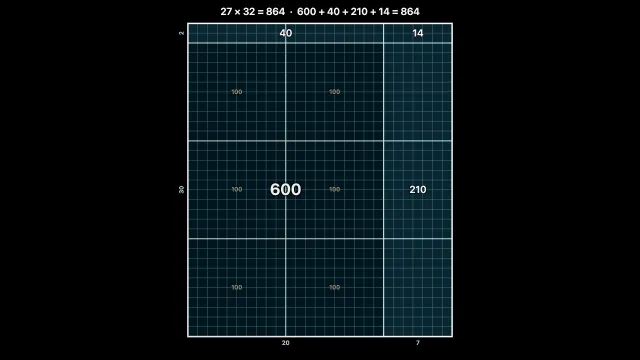
Return to the opening rectangle: twenty-three by twenty-seven. Its base-ten cuts give a twenty-square, a twenty-by-seven strip, a three-by-twenty strip, and a three-by-seven corner. Their areas are four hundred, one hundred forty, sixty, and twenty-one.
Watch the sixty-unit strip turn and move beside the one-hundred-forty-unit strip. Rotation changes its orientation, not its area. Together the strips have length twenty and combined thickness seven plus three, which is ten.
The combined strip contains two hundred. Add the twenty-square and the corner: four hundred plus two hundred plus twenty-one equals six hundred twenty-one. The easy grouping comes from the complementary endings, three and seven, which add to ten.
Compare twenty-two times twenty-eight. The two strips now contribute forty and one hundred sixty. Move them together: their combined thickness is two plus eight, again ten. The main square stays four hundred, but the corner becomes two by eight, or sixteen.
The product is six hundred sixteen. Both rectangles share four hundred in the main square and two hundred in the combined strips. Their different corners explain their different answers. The shortcut is not a rule about digits without a reason; it records a visible rearrangement.
Different tens and zero remainders
Compare fourteen by twenty-three. The tens parts are now different: ten in one direction and twenty in the other. Opening the regions exposes a two-hundred rectangle, not a hundred-square. Distributing still pairs every width part with every height part. It does not require the leading portions of the two factors to be equal.
Read the four areas: ten times twenty is two hundred, ten times three is thirty, four times twenty is eighty, and four times three is twelve. Their sum is three hundred twenty-two. The corner uses only the two remainders, four and three; it does not inherit either ten or twenty from the larger region.
Swap the factors to twenty-three by fourteen. The rectangle changes orientation, while its total remains three hundred twenty-two. The two strips exchange their roles, but they still contribute thirty and eighty. Every width-height pairing has a matching pairing after the swap. This gives a geometric reason that reversing multiplication does not change its answer.
Return to fourteen by twenty-three and close the gaps. Predict the effect of increasing only twenty-three to twenty-four. The new strip must be fourteen units long and one unit wide, so its area will be fourteen. Before changing the example, locate the complete fourteen-unit side that determines that strip.
Here is fourteen by twenty-four. The partition now contains two hundred, forty, eighty and sixteen, totaling three hundred thirty-six. Compared with the previous partition, the thirty became forty and the twelve became sixteen. The increases of ten and four add to fourteen, exactly matching the single complete strip we predicted.
Now use fourteen by twenty. The second factor has no remainder beyond twenty. Two of the four formal products therefore contribute zero area. The visible material contains two hundred and eighty, totaling two hundred eighty. A zero term does not require a visible piece with thickness; it records that there is no extra region in that direction.
Increase twenty to twenty-one. The missing remainder now has width one, producing new regions of ten and four. Together they add fourteen, and the product becomes two hundred ninety-four. Watch how the general four-part expression includes the exact-multiple case and the one-more case without changing its meaning.
The expression follows the picture
Return to twelve by thirteen and its four regions. Name the two width pieces a and b, and the two height pieces c and d. The regions have areas a c, a d, b c, and b d. Every possible width-height pairing appears once.
For this rectangle, those pairings are ten times ten, ten times three, two times ten, and two times three. The abstract expression preserves the organization we can already see. It is not an unrelated instruction to memorize.
The same rectangle admits other groupings. You could keep the whole width twelve and split only the height into ten and three: one hundred twenty plus thirty-six. The four-region partition simply divides those two contributions more finely.
Finish at the opening construction. Twenty-three times twenty-seven is six hundred twenty-one because the two complementary strips make two hundred beside the four hundred and twenty-one. Look at the dimensions, choose a useful grouping, and let the symbolic calculation describe what you see.