Mathematical reference
- Ordered coordinates
- (x,y) = (cos θ,sin θ), horizontal first
- Unit-radius identity
- cos²θ+sin²θ = 1
- Choose the sign from position
- If cos θ=3/5 and the point is above the axis, sin θ=4/5
Lesson transcript
This is the text of the narrated lesson. References to turning, highlighting or changing an object describe the linked interactive lesson; its demonstrations are not embedded in this reading page.
One radius gives two coordinates
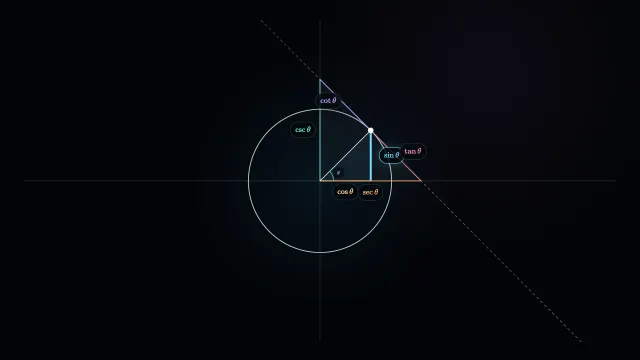
Begin with the point directly to the right of the centre. The radius has length one. We measure the angle from the positive horizontal axis, turning counterclockwise for positive angles. The horizontal coordinate is cosine and the vertical coordinate is sine. At this starting position, cosine is one and sine is zero.
Follow the point as the radius turns toward sixty degrees. Its horizontal displacement decreases while its vertical displacement increases. The radius itself keeps its length. The two coordinates describe where its endpoint lies; they are not two separate radii, and neither alone records the whole displacement.
Hold at sixty degrees. The point is one half unit to the right and the square root of three over two units above the centre. The exact values belong to this angle, not to every point in the first quadrant. Notice which displayed component is horizontal before naming cosine.
Continue toward the top of the circle. At a quarter turn, the horizontal component disappears and the vertical component becomes the entire unit radius. Watch the components change continuously rather than treating the endpoint values as unrelated entries in a table.
Signs come from directions
At ninety degrees, cosine is zero and sine is one. Zero horizontal displacement does not mean there is no radius. It means the radius points entirely upward. The coordinate pair is ordered: horizontal first, vertical second. Interchanging those entries would describe the rightmost point instead.
Turn into the second quadrant, ending at one hundred twenty degrees. The point remains above the horizontal axis but moves to the left of the centre. Its cosine becomes negative while its sine remains positive. Direction supplies these signs before any exact radical calculation is needed.
Here the horizontal coordinate is negative one half, while the vertical coordinate is still the square root of three over two. Compare this with sixty degrees: reflecting across the vertical axis reverses the horizontal displacement and preserves the vertical one. The positive radius length is unchanged.
Continue into the third quadrant, to two hundred forty degrees. Now both coordinates are negative because the point is left and below. A negative coordinate records direction; it does not assign a negative physical length to the sloping radius or to a drawn segment.
A full turn returns the same point
At two hundred forty degrees, cosine is negative one half and sine is negative the square root of three over two. Reflect across the horizontal axis to compare with one hundred twenty degrees. The horizontal coordinate stays fixed while the vertical coordinate changes sign.
Continue around to one complete turn. The point passes through the bottom and right-hand side before returning to its original position. The angle has accumulated a full rotation even though the endpoint will agree with the starting endpoint.
At three hundred sixty degrees, the coordinates are again one and zero. Every extra full turn has the same effect on the endpoint. This is why sine and cosine repeat with period two pi radians. The angle records turning; the coordinate pair records the resulting position.
Compare a negative sixty-degree angle. Clockwise turning reaches the point one half unit right and the square root of three over two units below. Cosine is unchanged from positive sixty degrees, while sine changes sign. These reflections explain even cosine and odd sine geometrically.
The squares share a unit total
Use Identity Tiles at forty-five degrees. Each coordinate has magnitude the square root of one half. Squaring either gives one half, so the two displayed areas total one. The equation is cosine squared plus sine squared equals one, because the hypotenuse is the unit radius.
Change the angle toward a point whose cosine is three fifths. The cosine square shrinks while the sine square grows. The total remains one throughout the movement. An area comparison removes coordinate signs, so use the circle position when a signed coordinate is required.
Cosine is now three fifths. Its square contributes nine twenty-fifths. The remaining sixteen twenty-fifths is sine squared, giving sine four fifths in this first-quadrant example. The positive square root is selected by the point being above the horizontal axis.
Reflect that angle below the horizontal axis. The square areas are unchanged, but sine becomes negative four fifths. A squared equation alone cannot decide the sign. Combine the area relation with the point location to recover the complete coordinate pair.
Recover signed coordinates from a measured component
Suppose the cosine coordinate is three fifths and the point is above the horizontal axis. Its square is nine twenty-fifths. Subtract that from one to obtain sine squared equal to sixteen twenty-fifths. The upper position chooses positive four fifths, giving the coordinate pair three fifths, four fifths.
Now compare the point below the horizontal axis with that same cosine three fifths. The horizontal displacement is unchanged, but the vertical coordinate is negative four fifths. The squared identity gives the magnitude, while the quadrant supplies the sign. Both pieces of information are necessary to identify the point.
Move to the corresponding point in the second quadrant. Cosine is negative three fifths and sine positive four fifths. Its distance from the center is still one because the two squared components remain nine twenty-fifths and sixteen twenty-fifths. Negative coordinates record direction, not a different radius length.
The third-quadrant point has both coordinates negative. It shares the same pair of squared magnitudes with the other three examples. Four distinct points can therefore correspond to the same two square areas. An area-only picture cannot recover both coordinate signs without additional positional information.
Compare their common area decomposition at the original first-quadrant angle. The cosine square contributes nine twenty-fifths, and the sine square sixteen twenty-fifths. Together they fill one unit of area. This is the geometric reason that the sign changes left both squared values unchanged.
Compare exchanged coordinates and equal endpoints
Return to sixty degrees, with horizontal coordinate one half and vertical coordinate square root of three over two. At the complementary thirty-degree angle those coordinates exchange places. Reflection across the diagonal y equals x swaps horizontal and vertical roles while preserving the unit circle.
At thirty degrees, cosine is square root of three over two and sine one half. The angle is measured from the horizontal axis, so naming the shorter component requires knowing its direction. The same two positive lengths appear at sixty degrees, but their names are exchanged.
Compare forty-five degrees, where reflection across the diagonal leaves the point fixed. The two coordinates must be equal. Their squared sum is one, so each coordinate has magnitude square root of one half. Symmetry supplies equality and the unit-radius identity supplies the numerical value.
Add a full turn to forty-five degrees. The endpoint is the same, even though the accumulated angle is four hundred five degrees. Sine and cosine depend on that endpoint and repeat after a full turn. The angular record can contain more information than the coordinate pair alone.
Finish by comparing negative forty-five degrees. Its cosine agrees with positive forty-five degrees, while its sine has the opposite sign. Use Interact to test another angle and its negative. Identify the reflection first, then predict which coordinate changes sign before checking the exact labels.
Reconstruct instead of recalling
Return to a diagonal in the first quadrant. Before reading the numbers, decide the two signs and compare the lengths. At forty-five degrees the coordinates are equal by reflection across the diagonal, and their squared sum is one. Each must be the square root of one half.
Now look at one hundred thirty-five degrees. The diagonal lengths are the same, but horizontal displacement points left. Cosine is negative the square root of one half; sine is positive the square root of one half. The angle changed the signs, not the shared magnitudes.
At two hundred twenty-five degrees both coordinates have that same magnitude and both are negative. Compare the radius, horizontal direction and vertical direction separately. Naming the quadrant first prevents a correct magnitude from being paired with an incorrect sign.
Finish at three hundred fifteen degrees. Cosine is positive and sine negative. You can reconstruct these coordinate pairs from symmetry, the unit radius and the squared relation. Choose Interact to move to another angle, predict the signs, and test your prediction against the native point and readouts.