Mathematical reference
- Average need not be a term
- 2,4,6,8,10,12 have mean 7 and sum 42
- Shift all terms
- Raising each of six terms by 3 raises the sum by 18
- Count intervals, not terms
- aₙ = a₁+(n−1)d; five terms contain four increments
Lesson transcript
This is the text of the narrated lesson. References to turning, highlighting or changing an object describe the linked interactive lesson; its demonstrations are not embedded in this reading page.
Half of every equal pair
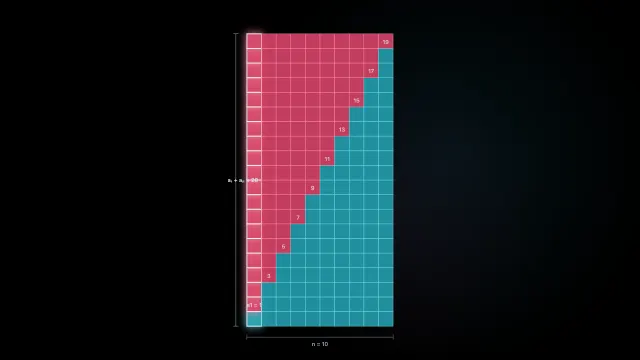
The sequence two, four, six, eight, ten, twelve joins its reversed copy. Every pair totals fourteen. Half of that pair total is seven. Seven is the average of the sequence, even though seven is not one of its terms. The arithmetic mean asks which equal value would give the same total when repeated six times.
Six times seven is forty-two, which matches the original sum. This makes the formula read as number of terms times average term. For an arithmetic sequence, the average is half the sum of the first and last terms. That endpoint shortcut needs the equal-spacing condition. The average of an arbitrary list is still total divided by count, but its endpoints need not determine it.
Try the list two, two, twelve: its endpoint average is seven while its actual mean is sixteen thirds. Our visible staircase has regular steps, and the reversed copy makes the balancing structure explicit.
Raise every term by the same amount
Keep six terms and a common difference of two. The sum is forty-two. Suppose the first term rises from two to five while the difference stays fixed. Every term rises by three, because they all inherit the shifted starting point. There are six terms, so the total must rise by eighteen.
Predict sixty before we change the control.
The first term is now five. The sequence ends at fifteen, its pair total is twenty, and six times twenty divided by two is sixty. The average rose from seven to ten, also by three. This is a useful way to check a change without adding every term again.
The staircase kept its step sizes but gained equal quantities everywhere. In general, raising each of n terms by a constant c raises the sum by n times c. That statement works for any list; the arithmetic staircase makes the uniform shift particularly easy to inspect.
Change the spacing between terms
Now keep the first term at two and the number of terms at six. With difference one, the sequence runs from two through seven, and the sum is twenty-seven. Predict the effect of raising the difference to two. The first term does not change. The second gains one, the third gains two, and so on, until the sixth gains five.
The total gain is zero plus one plus two plus three plus four plus five, or fifteen.
The difference is now two, and the sum becomes forty-two. Increasing the common difference affects later terms more strongly because they contain more steps from the beginning. This differs from changing the first term, which shifts every term equally. For n terms, changing the difference by one adds n times n minus one divided by two to the sum.
That count is the sum of the step indices from zero through n minus one. Explain this pattern from the sequence before memorizing the expression.
Adding terms extends the same rule
There are five terms from two through ten. Their sum is thirty. Imagine extending the same sequence by one more term. The new term is twelve, so the sum should become forty-two. We are adding one new bar, not increasing all the existing bars. The first term and common difference remain fixed, while the last term and total respond to the new count.
The sixth term is now present. The mean changed from six to seven because the new endpoint is larger. Six terms times seven agrees with thirty plus twelve. Both descriptions are useful: adding the new term follows the growth of the sequence, while the average formula describes the completed whole.
Extend once more in your own reasoning. The seventh term will be fourteen, so the sum will be fifty-six. Do not multiply the old average by the new count without checking it; adding a term usually changes the average as well as the count.
The same average can accompany different counts
Start with six terms from two through twelve in steps of two. Their sum is forty-two and their average is seven. The first and last terms total fourteen, so every reversed pair has that same total. The average is half of fourteen, while the sum also depends on the six positions.
Keep the endpoints two and twelve but use three terms with difference five: two, seven and twelve. The average is still seven, yet the sum is now twenty-one. The repeated pair height remains fourteen and the rectangle has only three positions. Same endpoints do not imply the same sum when the count changes.
Use eleven terms with difference one, still beginning at two and ending at twelve. Their average is again seven, but now the sum is seventy-seven. We have kept the endpoint balance fixed while changing how many equally spaced values share it. Eleven copies of the mean account for the total.
Focus on the middle value of this eleven-term list. It is seven, equal to the average. In the earlier six-term list, seven lay between the two middle values instead. Whether the mean occurs as an actual term depends on the count and spacing; its role in multiplying out the sum is unchanged.
Two controls change the sum in different ways
Return to six terms beginning at two with difference two. The original total is forty-two. We will compare changing the first term with changing the common difference. Both operations can raise the final value, but they distribute their added amounts differently among the terms.
Raise the first term by three, to five, keeping six terms and difference two. Every term is now three larger: five, seven, nine, eleven, thirteen and fifteen. Six additions of three raise the total by eighteen, from forty-two to sixty. The mean also rises by three, from seven to ten.
Restore first term two, then increase the difference from two to three. The list becomes two, five, eight, eleven, fourteen and seventeen. The first term did not rise at all. Later terms gain one, two, three, four and five relative to their old values, so the total increases by fifteen rather than eighteen.
Approach the last term, seventeen. It is five greater than the previous last term twelve because five intervals follow the first position. The sum is fifty-seven and the mean nine and a half. Changing a step acts repeatedly across the list; changing its starting value shifts every term by the same amount.
Count the intervals after the first term
Choose five terms beginning at four with difference three. They are four, seven, ten, thirteen and sixteen. There are four increases after the starting term, so the last value is four plus four times three. Using five increases would predict nineteen, which belongs to the next term instead.
The middle value is ten. The endpoints four and sixteen also average ten, and five times ten gives the total fifty. This connects the local step count, the endpoint calculation and the sum. Each way of reading the arrangement must use the same five positions.
Add the sixth term. It is nineteen, so the new total is sixty-nine. The average rises to eleven and a half, halfway between the unchanged first value four and the new endpoint nineteen. Adding a term changes both the count and the endpoint; it does not simply multiply the old mean by a new count.
Compare a constant list of six fours. Here the difference is zero, all endpoints and middle terms equal four, and the total is twenty-four. The same endpoint average formula still works. Zero difference is a valid limiting case of equal spacing, not an exception that needs a separate sum rule.
Reduce that constant list to five terms. The total becomes twenty, but the average remains four because removing a four leaves only other fours. This contrasts with removing an endpoint from a nonconstant arithmetic sequence, which changes its endpoint average. A parameter rule needs its conditions: changing the count can change the mean, but it does not have to when all entries are equal.
A staircase with no rise
Watch a reversed copy join this flat arrangement. Every term is four because the common difference is zero. The total is seven times four, or twenty-eight. The pairing formula still works: first plus last is eight, seven copies of eight give fifty-six, and dividing by two gives twenty-eight.
Constant difference includes zero; the staircase need not slope upward.
Now use difference one while keeping the count and first term unchanged. The sequence runs from four through ten. Its average is seven, and the sum is forty-nine. The increase of twenty-one is zero plus one through six. Together these experiments give three distinct causes of change: shifting the starting value, changing the spacing, and extending the number of terms.
Choose one control for your own prediction, state what stays fixed, and explain the resulting sum through both the bars and the average. That is a stronger check than relying on the displayed answer alone.