Mathematical reference
- First positive odd terms
- 1+3+⋯+(2n−1) = n²
- Next contribution
- (n+1)²−n² = 2n+1
- A later block
- 7+9+11+13+15 = 8²−3² = 55, not 5²
Lesson transcript
This is the text of the narrated lesson. References to turning, highlighting or changing an object describe the linked interactive lesson; its demonstrations are not embedded in this reading page.
The first four odd numbers
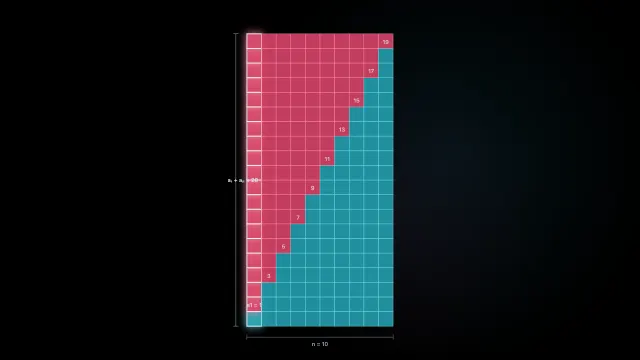
Four odd numbers form this staircase: one, three, five, seven. Watch the reversed copy pair with it. Each column totals eight, and four columns represent twice the original sum. Half of thirty-two is sixteen. Notice that sixteen is four squared. Is that a coincidence, or does the structure predict a square for other numbers of odd terms?
The last of the first n positive odd numbers is two n minus one. Adding the first term, one, gives two n. The paired rectangle therefore has n columns and pair total two n. Halving its area gives n squared. We did not assume the answer from the small example.
The endpoint formula explains why it holds for every positive integer n. The World shows a paired rectangle, not a rearrangement into an actual square. The square relationship follows from its equal factors after dividing by two.
Why the next square gains an odd amount
The first four odd numbers sum to sixteen. Predict the next term and the new sum. The next odd number is nine, so adding it gives twenty-five, which is five squared. Look at the existing four terms before the fifth arrives. Only one new term is added; the earlier ones retain their values.
The fifth term is now nine. The new paired rectangle has five columns of ten, representing twice twenty-five. In general, the difference between the next square and the current square is two n plus one. Expand n plus one squared and subtract n squared to get that result.
Geometrically, one can also place an L-shaped border around a square: n units along one side, n along another, and one corner. That border is a separate mental explanation; our current display shows the equivalent odd-term addition through bars. Both arguments describe the same increase.
The smallest cases belong to the same rule
Start with just one odd term, one. Its reversed copy supplies a second one, so the doubled rectangle has area two. Removing the duplicate leaves one. One term gives one squared. This small case matters because the relationship begins at the first term, not only after a large pattern becomes visible.
Now use two odd terms: one and three. Each pair totals four, and two pairs total eight. The original sum is four, which is two squared. The count of pairs and the half-height both equal two after accounting for the duplicated staircase.
With three odd terms, the list is one, three, five. The reversed pairs each total six. Three copies of six give eighteen, and the original sum is nine. We have changed the term count while preserving the rule that generates the odd terms.
Approach an outside pair in this three-term arrangement. Its one and five give the same total as the central three and three. The geometry shows equal paired heights. Halving the doubled area leaves three times three. The square value comes from those equal factors; this display has not rearranged the bars into a square.
Predict before counting individual units
Choose eight odd terms. The first is one and the last is fifteen because seven increases of two follow the first term. The endpoint pair totals sixteen. Before the complement arrives, predict the sum from eight copies of sixteen, then remove the duplicate.
The result is sixty-four. The average term is eight, even though eight is not in this list of odd terms. Eight terms with average eight have total eight squared. An average can describe the balance of a list without being one of its entries.
Increase the count to nine. The new last term is seventeen. Adding it to sixty-four gives eighty-one, which is nine squared. The endpoint calculation also agrees: one plus seventeen is eighteen, and nine times eighteen divided by two gives eighty-one.
Return to the whole nine-term arrangement. The difference between consecutive square totals is the next odd term. Here eighty-one minus sixty-four equals seventeen. This connects the growth of the sequence with the paired-rectangle calculation, so the two ways of finding the sum reinforce each other.
Read the next square from the next odd term
Take the first ten positive odd numbers, from one through nineteen. The reversed endpoint pair totals twenty. Ten such pairs make two hundred in the doubled rectangle, so the original sum is one hundred. The factors ten and ten give ten squared without counting every unit individually.
The last odd term is nineteen, not twenty-one. Ten positions contain nine increases of two after the first one. This distinction between positions and increases matters when applying the square rule: it identifies exactly which odd numbers are included in the displayed total.
Add the next term, twenty-one. The first eleven positive odd numbers now sum to one hundred twenty-one. The new total is eleven squared, and subtracting the old ten squared gives twenty-one. The difference of consecutive square numbers is the added odd term, not twice the old square or a fixed increment.
Compare the endpoint calculation for these eleven terms. One plus twenty-one is twenty-two; eleven times twenty-two is two hundred forty-two; half is one hundred twenty-one. The pairing argument and the one-new-term argument agree. This World displays paired bars, so the square is the resulting numerical quantity rather than an extra square tiling drawn here.
A later block of odd numbers is a difference of squares
Use five odd terms beginning at seven: seven, nine, eleven, thirteen and fifteen. The endpoint pair totals twenty-two, so the doubled rectangle contains one hundred ten and the original sum is fifty-five. Five odd terms do not automatically sum to twenty-five; beginning at one is part of the square rule.
Compare all eight positive odd terms from one through fifteen. Their sum is sixty-four, which is eight squared. This larger list contains the five terms we just used together with the three earlier terms one, three and five. We can calculate the later block by removing exactly that earlier contribution.
Now display those first three odd terms. Their sum is nine, or three squared. Subtracting nine from sixty-four gives fifty-five, agreeing with the five-term calculation. The two square numbers come from complete initial odd sequences; their difference isolates the later consecutive block.
Return to the five terms beginning at seven. Their sum is eight squared minus three squared, not five squared. The count five is the difference between the endpoint indices eight and three. Squaring a difference and subtracting squares are different operations, and this example gives twenty-five for one but fifty-five for the other.
Compare the same count at different starting values
Keep five terms but begin at one. Their total is twenty-five. Shift the start to seven in your calculation before changing the display: every term must gain six, and five such gains contribute thirty. The predicted new sum is fifty-five. This is another explanation of the later odd block.
Here is the shifted block beginning at seven. The total is indeed fifty-five. Its average is eleven, whereas the average of the first five odd terms was five. Both lists have five positions and difference two, but their different starting values change the mean and therefore the sum.
Choose four odd terms beginning at seven instead. The list ends at thirteen and totals forty. Relative to the first four odd numbers, which sum to sixteen, each term has gained six. Four gains of six add twenty-four, so sixteen plus twenty-four gives forty. The count and shift both appear in the correction.
Return to five odd terms beginning at one. The clean square rule is recovered because the shift is zero. State all three ingredients when predicting a square total: first term one, common difference two, and the specified number of terms. Pairing remains available when any of those ingredients changes.
Starting later changes the total
Keep six odd terms but begin at one. Their values run through eleven, and their total is thirty-six. This is the first six positive odd numbers, so the square relationship gives six squared. Both the starting value and the count are part of that statement.
Now begin at three instead. The list is three, five, seven, nine, eleven, thirteen. Each term is two larger than its partner in the previous list. Across six terms that adds twelve, giving forty-eight. A list of six odd numbers does not automatically sum to thirty-six.
Approach the endpoint pair. Three plus thirteen is sixteen, and six pairs total ninety-six. Removing the duplicate gives forty-eight again. The general pairing relationship still applies, even though the special formula for the first positive odd terms does not apply unchanged.
Return to the first six positive odd terms. Their sum is again thirty-six. State the condition when using the square relationship: begin at one, increase by two, and include n terms. In the next lesson, a different constant increase will connect these same bars with triangular sums.