Mathematical reference
- Double, then halve
- Sₙ = n(a₁+aₙ)/2 for an arithmetic sequence
- An odd term count
- 1+3+5+7+9 = 5×10/2 = 25
- Zero is still a term
- 0+3+6+9+12+15 = 6×15/2 = 45
Lesson transcript
This is the text of the narrated lesson. References to turning, highlighting or changing an object describe the linked interactive lesson; its demonstrations are not embedded in this reading page.
Two copies reveal a constant
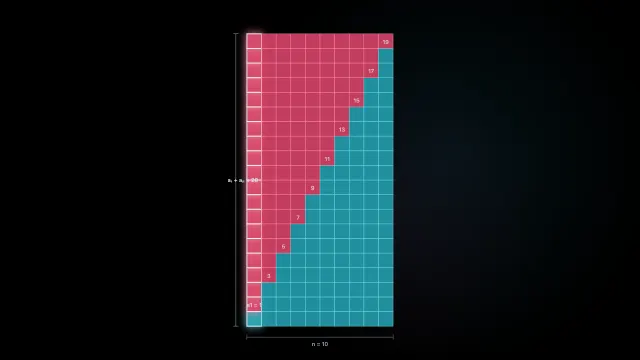
Watch a reversed copy move beside this staircase. The original sequence is one, three, five, seven, nine, eleven, thirteen, fifteen. Each bar represents a term, and the constant increase is two. Follow the smallest bar as it meets the largest copy. One plus fifteen is sixteen. The next pair is three plus thirteen, also sixteen.
Predict the next pair before counting it. Five plus eleven and seven plus nine also give sixteen. Moving inward raises one partner by two while lowering the other by two. Their combined value stays fixed. The completed arrangement has eight columns, each totaling sixteen. Its area represents one hundred twenty-eight.
But we introduced a second copy of the entire original sum. The original sum is half that amount, sixty-four. Keep both copies visible while explaining the division by two: it removes the extra copy from our accounting, not half of an individual bar.
Why every pair has the same total
Here is a new staircase: two, five, eight, eleven, fourteen, seventeen. Its reversed copy approaches. Before the pieces meet, predict the common pair total. Two plus seventeen gives nineteen. Five plus fourteen gives nineteen, and eight plus eleven gives nineteen. A constant difference is the reason the pairs agree.
The increase along one list exactly cancels the decrease along the reversed list. There are six copies of nineteen in the combined rectangle. Six times nineteen is one hundred fourteen, so the original sum is fifty-seven. Check by ordinary addition: two plus five plus eight is fifteen; eleven plus fourteen plus seventeen is forty-two; fifteen plus forty-two is fifty-seven.
The direct check supports our example, while the cancellation argument explains every arithmetic sequence. A list that merely increases is not enough. For one, two, four, eight, the outside pair is nine while the inside pair is six. That list doubles instead of adding a constant, so this particular rectangle argument does not apply.
Read the dimensions, then write the rule
Return to the original staircase and follow its reversed copy into place. Let n mean the number of terms, a one the first term, and a n the last term. The rectangle contains n equal pairs. Each pair totals a one plus a n. Thus twice the wanted sum equals n times the sum of the first and last terms.
Dividing by two gives the arithmetic-series formula.
Show Breakdown connects the expression with the construction. Eight is the number of columns, sixteen is the height of each pair, and the division by two accounts for the duplicated sequence. Do not confuse n with the last term. Here n is eight while the last term is fifteen.
Nor is the common difference the last term: the difference is two. Try covering the formula mentally and reconstruct it from the visible dimensions. The symbols compress the pairing argument; they do not replace the reason every pair is equal.
An odd number of terms
This sequence has five terms: one, three, five, seven, nine. The reversed copy still pairs perfectly. Each column totals ten and there are five columns, so the doubled sum is fifty. The original sum is twenty-five. There is no requirement that the number of terms be even. Our construction pairs every original term with a term from the second copy.
If you pair terms within just the original list, one meets nine and three meets seven, leaving the middle five alone. That also gives ten plus ten plus five, or twenty-five. Both arguments are valid, but they count different objects. In the two-copy rectangle, the middle five meets another five and makes a full column of ten.
In the one-copy calculation, the middle term appears only once. Explain the distinction before using a phrase like five pairs. Five pairs belong to the doubled arrangement, whereas the original list contains five terms.
A zero-height term still occupies a position
Use six terms beginning at zero and increasing by three. The list is zero, three, six, nine, twelve and fifteen. The first original bar has no height, but it still occupies the first position in the sequence. There are six terms, not five. We will pair those six positions with a complete reversed copy.
Approach the first pair. The original zero joins a copied fifteen, making fifteen. At the other end, the original fifteen joins a copied zero and gives the same result. A zero contribution does not remove the position or prevent its companion from completing a full-height pair.
The next pair contains three and twelve, again fifteen. The central pair contains six and nine, also fifteen. The increase of three in the original list is canceled by the decrease of three in its reversed companion. That cancellation is the reason the top of the combined arrangement is level.
Return to the whole rectangle. Six paired columns each contain fifteen, giving ninety. This is twice the wanted sum because every original value appears once in each copy. Dividing ninety by two gives forty-five. Counting only the five positive bars would use the wrong width for the duplicated construction.
What happens to the middle term
Choose five terms beginning at two and increasing by four: two, six, ten, fourteen and eighteen. The two endpoints total twenty. Reverse a second copy and join it to the original. Five pairs of twenty make a rectangle of area one hundred, so the original list totals fifty.
Look closely at the middle pair. The original ten meets the copied ten. Neither ten has been cut in half, and no half-sized bar is missing. The central original term occurred once in the requested sum. It occurs twice only because we intentionally introduced a second copy of the entire sequence.
Compare an outside pair, two and eighteen. That pair also totals twenty. A different method might pair positions within the original list and leave the middle ten aside. Our displayed method instead pairs across two complete lists. Keeping the methods distinct explains why this rectangle has five full pairs even though the term count is odd.
Rotate the presentation to horizontal. The same original and reversed values remain paired, so the doubled quantity stays one hundred and the original stays fifty. Orientation changes where the lengths appear on screen. It does not change which copy a piece belongs to or remove the need to divide the doubled total by two.
An odd pair total can still give a whole sum
Use four terms, three, six, nine and twelve. Each reversed pair totals fifteen, an odd number. Four copies of fifteen give sixty, and half gives thirty. The formula does not require the pair total itself to be even. It requires us to halve the complete doubled quantity.
Approach an endpoint pair. Its two values average seven and a half. That average lies between six and nine and is not one of the listed terms. Nevertheless, four terms with average seven and a half total thirty. The average is a balance value; it need not label an individual bar.
Change to five terms with the same first value and difference. The last term becomes fifteen, so the endpoint pair is eighteen. Five copies of eighteen give ninety and half gives forty-five. Adding the fifth term added fifteen to the old thirty, which checks the new paired calculation independently.
Return to four terms. The endpoint rule uses the first value, the last value and the number of terms together. Before applying it, check that the sequence really has a constant difference. Equal reversed pair sums follow from that structure, and the matching rectangle makes the structure visible in each example.
Make a prediction from the endpoints
Make a prediction for seven terms beginning at three and increasing by two. The last term is fifteen: there are six steps after the first term, so add six times two. Before the reversed copy finishes moving, find the pair total and the sum. Three plus fifteen gives eighteen.
Seven copies of eighteen make one hundred twenty-six, and half gives sixty-three.
The breakdown now reveals the same result.
Change the orientation to Horizontal and inspect the construction again. Its numerical relationships do not depend on which way the bars point. For independent exploration, keep the first and last terms clear, count how many terms occur, and explain why the pairs stay equal. Then use Complement to separate and reconnect the copies while following a particular bar.
If a prediction disagrees with the result, check the number of steps and the extra copy before treating it as an arithmetic mistake.