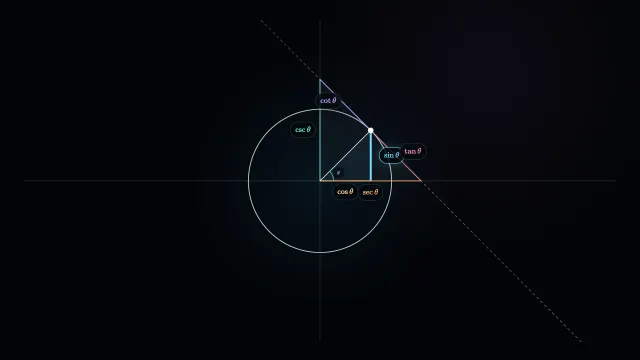
Mathematical reference
- Unit-circle hexagon
- Each central triangle is equilateral with side length 1
- Half-triangle height
- √(1−(1/2)²) = √3/2
- Reflection to 150°
- (cos 150°,sin 150°) = (−√3/2,1/2)
Lesson transcript
This is the text of the narrated lesson. References to turning, highlighting or changing an object describe the linked interactive lesson; its demonstrations are not embedded in this reading page.
Six triangles reveal one half
Watch six equal triangles turn together. A single radius and a regular hexagon will give us the half values around the unit circle. As the figure settles, look for the triangle resting on the horizontal radius. Its height divides that radius into two equal parts.
We are at one sixth of a turn, tau over six, also called sixty degrees. Tau names one complete turn in radians. Six equal central angles fill that turn. Each sector triangle has two radius sides, and its included angle is sixty degrees. The other two angles are equal and together make one hundred twenty degrees, so each is sixty degrees too. The triangle is equilateral: all three side lengths equal the radius.
The vertical segment from the upper vertex meets the midpoint of the horizontal radius. Why the midpoint? The two smaller right triangles have equal hypotenuses and share the same vertical leg. Their remaining legs therefore have equal lengths. The whole horizontal side has length one, so each half has length one half. The point is one half unit to the right. Cosine of tau over six equals one half. This is a horizontal component, not the height and not the entire sloping radius.
Now turn toward one twelfth of a rotation. Keep following the same white point as the hexagon changes orientation. Look for the vertical side of the equilateral triangle, with one endpoint above the horizontal axis and the other below it.
At tau over twelve, or thirty degrees, the horizontal axis bisects that vertical side. Its total length is one radius, so the upper half has length one half. The vertical coordinate is positive: sine of tau over twelve equals one half. These two pictures exchange the roles of horizontal and vertical. We have derived a value from an equilateral triangle and a bisection, without needing a completed table.
The same magnitude, opposite directions
Follow the point across the upper semicircle to five twelfths of a turn. Predict which coordinate will keep its value and which direction will reverse. The endpoint is the reflection of our thirty-degree point across the vertical axis.
At five twelfths of a turn, sine still equals one half. The point has the same height. Its horizontal component points left, so cosine is negative. Reflection preserves the lengths in the triangle; it changes the direction of one component. A minus sign records that opposite direction. It does not make a physical side length negative.
Continue below the horizontal axis, toward seven twelfths of a turn. Before arrival, predict the sign of the vertical component. Compare the endpoint with the point immediately above it.
Sine of seven twelfths of a turn equals minus one half. Now the point is below the axis. Its height magnitude is half a radius, and its directed vertical coordinate is negative.
Travel across the lower half to eleven twelfths of a turn. The point returns to the right side while remaining below the horizontal axis. Watch the triangle preserve its endpoint height.
Sine of eleven twelfths of a turn equals minus one half. In one turn, the sine-half positions are one twelfth and five twelfths; the negative-sine-half positions are seven twelfths and eleven twelfths. A horizontal line at either of these heights meets the circle twice. The two intersections explain why there are two positions for each signed value.
Read cosine from left and right
Return to the upper-right sixth-turn position. This time follow the horizontal component. We will carry the same half-radius magnitude into all four quadrants, stating a complete cosine equation at each stop.
Cosine of one sixth of a turn equals one half. The endpoint is half a radius to the right of the vertical axis. Predict what its reflection on the left will do to cosine.
Turn across the top to one third of a rotation. The height rises and falls along the way; compare the two endpoints after the motion stops.
Cosine of one third of a turn equals minus one half. The component has the same magnitude as before, but points left. Now predict the value at two thirds of a rotation, below this point.
Continue around the left side until two thirds of the rotation is complete. The vertical direction reverses between the endpoints. The horizontal direction remains leftward.
Cosine of two thirds of a turn equals minus one half. Say two thirds of a turn while looking at this position. The fraction describes a portion of one complete rotation. Two tau over three and four pi over three are equal expressions for the same angle.
Continue through the bottom to five sixths of a rotation. Predict the sign before the point reaches its next half-radius horizontal component.
Cosine of five sixths of a turn equals one half. We now have every positive and negative cosine-half position in one turn. Choose Interact to retrace them. For each point, say cosine, the angle, equals, the signed value; then name the horizontal direction that makes your statement true.
Use a hexagon triangle to derive both component lengths
Display the regular hexagon around the unit circle. Each central triangle has two unit radii and a sixty-degree included angle. Its third side is also one, so the triangle is equilateral. The hexagon’s side length equals the radius because of this angle and symmetry, not because every inscribed polygon has that property.
Bisect one equilateral triangle into two right triangles. Half of its base is one half, while the hypotenuse remains one. The remaining altitude has square one minus one quarter, or three quarters. Its positive length is square root of three over two. These are the two nonzero coordinate magnitudes at thirty and sixty degrees.
At sixty degrees, the horizontal coordinate is the shorter one half, and the vertical coordinate is the altitude square root of three over two. At thirty degrees their roles reverse. Both angles can be read from the same bisected equilateral triangle, provided the reference axis is kept explicit.
At thirty degrees the sine is one half. That statement concerns vertical displacement, not half of the arc length from zero to thirty degrees. Arc length and coordinate projection are different measurements. The half-radius result comes from the triangle’s geometry and cannot be extended to arbitrary angles by proportional reasoning.
Carry the half-length result around the circle
Reflect thirty degrees across the vertical axis to reach one hundred fifty degrees. The vertical coordinate remains one half, while the horizontal coordinate becomes negative square root of three over two. Reflection preserves the component magnitudes and changes the direction of horizontal displacement.
Reflect that point below the horizontal axis to reach two hundred ten degrees. Now both coordinates are negative. The vertical magnitude is still one half and the horizontal magnitude square root of three over two. The triangle gives the lengths, and the quadrant gives their signs.
Compare three hundred thirty degrees, the clockwise thirty-degree point. Its vertical coordinate is negative one half but its horizontal coordinate positive square root of three over two. This completes the four sign combinations associated with the same pair of component magnitudes. The six-vertex construction remains the source of the exact lengths.
Return to sixty degrees and reconstruct its ordered pair without consulting a table. Identify the equilateral triangle, halve the base, use the unit hypotenuse for the other component, and apply the signs from the position. Use Interact to compare this hexagon-derived pair with the equal components coming from a square.
No component, or a complete radius
Turn from the lower-right quadrant to the end of one complete rotation. The point lands on the positive horizontal axis, which is also the starting position. A full turn returns both coordinates to their initial values.
Cosine of a full turn equals one, and sine of a full turn equals zero. The horizontal component is the complete radius. The vertical component is zero. The same equations hold at zero turns. On paper, label this point with the ordered pair one, zero: cosine first, sine second.
Begin again and move upward through a quarter of a turn. Predict the ordered pair when the radius becomes vertical.
At a quarter turn, cosine equals zero and sine equals one. The full radius points upward. A quarter of tau is pi over two, or ninety degrees; it is not half a turn.
Continue to half a turn, following the horizontal component as it extends to the left.
Cosine of half a turn equals minus one, and sine equals zero. Say the complete radius points opposite the positive horizontal direction. Merely saying a different direction is insufficient: infinitely many different directions do not give cosine minus one.
Turn downward to three quarters of a rotation. Name the two coordinates before the point arrives on the lower axis.
Cosine of three quarters of a turn equals zero, and sine equals minus one. The full radius points opposite the positive vertical direction. You can now reconstruct the axes and all half-radius positions. Draw them without a table, speak the equations aloud, then use Interact and the angle control to check your own diagram.