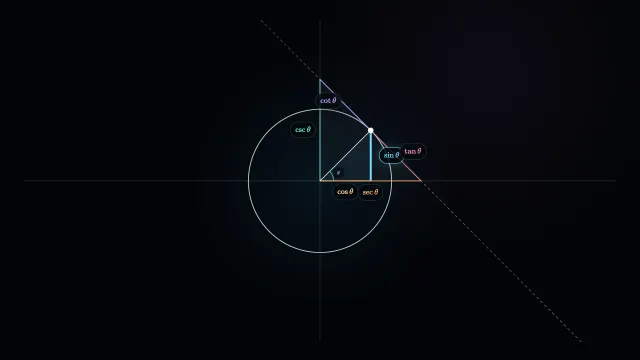
Mathematical reference
- Quarter-turn rule
- A counterclockwise 90° turn sends (x,y) to (−y,x)
- Four axis positions
- 0°: (1,0); 90°: (0,1); 180°: (−1,0); 270°: (0,−1)
- Thirty to one hundred twenty degrees
- (√3/2,1/2) becomes (−1/2,√3/2)
Lesson transcript
This is the text of the narrated lesson. References to turning, highlighting or changing an object describe the linked interactive lesson; its demonstrations are not embedded in this reading page.
Zero and ninety degrees
Watch the vertical component disappear as the radius turns onto the horizontal axis. One coordinate becomes zero, while the other becomes the whole radius. This is the pattern behind multiples of ninety degrees. We will derive every value from the point’s position, rather than memorize a list.
Start at zero degrees. The point is one unit to the right of the center and neither above nor below it. Cosine measures horizontal displacement, so cosine of zero equals one. Sine measures vertical displacement, so sine of zero equals zero. The ordered pair is one, zero: cosine first, sine second. The radius still has length one even though one component has vanished.
Turn counterclockwise through one quarter of a full rotation. Follow the horizontal component as it shrinks, and the vertical component as it grows. Predict which coordinate will be zero at the top.
At ninety degrees, the point is directly above the center. There is no horizontal displacement, so cosine is zero. The vertical displacement is the full unit radius upward, so sine is one. Say the complete statements: cosine of ninety degrees equals zero; sine of ninety degrees equals one. The ordered pair is zero, one. The coordinates have exchanged roles since the starting position.
Ninety degrees is a quarter turn. Tau denotes one full turn in radians, so this angle is tau divided by four, also pi divided by two. A quarter of tau is not half of tau. The different angle notations name this same upward direction. Read the angle above the circle, then identify the complete radius and the missing horizontal component.
One hundred eighty and two hundred seventy degrees
Continue counterclockwise through another quarter turn. Watch the horizontal component extend to the left while the height returns to zero. Predict both coordinates when the radius lies along the negative horizontal axis.
At one hundred eighty degrees, cosine is minus one and sine is zero. The point is a full unit to the left, with no vertical displacement. This is half a turn: tau divided by two, or pi radians. The ordered pair is minus one, zero. The radius length is positive one; minus one describes a directed coordinate, not a negative physical length.
Be precise about the sign. The radius points opposite the positive horizontal direction. Merely saying a different direction would not be enough: many different directions have a horizontal component between minus one and one. Here the entire radius lies on the negative horizontal axis. That is why the cosine is exactly minus one.
Turn through a third quarter, down the left side of the circle. The horizontal component shrinks back to zero. The vertical component now points downward. Predict its signed value when the point reaches the bottom.
At two hundred seventy degrees, cosine is zero and sine is minus one. The point lies directly below the center. Its vertical displacement is the complete radius opposite the positive vertical direction. The ordered pair is zero, minus one. This angle is three quarters of a full turn: three tau divided by four, or three pi divided by two. It is a three-quarter rotation from the starting direction.
A full turn and a negative quarter turn
Complete the final quarter turn. Watch the downward component disappear while the horizontal component grows to the right. The point returns to the position where this lesson began.
At three hundred sixty degrees, cosine is one and sine is zero. One full turn is tau, or two pi radians. Zero degrees and three hundred sixty degrees are different amounts of rotation, but they finish at the same point. The coordinates therefore agree. Adding another complete turn would bring us back again; this is the geometric reason sine and cosine repeat.
Now begin again at zero and turn clockwise through one quarter. Clockwise rotation gives a negative angle. Follow the radius down the right side and compare its destination with our earlier three-quarter counterclockwise turn.
Minus ninety degrees and two hundred seventy degrees end at the same point. Both have cosine zero and sine minus one. Their angles differ by a full turn. Negative angle describes the direction of rotation; negative coordinate describes the point’s position relative to an axis. These are different ideas. Here clockwise travel happens to end below the center, but a negative angle does not make every function value negative.
Follow a coordinate pair through repeated quarter turns
Start with the coordinate pair one, zero. A positive quarter turn rotates it to zero, one. More generally a counterclockwise quarter turn changes a pair x, y into negative y, x. The axis examples make that rule concrete before we apply it to points with two nonzero coordinates.
Apply another positive quarter turn. Zero, one becomes negative one, zero. The horizontal coordinate is now negative and the vertical coordinate zero. We have used the same coordinate transformation twice; the half-turn result follows by composition, rather than requiring an unrelated memorized value.
The third quarter turn changes negative one, zero into zero, negative one. A zero horizontal coordinate locates the point on the vertical axis, but the sign of the other coordinate distinguishes bottom from top. Keep the ordered pair intact when describing an axis position.
The fourth quarter turn returns zero, negative one to one, zero. Four applications of the quarter-turn rule restore every coordinate pair, including the starting one. This explains the repeating four-position pattern at multiples of ninety degrees and the full-turn period of both sine and cosine.
Compare clockwise quarter turning from the starting point. It reaches zero, negative one in a single negative ninety-degree turn. The endpoint agrees with positive two hundred seventy degrees, because those two angles differ by one full turn. Equal endpoints do not require equal signed angle measures.
Apply the same quarter-turn rule beyond the axes
Begin at thirty degrees with cosine square root of three over two and sine one half. Both components are nonzero. Rotate by a positive quarter turn to one hundred twenty degrees. The new horizontal component is negative the old vertical component, and the new vertical component is the old horizontal component.
At one hundred twenty degrees the ordered pair is negative one half, square root of three over two. This verifies the coordinate rule with unequal component lengths. The transformation exchanges the components and changes one sign, so it is not merely a reflection across the diagonal.
Apply another quarter turn to reach two hundred ten degrees. Both coordinates are the negatives of those at thirty degrees. Two quarter turns form a half turn, which sends any point through the center to its opposite point on the circle. The radius length remains one.
At two hundred ten degrees the horizontal coordinate is negative square root of three over two and the vertical coordinate negative one half. The same lengths still occur; their directions changed. This provides a check on the signs without recalculating the triangle from the beginning.
Return to thirty degrees and use Interact to add or subtract quarter turns. Predict the new ordered pair by exchanging the coordinates and applying the appropriate sign. Then compare that prediction with the displayed circle. The familiar four axis values are the simplest cases of this general coordinate operation.
Reconstruct the four positions
Return counterclockwise to the right-hand starting point. Before reading the values, name the horizontal displacement and the vertical displacement. Use the picture to recover the ordered pair.
Right gives one, zero. Cosine is one and sine is zero. Now predict the pair at the top: which coordinate disappears, and which becomes a full positive radius?
Move upward through a quarter turn and check your prediction against the radius.
Up gives zero, one. Cosine is zero and sine is one. Predict the pair on the left, keeping physical length separate from signed displacement.
Continue through the upper-left quadrant until the radius points directly left. Follow the vertical component all the way back to zero.
Left gives minus one, zero. Cosine is minus one and sine is zero. Predict the final pair at the bottom, where the full radius will point opposite the positive vertical direction.
Move down through the next quarter turn. Check which component shrinks to nothing and which reaches the full radius.
Down gives zero, minus one. Cosine is zero and sine is minus one. Choose Interact and revisit these four positions with the angle control. On paper, draw the circle, mark zero, ninety, one hundred eighty and two hundred seventy degrees, and add their fractions of tau. At each point, write cosine first and sine second. Explain each zero as no displacement and each signed one as a whole radius in a specified direction. Then close your notes and reconstruct the diagram again.