Mathematical reference
- Filled versus boundary
- The filled Julia set contains bounded starting orbits; the Julia set is its boundary
- For c=0
- Filled set: |z|≤1; Julia set: |z|=1
- For c=−2
- Both sets equal the real interval [−2,2], which has no planar interior
Lesson transcript
This is the text of the narrated lesson. References to turning, highlighting or changing an object describe the linked interactive lesson; its demonstrations are not embedded in this reading page.
One parameter, many starting points
Keep the parameter c fixed at zero. Every point of this plane is now a possible starting value z zero for the same rule, square z. The picture summarizes many orbits at once. Moving to another point selects another starting value; it does not change the parameter.
The filled Julia set consists of all starting values whose forward orbits remain bounded. For c equal to zero, this set is the closed unit disk: every point with magnitude at most one. The binary view separates the finite computation’s nonescaping samples from its escaping samples.
Choose one half inside the disk and display three steps. Its successive values shrink toward zero. This particular orbit is bounded, and the same magnitude argument applies to every starting point strictly inside the unit circle.
Choose one point two outside the disk and display three steps. Repeated squaring increases its magnitude beyond two. This starting value is outside the filled set. The screen’s orbit marker represents one example within the much larger classification shown by the background.
The Julia set is the boundary of the filled set
Return to the whole disk. The Julia set is the boundary of the filled Julia set. For this example, the filled set includes the complete closed disk, while the Julia set is just the unit circle. The interior and boundary are related but are not the same set.
Approach the boundary near the positive real point one. Every small neighborhood of a boundary point contains starting values inside the filled set and starting values outside it. The circle separates these two types of behavior even when the camera is close to a small arc.
Select i on that boundary and take two steps. The orbit passes through minus one to one and then stays there. Boundary points can have bounded orbits. Belonging to the boundary does not mean that the point escapes or that its orbit must approach zero.
Compare zero point six plus zero point eight i, also on the unit circle. Its squared coordinates sum to one. Under squaring, its magnitude remains one while its angle doubles. The whole circle is invariant as a set, but individual points can move along it.
Why the disk classification is exact
Show the complete binary disk again. If a complex value has magnitude r, its square has magnitude r squared. After n squarings, its magnitude is r raised to the power two to the n. This formula gives an exact classification for c equal to zero.
For r less than one, these magnitudes approach zero. For r equal to one, they stay one. For r greater than one, they grow without bound. The three cases establish the closed disk as the filled set and its circumference as the boundary, independently of pixel resolution.
Increase the numerical iteration limit from sixteen to one hundred sixty while inspecting this boundary. The theorem does not change. The finite picture may sharpen its classification of points just outside the circle because those points have had longer to reveal escape.
Compare the short sixteen-step computation explicitly. A sample that has not escaped yet is not automatically an exact member. Here we know the disk from mathematics; in a more complicated example, the finite rendering alone does not settle every borderline sample.
Changing c changes the filled set
Change c to minus one and return to the overview. The filled set now has connected lobes instead of a round disk. All starting points in this new picture use the rule z squared minus one. The changed shape reflects a changed transformation.
Select zero and show four steps. It alternates exactly between zero and minus one. This bounded orbit belongs to the new filled set. Its behavior differs from the contracting orbit of zero under the earlier parameter, even though the starting position is the same.
Select two under the same parameter and take two steps. The values are three and eight, and this orbit escapes. The contrast between zero and two is a contrast between starting points for one fixed rule. It does not require changing c again.
Approach the central region of the lobe pattern. The Julia boundary has much more detail than the circular example. A close view reveals structure at the chosen finite resolution; it does not create a different Julia set or prove every apparent connection in the image.
A filled set need not have planar interior
Set c to minus two. In this exact quadratic example, the filled Julia set is the real interval from minus two to two. It has no interior as a subset of the plane. Consequently its planar boundary is the entire interval, so the Julia and filled Julia sets coincide.
Start at zero and show three steps. The orbit goes to minus two, then to two, then stays at two. These real points lie in the interval. The interval’s invariance can be checked directly: squaring a value between minus two and two and subtracting two keeps it in that interval.
Move the starting value slightly off the real axis, to zero point zero five i. One step gives minus two point zero zero two five, already beyond the radius-two threshold. A visually tiny displacement has left the filled set. The interval’s apparent pixel thickness is not mathematical interior.
Return to the whole interval. The word filled is a conventional name for the bounded-orbit set; it does not guarantee a region with positive area or an interior. The definition through bounded orbits is more reliable than guessing from the word or the picture.
Distinguish interior, boundary and an interval example
For c equal to zero, select a starting point of magnitude one half. Its orbit approaches zero, so this point lies inside the filled Julia disk. The filled set includes all bounded starting points, not merely the boundary drawn between escaping and nonescaping behavior in a color image.
Move to the point one on the unit circle. It is fixed and bounded, so it also belongs to the filled set. But it lies on the boundary: arbitrarily nearby starting points outside the circle escape. A bounded orbit is not enough by itself to distinguish an interior point from a boundary point.
Compare one point zero one just outside. Its escape can take several steps to detect, yet the magnitude-squaring argument identifies it as outside the exact filled disk. Zooming near the boundary enlarges this contrast without changing c or the orbit rule. A camera change must not be mistaken for a new Julia set.
Change the parameter to minus two. The filled Julia set is now the real interval from negative two to two, rather than a region with a two-dimensional interior. Select zero: it maps to negative two and then positive two, which is fixed. These exact steps provide one bounded orbit within the interval.
Inspect the right endpoint two. Squaring and subtracting two returns two, so it is fixed. Its membership does not make it an attracting center of a disk. The filled interval has empty interior in the complex plane, and every one of its points belongs to its boundary as a planar set.
Now inspect the left endpoint negative two. Its next image is positive two. It is bounded and belongs to the same filled interval despite not being fixed itself. The distinction between a point being in the set and its orbit having a particular period remains important even in this very simple exact example.
Return to the disk example and its circular boundary. Compare a filled set with nonempty interior to a filled set that is only an interval. The general definition remains bounded forward orbit under a fixed parameter. The examples show why the filled set, its boundary, and a finite colored rendering must be named separately.
Read the image with its computational limits
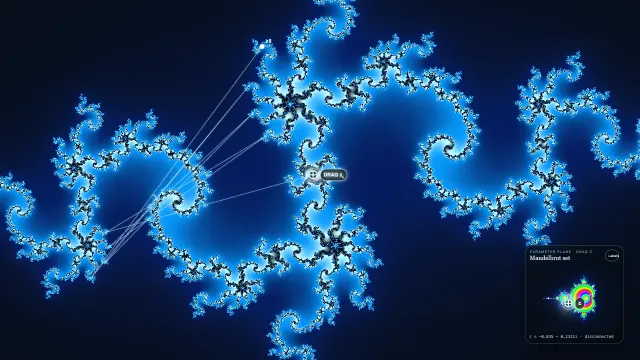
Choose the parameter zero point three six plus zero point six eight i. The Julia view now shows separated structures. The next lesson will connect this behavior to the orbit of zero and the Mandelbrot parameter plane. Here, keep the displayed parameter fixed while comparing numerical detail.
Increase the iteration limit to one hundred sixty. More starting samples have time to reveal escape. Some dark regions can disappear or become more finely divided. A finite nonescaping mask is an approximation, not a proof that every dark sample belongs to the exact filled set.
Return to the c equal to minus one overview and change only the presentation to binary membership. Escape colors, bands, and smooth gradients encode computed information outside or inside a finite mask. Changing that encoding does not redefine the mathematical Julia set.
Finish with the ordinary smooth view of the same parameter. Distinguish three objects: the filled set of bounded starting values, its Julia boundary, and the finite image produced by an algorithm. That distinction remains necessary in the simple disk, the real interval, and the more intricate fractal examples.